

Editor’s Note: A state Supreme Court judge in Manhattan invalidated the sugary beverage ban after this article was originally published. Mayor Bloomberg has stated that he intends to fight the ruling.
CKE, parent company of Hardee’s and Carl’s Jr., doesn’t have any stores in New York City. In fact, it doesn’t have any in the Empire State at all.
But that hasn’t stopped CEO Andy Puzder from speaking out against the sugary-beverage ban proposed by New York City mayor Michael Bloomberg and passed by the city’s Board of Health in September.
“Mayor Bloomberg’s foray into this area is misguided. I think it’s ridiculous. I think it’s anti-American. Every time you increase the power of government, you decrease our individual liberties,” Puzder says. “And it’s very difficult to see what’s a more personal decision a person can make than what they eat. Mayor Bloomberg’s attempt to cut back on those choices is really an attempt to try to change the government structure that we’ve had for the past 235 years.”
Puzder’s passion for the subject doesn’t come out of left field, even as an executive of a brand unaffected by the ban. After all, this isn’t the first time Bloomberg has attempted to regulate the city’s foodservice options in an effort to curb the obesity crisis in New York and across the country. And eight years after the mayor introduced his first food regulation—a citywide trans fat restriction—the restaurant industry continues to see a ripple effect from his actions, from his office in New York City to CKE’s Carpinteria, California, headquarters.
The line in the sand
While Puzder’s words may seem aggressive, maybe even rash, he’s not the only quick-serve executive who believes the sugary-beverage ban has crossed a line that even the mayor’s previous regulations did not.
“Sometimes the ideas people have in terms of how to tackle a problem look good in a textbook setting,” says Jamie Richardson, vice president of White Castle. “It might look good in an academic setting. But when you try to implement those ideas in a real-world setting, it has horrific effects on real people and real neighborhoods. This is a classic example of government gone mad, [of] aggressive overreach.”
Industry leaders, it’s clear, are no supporters of the sugary-beverage ban. But they aren’t the only ones crying foul over the regulation, which goes into effect March 12 and prohibits the sale of sugary beverages larger than 16 ounces in the city’s restaurants, food carts, delis, movie theaters, stadiums, and arenas.
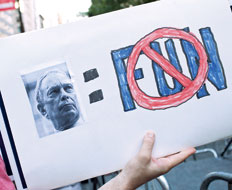
A September New York Times poll found that a full 60 percent of New Yorkers considered the ban a “bad idea,” while only 36 percent considered it a “good idea.” Nearly 500,000 people support the New Yorkers for Beverage Choices organization, a coalition opposed to the recent ban. Some 2,400 individuals, businesses, and community organizations, meanwhile, have signed up as official coalition members, including dozens of national quick-service chains.
“What the mayor and the health commission are telling people is that we’re not educated. That’s not what we found,” says Eliot Hoff, spokesman for New Yorkers for Beverage Choices. “As I visited the neighborhoods in the city, especially in the … lower socioeconomic communities, the feeling on the street is that people are offended that their mayor and their health commissioner and their department of health don’t think they know that there’s a health risk to overindulging in anything.”
Whether or not the mayor’s office believes that, the obesity problem in New York, much like in the rest of the country, is indeed severe. Bloomberg said in a September 16 radio address that almost 60 percent of New York adults and 40 percent of children are overweight or obese.
“We took this step because, as a growing number of health experts have pointed out, added sugars—especially those found in sugary drinks—are one of the key drivers of the obesity epidemic in New York and across the United States,” Bloomberg said in his address. “Americans get more excess calories from sodas and other sugary beverages than any other individual source. Even worse, these drinks flood our bodies with sugar without making us feel full; that’s why we’re targeting sugary drinks and not other junk foods.”
Just what—and who—the latest regulation targets, though, has become a point of contention in the food-regulation sphere.
The problem with regulations
Quick-service executives are concerned about the sugary-beverage ban for a number of reasons. For some, like Puzder and Richardson, the simple matter of telling Americans what they can and cannot eat or drink goes against our nation’s founding
principles.
“The question we’re all asking is, If this is happening with soft drinks, what’s next?” Richardson says. “Portion-controlled plates? The death of the buffet? It just feels that this is a real overreach.”
Others believe the regulation is massively flawed. Scott DeFife, executive vice president of policy and government affairs for the National Restaurant Association (NRA), says one major problem with the sugary beverage ban is that it does not affect convenience stores or supermarkets. In theory, a customer could grab a burger and fries from McDonald’s and walk across the street to pick up a two-liter at 7-Eleven.
Another problem, DeFife says, is that there isn’t much science to back up the mayor’s claims that the ban will help fight obesity.
“This is a setting of policy under the rubric of food safety or health where they don’t have any real, solid evidence that there’s something here, or that their regulation is meeting their objective,” DeFife says. “There is something in the fundamental tenets of government regulation that you can’t purport to be solving one problem by taking an action that doesn’t really relate to the problem you’re trying to solve.”
Most operators, however, are worried about the business implications of limiting the size of drinks. White Castle, for example, has 45 company-owned restaurants in the New York metro area, and its small, medium, and large soft-drink sizes are 21, 30, and 44 ounces, respectively. Richardson says the stores will have to roll out thousands of new cups to comply with the law.
A similar situation will unfold in the New York–area Blimpie stores, says Pat Conlin, president of Blimpie Long Island. The company will have to replace its 21- and 32-ounce cups, just a few years after it replaced all of its menuboards under Mayor Bloomberg’s menu-labeling mandate.
“So now we’re going to have to employ another cup, just for New York City,” Conlin says. “We’re not going to have the volume and usage of those cups, so they’re going to be expensive. And we’re going to have to redo those menuboards again.”
[pagebreak]
Operators outside New York City should take note. Mayor Bloomberg’s past food regulations have had a major effect beyond the Big Apple. The trans fat regulation, which limited artificial trans fats in foods to 0.5 grams per serving, encouraged chains like McDonald’s to change their recipes systemwide. Other cities—including Philadelphia, San Francisco, and Chicago—have since explored their own trans fat regulations.
And New York’s menu-labeling law, which Bloomberg introduced in 2008 and required city restaurants to post calorie counts, was the impetus for the national menu-labeling mandate that passed with the Patient Protection and Affordable Care Act in 2010.
There is reason to believe Bloomberg’s previous regulations were steps in the right direction. According to research published in Annals of Internal Medicine last year, trans fat counts in New York lunches dropped an average 2.4 grams after the restriction; the counts dropped an average 3.8 grams at hamburger chains. And many brands, including McDonald’s, are taking steps to roll out menuboards with calorie counts well before they’re required to by law.
DeFife says a few other municipalities, including Washington, D.C., and Cambridge, Massachusetts, have initiated conversations on their own sugary-beverage bans. But he thinks the ban is far too much of a stretch to take hold nationally, which could be good news for the $200 billion-plus quick-service industry.
“I would say our beverage sales are 5–10 percent of our overall sales, so if we lose a portion of that, if the quick-serve industry loses a portion of that—and it’s a high-profit item to begin with—that’s taking a big chunk off the bottom line,” Blimpie’s Conlin says. “Those customers who want that 32-ounce soda, they’re going to get it somewhere.”
The new reality
Though the sugary-beverage ban is set to take effect in March, a group of organizations, including the NRA and the American Beverage Association, filed a 61-page lawsuit in October with the New York State Supreme Court in Manhattan challenging the validity of the regulation.
“Our intention in participating in the lawsuit is we think the regulation that is being imposed on restaurants in the city oversteps the bounds of regulatory authority into policy making that should be done by a policy-making body, not a regulatory body,” DeFife says. “And there is a disconnect between what they’re actually doing in the regulation and the purposes of the regulation. We want the court to clarify whether that has a base.”
DeFife adds that New York–area operators should be discussing cup changes with their suppliers, in case the lawsuit fails to prevent the ban from going into effect.
Joe Hainthaler, government affairs specialist for Auntie Anne’s, says that if the ban takes effect as planned, city officials should follow up with its success to determine whether or not food regulation like this has an impact on obesity.
“We would encourage [New York’s] Department of Health and Mental Hygiene and the mayor’s office to track whether obesity declines and to what extent this ban is responsible for that decline,” Hainthaler says. “That would provide a solid statistical basis for whether a ban like this works. That should be the basis for deciding whether to expand this sort of thing elsewhere. The facts matter.”
Until a statistical basis can be established, however, operators in New York and across the country are left with a new reality in which regulation has become a weapon against a national consumption crisis, much like it did with tobacco.
The industry is not, however, defenseless against regulatory bodies. All experts interviewed for this story confirm that quick serves should be in contact with their local and state legislators, as well as with groups like the NRA, to voice their opinion and spark regulatory discussions.
Richardson says a dialogue between government and industry can help create a “range of solutions that can actually make a difference,” and that the lack of dialogue was the primary failure of Bloomberg’s sugary-beverage ban. He believes the industry needs to speak up on the issues that are important not just to business, but also to customers.
“I think it’s important that all of us work together to find the best solutions, because we want to have a healthy and energetic citizenry,” he says. “How do we continue to have not only healthy minds, but healthy bodies? I think the restaurant industry absolutely needs and wants to be part of that dialogue. And there are so many in our industry who are doing just that by offering different choices, that are offering better menus, and that are working with different fitness programs in ways to promote what I would call a healthy and energetic lifestyle.
“What that recognizes is food is the fuel that allows us to be,” Richardson continues. “We’ve seen the increase in obesity, but to overregulate food and overregulate people’s lives doesn’t seem to be a solution that leads to positive results.”