

You probably opened your restaurant because you love food and hospitality—not because you wanted to calculate delivery fees. But as takeout and delivery continue to shape restaurant operations, both have emerged as major drivers of sales and brand loyalty. The challenge? Charge too little and you lose margin. Charge too much and you lose customers.
With average restaurant profit margins hovering around 6 percent, according to Restaurant365, every dollar matters. And according to recent research from Cornell University and new consumer surveys from Shipday, one number seems to hit the sweet spot: $4.
At that price, diners view delivery as a fair convenience fee rather than a penalty. Restaurants—including many using Shipday’s delivery-management platform—see higher order volumes that often outweigh smaller per-order fees. “Delivery has gone from being a nice-to-have to a core part of operations,” says Moin Islam, CEO of Shipday. “The question isn’t whether to offer it, but how to do it in a way that keeps customers happy and the business profitable.”
Shipday is a delivery-management platform that helps restaurants, ghost kitchens, and local retailers power efficient, branded delivery experiences. From dispatching to real-time tracking, Shipday enables operators to reduce costs, streamline logistics, and grow direct sales.
Cornell’s research shows that when restaurants set delivery fees around $4, customers are far more likely to complete their orders. At $7, conversion rates drop sharply. Four dollars is considered a ‘comfort numberIt’s enough for diners to recognize delivery has a cost, but not so high that it feels like a surcharge.
The same pattern shows up in e-commerce. Amazon built its entire Prime model around reducing shipping fees because high delivery costs were the biggest reason customers abandoned their carts. Once fees became predictable—and lower—checkout conversions jumped. Restaurants are seeing the same thing: when delivery feels fair, people follow through.
Industry data supports this shift. In 2022, the average delivery fee was nearly $7. By 2024, it had dropped 15 percent to $5.96 as operators rethought how to compete with third-party apps. A 2024 Toast survey found that nearly half of diners are willing to pay between $3 and $6 for delivery, but only 20 percent would pay more. Women proved more price-sensitive, with 15 percent ordering only when delivery is free.
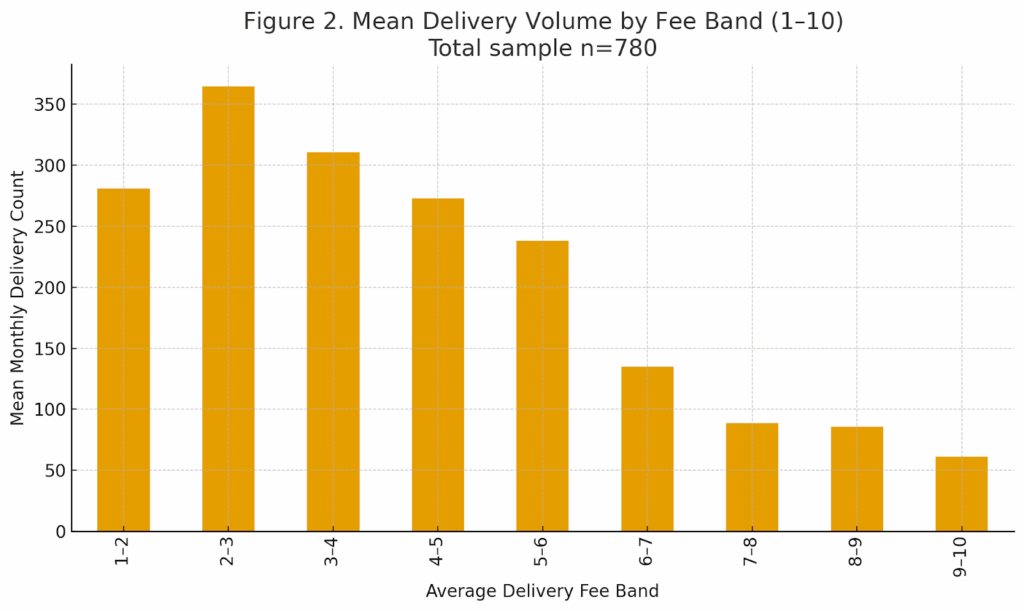
In a review of 780 U.S. restaurants, Shipday found a clear negative correlation between delivery fees and order volume. Locations charging between $2 and $4 saw the strongest demand, averaging 310–364 monthly deliveries. Once fees rose above $5, volume fell sharply. Restaurants charging $6–$7 averaged just 135 deliveries per month—a relative drop of about 50 percent compared to the $2–$4 range. Those charging $9–$10 fell even further, averaging roughly 61 monthly deliveries. The data suggests customers tolerate fees up to about $5 without a major drop-off, but anything higher meaningfully cuts into conversion.
“Customers are okay with paying for convenience,” Islam says. “What they don’t want is to feel manipulated into spending more than they intended.” Across Shipday’s network, operators who reduced their delivery fee to $4 often saw immediate sales increases. The volume makes up for the smaller fee ,and because those orders stay in a first party channel instead of going through third-party apps, restaurant’s keep more revenue and customer data.
As delivery matures from a pandemic-era necessity to a long-term profit center, Islam sees four trends shaping the future: shrinking fees, subscription models, regulation, and smarter technology. “AI-powered delivery dispatch and customer support automation can cut delivery costs by up to 40 percent,” he says. “That’s how operators can sustain lower fees and still grow direct sales.”
This $4 rule represents more than just math. It’s a matter of trust. When restaurants show customers that delivery is fair, transparent, and local, they win loyalty that third-party apps can’t buy.
Discover how Shipday can help your restaurant build smarter, more sustainable delivery operations by visiting Shipday’s website.
By Drew Filipski