Earlier in the year, John Cywinski, a former Applebee’s brand president who took the reins of Modern Restaurant Concepts in January 2023—a group that included QDOBA, Modern Market Eatery, and Lemonade at the time (Lemonade has since closed shop and Modern Market was sold to Thrive Restaurant Group)—called the Mexican fast casual a “diamond in the rough.” Namely, he felt the brand sat squarely between two mature, legacy battles in QSR: pizza and chicken. Mexican fast casual, however, remains a “sweet spot” amid a crowded landscape and a subcategory with plenty of whitespace.
Outside of Chipotle and its 3,934 year-end 2025 restaurants, QDOBA closed the calendar with 827 units and Moe’s Southwest Grill had 568 (the GoTo Foods brand had 722 in 2019). Del Taco, a closer comparison to Taco Bell than, say, an assembly line fast casual, had 576 as 2026 arrived. And regarding the Yum! Brands giant, it dotted 7,784 stores across America. There’s a reason Taco Bell often describes itself as a “category of one” at scale.
QDOBA, founded in 1995 as “Zuma Fresh Mexican Grill,” changing its name two years later to Z-TECA before becoming QDOBA Mexican Grill in 1999, hit 200 locations within a decade. Then, it took another six years to reach 600. It became QDOBA Mexican Eats in 2015 and was sold to Duckhorn-backer Butterfly Equity in 2022. Butterfly raised $527 million three years later, led by Apollo Global Management’s Sponsor and Secondary Solutions business. That continuation fund gave early investors a chance to cash out and also set QDOBA up with more money to keep growing.
Apollo previously owned QDOBA before selling it to Butterfly. Jack in the Box directed QDOBA from 2003 to 2018 and dealt it to the firm for $305 million. The burger brand took on QDOBA for $45 million when it had 85 restaurants. Apollo owned QDOBA for four calendars before Butterfly swooped in.
The L.A-based firm, which had an inaugural $305 million securitization effort in 2023 for QDOBA before a recent $435 million one, hired a new executive team (including Cywinski), shifted to a franchise-first model, turned toward new unit development, and positioned QDOBA as an asset-light, high-growth operator.
Store No. 800 arrived this year.
Cywinski, speaking at the ICR Conference, said “many, many more” QDOBAs were coming. He outlined a 10-year path to 2,000 restaurants, $2.7 million average-unit volumes, $5 billion in systemwide sales, a 28 percent store-level EBITDA margin, and a $200 million national marketing fund.
Cywinski also spoke about some of the underlying levers and why QDOBA was, in his view, a best-kept secret of sorts. The brand between 2004 and 2025 posted same-store sales growth 19 of 22 years. And that came despite those ownership flips.
Same-store sales:
- 2015: 9.3 percent
- 2016: 1.4 percent
- 2017: –1.5 percent
- 2018: 0.4 percent
- 2019: 4.2 percent
- 2020: –9.8 percent
- 2021: 10.7 percent
- 2022: 12.1 percent
- 2023: 6.1 percent
- 2024: 7.7 percent
- 2025: 4.4 percent
Average-unit volume:
- 2019: $1.2 million
- 2020: $1.1 million
- 2021: $1.3 million
- 2022: $1.4 million
- 2023: $1.5 million
- 2024: $1.6 million
- 2025: $1.7 million
Cywinski added QDOBA began 2026 with more than 650 restaurant commitments. It’s an arrow pointing upward. QDOBA closed a net of nine stores across 2021 and 2022 and then opened a net of 94 from 2023–2025.
Recently, QDOBA announced two development agreements to debut 50 new restaurants in Atlanta and Nashville.
QDOBA today, the company said, is at about 865 stores, and still believes it can double within the next eight years and get to 100 openings annually while it targets a franchise split of 85 percent. That latter mix has moved up from 55 percent in 2021. Today, more than 85 franchisees operate nearly 80 percent of the brand’s restaurants.
QDOBA’s Atlanta deal calls for 30 stores from a former McDonald’s operator. Additionally, the chain has 20 on deck from a Zaxbys franchisee who, over six months, grew their footprint from zero to 12 in Middle Tennessee.

Join QSR’s first restaurant operator community, QSR+!
QDOBA, as noted, is scaling with existing operators as well, with B Wild Investments affiliate 7 Star Eats completing an acquisition of 22 QDOBA stores in the Pacific Northwest. That brings the group’s footprint to 42 across Alaska, Colorado, Idaho, Montana, and Washinton, and makes 7 Star Eats one of the largest QDOBA partners in the country.
B Wild now touts an expanded 63-unit development commitment across Colorado, Utah, Washington, Nevada, and New Mexico.
QDOBA also claims major deals with North Fork Fresh Mex (its largest operator, who has dozens of Sonic’s, at 70); Barry Dubin (the former largest KFC franchisee, who is targeting 50); Mark Cafua (the largest private Dunkin’ franchisee, 50 expected openings); Thrive Restaurant Group (second-largest Applebee’s franchisee and Modern Market owner, 45); Doherty Enterprises (fourth-largest Applebee’s franchisee, 27); and The Rose Group (eighth-largest Applebee’s franchisee, 35).
QDOBA exited 2025 with systemwide sales of $1.268 billion.
Unpacking development, QDOBA’s U.S. store count slid by two in 2021 and six in 2022 before expanding by 14 in 2023 and 30 in 2025. Then, it popped to 50 net openings in 2025.
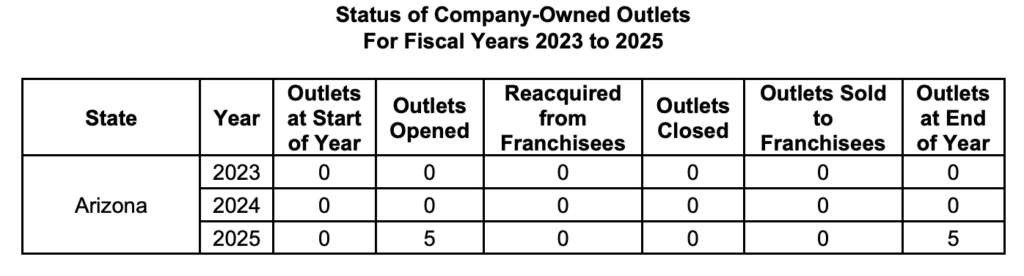
QDOBA had 447 franchised restaurants at the outset of 2023 but hiked the figure to 652 ahead of 2026. The company-run side has shifted from 286 to 175 over that span, with a triple-digit refranchising effort (110) taking place in 2023. The group grew by 11 net in 2025 after selling 11 stores in 2024 (Maryland). Three were also dealt to franchisees in 2025 (two in Missouri and one in Kansas).
Last year’s franchise development included 57 openings, a non-renewal, eight stores reacquired by the company, and nine that ceased operations for other reasons. QDOBA has had 31 franchised stores cease in the past three years alongside five non-renewals. No locations have been terminated. Three corporate restaurants closed in 2025 following one in 2024 and four in 2023. There were nine openings.
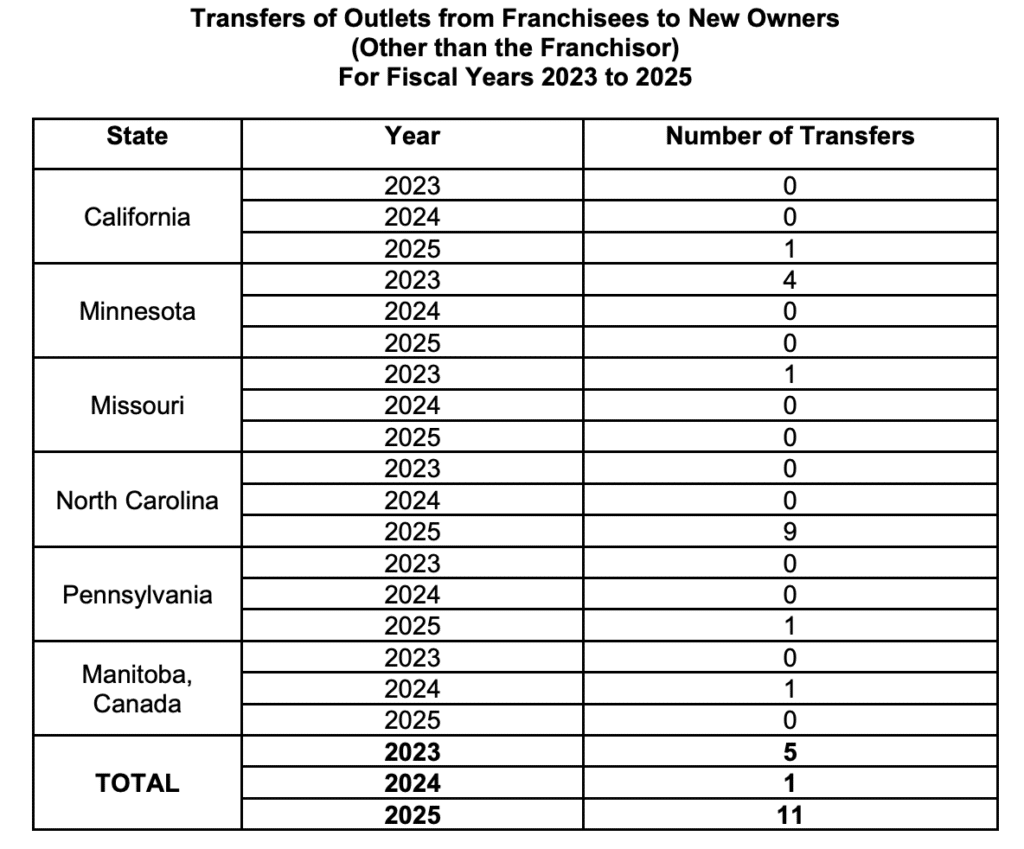
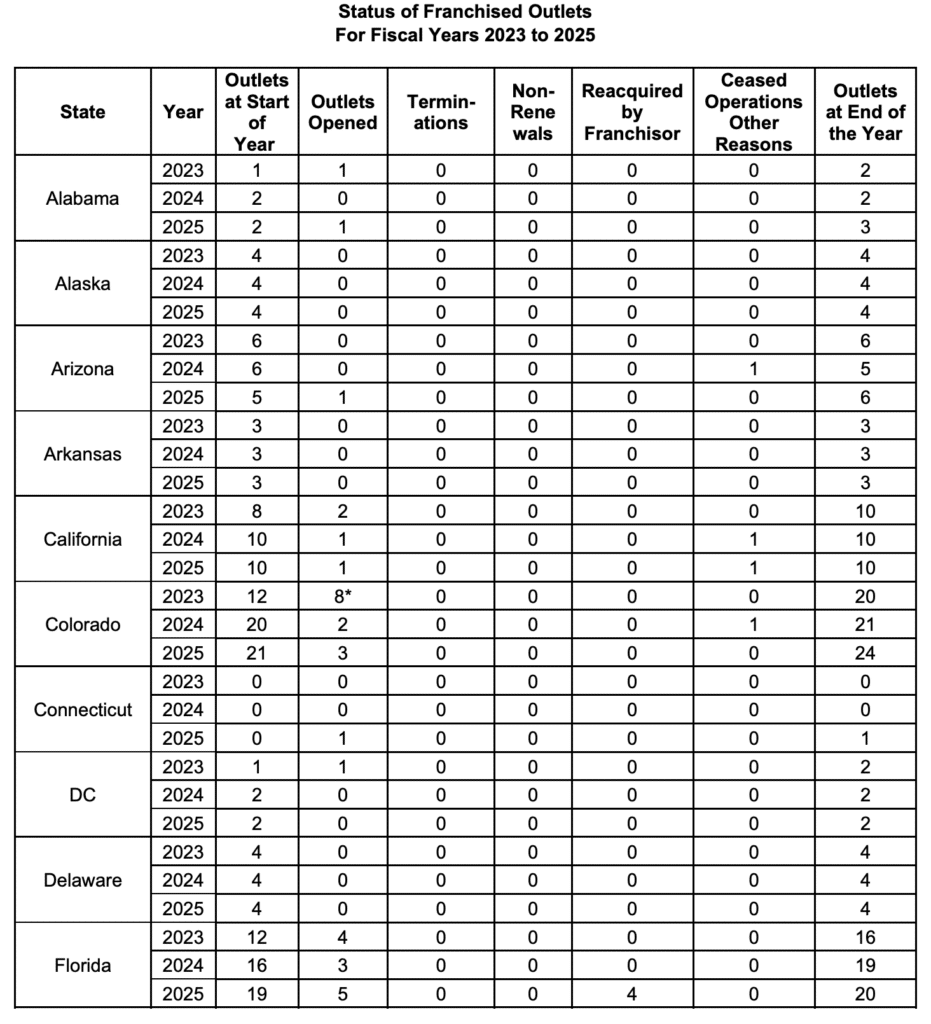
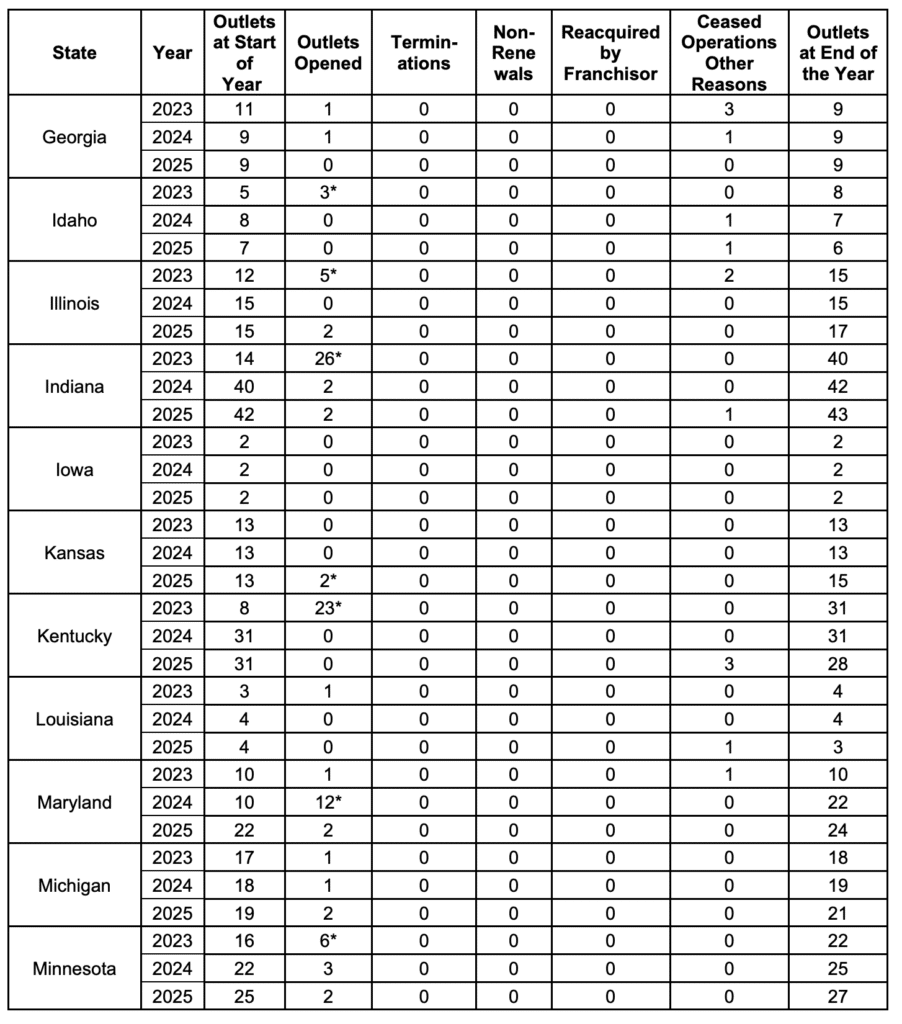
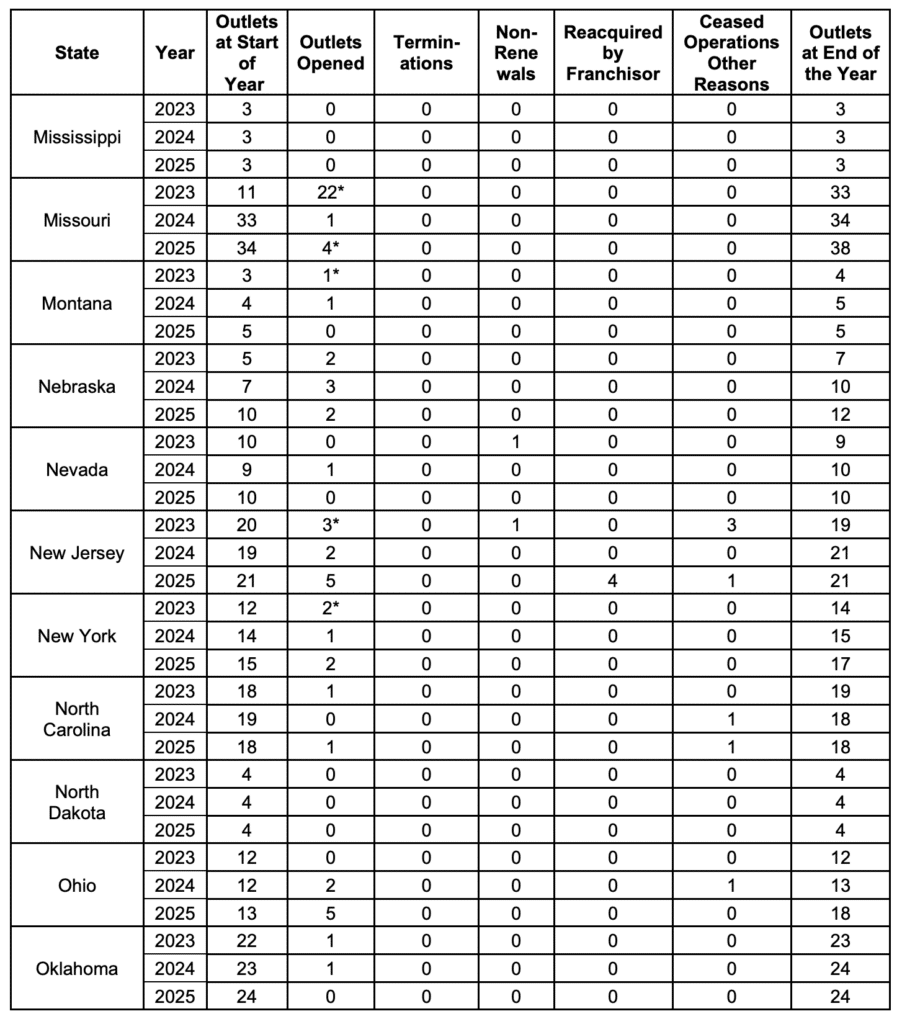
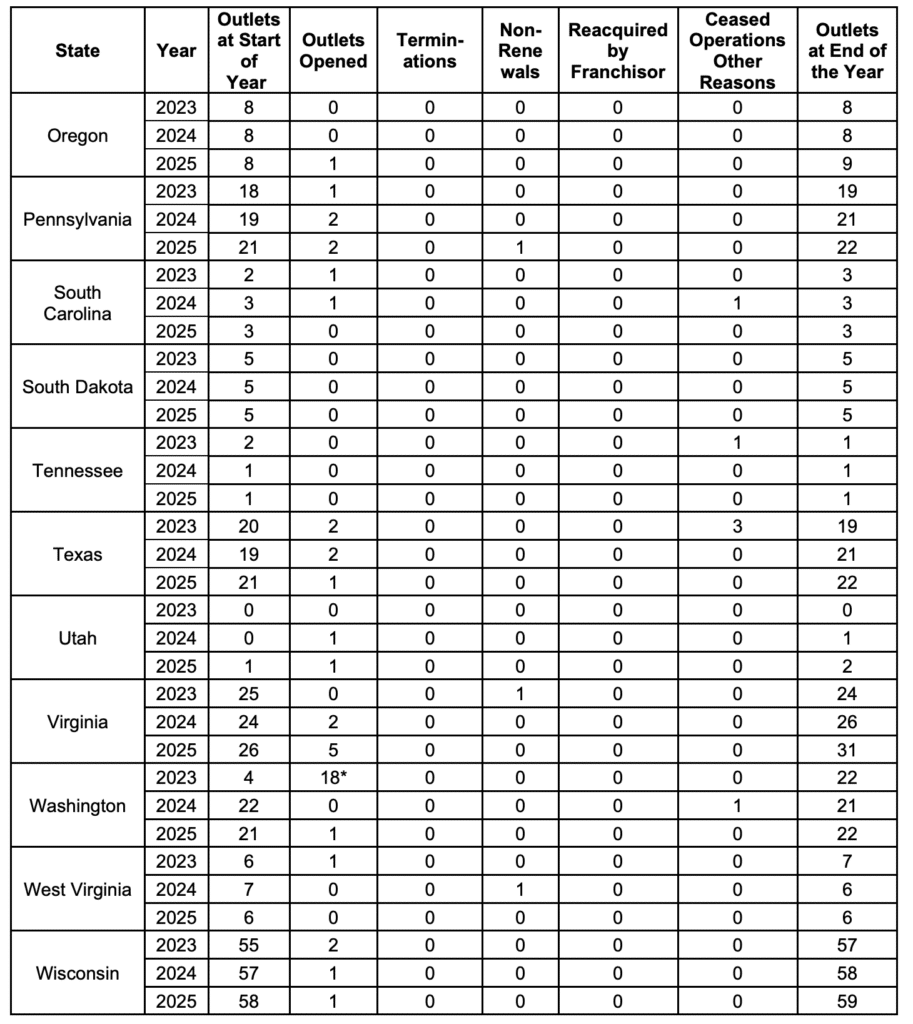
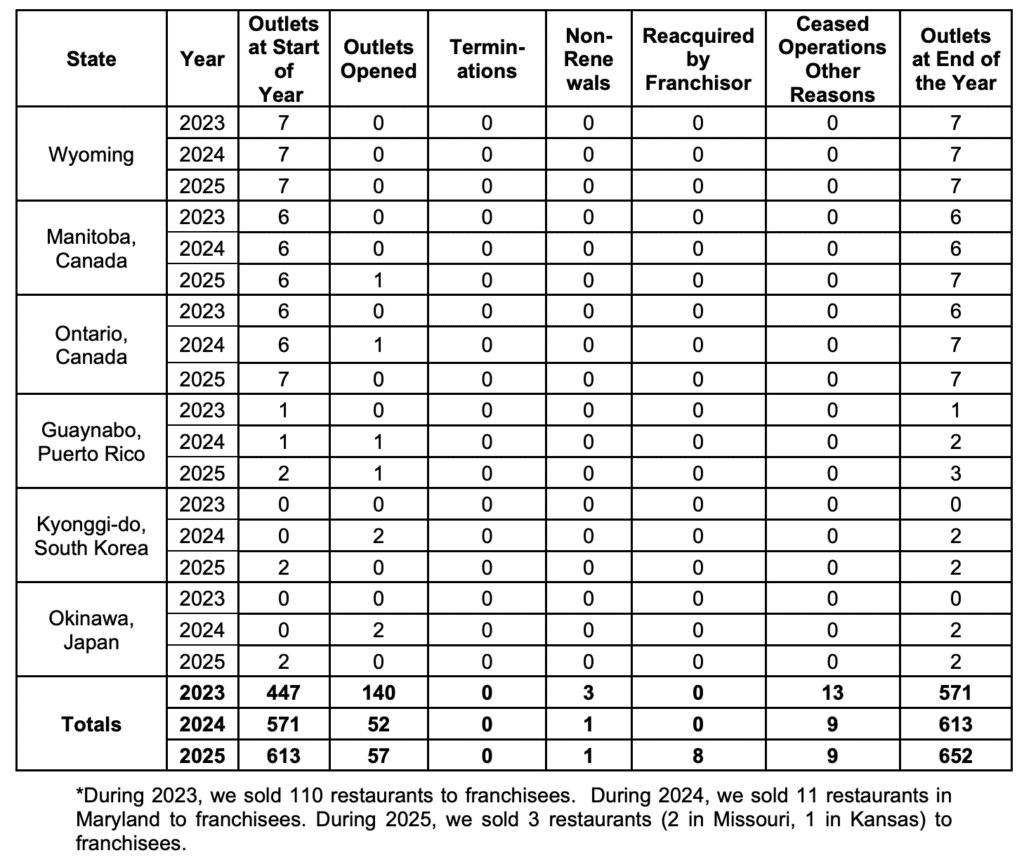


To Cywinski’s sentiment, QDOBA has momentum building with 77 projected new franchised outlets and 12 company (gross development) for 2026. It claims 14 franchise agreements signed without an outlet opened yet as well. That growth spreads across the map.


QDOBA shares performance data across a three-year window for 390 restaurants open and operated that entire run. It excludes 13 Canadian restaurants, 123 non-traditional outlets, five refranchised stores, 38 that opened in the last fiscal year, and 81 closed for more than 21 days.
Sales have reported steady year-over-year growth.
The highest performer in 2023 was $4.708 million and the low $431,709. Those numbers in 2024 and 2025, respectively, were $5.493 million and 417,422, and $5.079 million and $422,629.
Median net sales for those years were $1.477 million, $1.608 million, and $1.648 million.

The following chart examines average, median, and low/high net restaurant sales for select QDOBA stores for the trailing 12 months ended September 28, 2025. This group covers 464 franchised units open at least a year. The Canadian, non-trad, recent openings, and refranchised venues were stripped out again, as were seven restaurants closed three weeks or more.

And here’s a look at sales, selected costs, and operating results for 397 franchised locations.


QDOBA units typically range 1,500–3,000 square feet and seat 15–80 people, excluding potential patios. The total investment necessary to begin operation of a QDOBA is $548,100 to $1.294 million, including $40,000 paid to the company. For a non-trad restaurant, it’s $234,500 to $898,000 ($20,000 upfront).
Most QDOBAs are in strip shopping centers and freestanding builds. Its current focus is on endcap and freestanding restaurants. Inline units, the company said, hit $1.6 million AUVs and 21.5 percent EBIDA margins. Endcaps are $1.7 million AUV and 23.1 percent margins. Freestanding, $1.8 million and 23.8 percent, respectively.
QDOBA said in January only 43 percent of America is aware of the company, including less than 40 percent in the South, Southeast, Northeast, and West Coast regions. It expects that to change as it cuts the ribbon in places like California, Houston, Atlanta (coming soon), and Nashville (same story).
QDOBA said it convinced franchisees to bump national marketing contributions from 2.75 to 4.5 percent. And there’s a compelling case.
Internal data shows when a market has one to three locations, AUVs run about $1.6 million with EBITDA margins of 21.2 percent. When QDOBA has 12 or more restaurants, however, AUVs leap to $1.9 million and EBITDA margins 29.6 percent.