


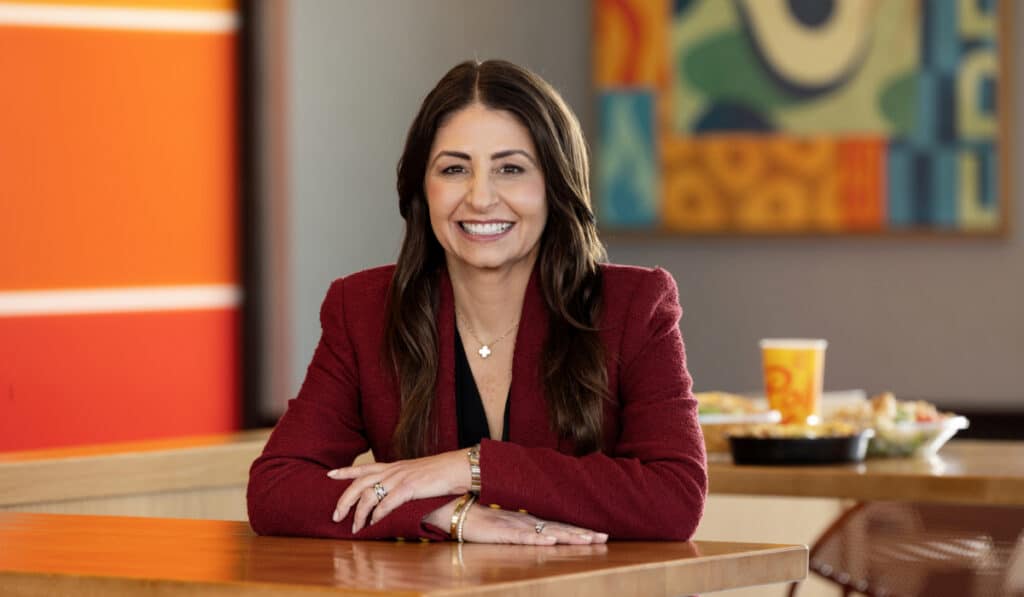
El Pollo Loco CEO Liz Williams had been a fan of the brand years before becoming part of the team.
She lives in Southern California, where the fast casual is based. The executive also previously worked for Taco Bell, which has a corporate office minutes away from El Pollo Loco’s Support Center.
When Williams received the call to consider the opportunity, she had the same question on her mind as everyone else.
“Why hasn’t this brand grown to be bigger than it is?” the CEO pondered.
Her quest to figure out the answer began in March 2024. She threw herself into the business by working opening and closing shifts inside restaurants, marinating chicken, and working the drive-thru line. Williams spent quality time with team members and franchise partners to gain a better understanding of El Pollo Loco’s operations.
The more she became part of the culture, the greater the opportunity seemed.
“I had a few anchors of leaders on the team, and I thought, huge opportunity to build out the team,” Williams says. “The brand hadn’t been focused on innovation. In fact, they had really gotten rid of the innovation team. They had gotten rid of the supply chain team. They really didn’t have a development team going, and I just thought, I know this industry. I know the hardest part is having a brand that has good quality. If you have that to start with, you can do everything else. And so that to me was exciting.”
Williams saw potential. All El Pollo Loco needed was a proper framework. So the CEO, along with the rest of the leadership team, developed a five-pillar strategic plan to create sophistication around the fast casual’s future.
The first is securing the chain’s spot as a leader in the better-for-you chicken category. That objective is followed by operating with a hospitality mindset, becoming a digital-first business, bringing forth favorable unit economics, and finally, driving unit growth and national expansion.
“We all agreed you got to start with the brand,” Williams says. “That is the absolute starting place. It then has to be underpinned with good operations. We had a huge opportunity with technology and digital that we were not utilizing. We were years and years behind. We needed to get our business model corrected and get our margins up to winning economics. And if you do all four of those things, your development will take off.”
As part of that overall guidance, this year—which marks El Pollo Loco’s 50th anniversary—the company took time to reflect on its DNA. The brand brought in third-party assistance to determine what consumers think and also went out and talked to guests directly.
The chain wanted to not only understand itself, but also to discover what it should use as inspiration as it continues to grow. The best part of El Pollo Loco’s findings, according to Williams, is that the brand stands for quality.
“The fandom and the customer love—absolute strength,” Williams says. “When you get the announcement that comes out that you’re taking this role, I just knew I’d made the right decision when my phone blew up over the next couple of days and everyone’s like, ‘I love El Pollo Loco. Did you know I love El Pollo Loco?’ People you haven’t heard from in years come out of the woodwork to tell you how much they love the brand.”
A Bolder Brand
At the heart of El Pollo Loco’s turnaround strategy is its latest “Let’s Get Loco” brand campaign.
CMO Jill Adams says the movement is about harnessing the power of your passion. The flip side of the campaign is that it’s a strategic call to action. When customers ask themselves, “Where are we going to have lunch?” or “Where are we going to have dinner?” El Pollo Loco answers with “Let’s Get Loco.”
“Our passion is around our fire-grilled chicken. It’s what’s fueled us for the last 50 years. It’s what’s going to fuel us for the next 50,” she says. And it was really this rallying cry of ‘Let’s Get Loco’—embrace what you are passionate about. For us, it’s chicken. For you, it might be sports. It might be writing, it might be gaming, but embrace your passion and it’s OK to be ‘loco’ about something. It’s OK to have ‘loco’ passion.”
Another crucial part is emphasizing that “getting loco” doesn’t necessarily mean going crazy.
“So many quick-serve restaurants, they don’t actually cook in their kitchens. They’re just reheating things that come in the back of house. They’re not necessarily using fresh ingredients,” Adams says. “They’re not making guacamole that’s fresh that we’re just going to put on all your burritos free of charge. They look at that and go, ‘That would be crazy. We would never be able to do that in our business model.’ We say it’s crazy not to. We are a restaurant first and foremost. It’d be crazy to not cook. It’d be crazy to not make things fresh. And so for us it’s that ‘loco’ attitude, that ‘loco’ spirit. So you could think of it as there’s nothing crazy about loco. Loco is truly believing in what you do and doing it to the best of your ability.”
The chain launched revitalized branding in May with new advertising, plus updated looks for its website, app, and kiosks. All of the expected consumer touchpoints were evolved with a youthful spin on what El Pollo Loco has always been, according to Adams—a place of quality chicken that’s fast, easy, and affordable.
Within this new rebranding, the company is targeting the “fast foodie.” These guests—an audience of over 20 million—are in their 20s and 30s and believe life should be as much fun as possible. They also prioritize quality as the most important factor when choosing where to eat and use food to bring family together.
The reason why El Pollo Loco is focused on this group is simply a math equation. When the chain looks across all demographic groups, Gen Z—which makes up the fast foodie category—is the only age range that is increasing its spend with QSRs. The brand’s research shows that everyone else, baby boomers, Gen X, and millennials, are spending less.

Adams says it’s not about abandoning El Pollo Loco’s core guests. It’s more centered around giving younger customers a seat at the table.
“They have this duality to them that I think has informed how we’re showing up with our marketing campaigns,” Adams says. “And by that duality, I mean they’re the most social generation. They put themselves out there on social media. They’ve documented their lives for the world to see. But they also are the generation that feels the lack of belonging, if you will, or really maybe sometimes a little more lonely. And so when I think about how we’re showing up with that group, we’re basically saying, ‘Hey, embrace what makes you you, embrace your passion, embrace your loco.’ Because at El Pollo Loco, you truly have a seat at our table. We embrace you for what you are.”
El Pollo Loco conducted focus groups with younger consumers to learn more about what they want from the brand. The guests rated the chain high on quality, but didn’t view their visits as memorable experiences or top of mind. They also sensed a lack of energy and vibes within the restaurant.
In response, next year El Pollo Loco will bring forth new employee uniforms, enhance packaging with updated logos and QR codes so guests can sign up for Loco Rewards, and standardize music playlists across the footprint to ensure it aligns with the “Let’s Get Loco” ethos. Additionally, the brand is showing up more outside the four walls in sports, gaming, and music. For instance, NBA player Dalton Knecht partnered with the brand on its quesadillas launch and Arike Ogunbowale joined El Pollo Loco as the chain’s first official WNBA partner.
The company also looks to generate buzz on social media, headlines, paid media, and activations. Adams says that over the past year, El Pollo Loco has increased its engagement and reach across all social channels and more people are seeing its content than ever before. She owes this growth to the brand leaning into pop culture, whether that’s the latest TikTok trend or inserting itself into popular TV shows, like “The Summer I Turned Pretty.”
Paid media continues to be the workhorse. The chain extended TV advertisements to markets outside of Los Angeles, mostly during live sports. In terms of activations, El Pollo Loco unveiled its first mango habanero fountain, food truck, National Grilled Chicken Day, and chicken AI challenge.
The numbers say El Pollo Loco’s brand shift is working. At the annual franchise convention in September, the company revealed it was seeing incremental growth in new and existing customers in 2025 prior to the brand refresh, and that those numbers more than doubled in the months following the brand refresh.
Increasing digital sales are keeping El Pollo Loco top of mind as well. In Q3, digital—app, web, delivery, and kiosk—mixed 27 percent, up from 20 percent in the year-ago period. Loyalty transactions lifted 28 percent year-over-year, with frequency of members increasing 15 percent. The third-party delivery business represented 15.1 percent of sales in Q3, up from 13.8 percent a year ago.
The ultimate goal is to continue pushing digital sales, and the brand hopes to achieve that by making the purchasing process easier, such as improved salsa ordering, a new app home screen, and better cross-selling opportunities. In 2026, El Pollo Loco plans to simplify signing up for the rewards program, redeeming said rewards, and reordering previous items. Meanwhile, the chain will continue to increase gamification around more challenges, add personalized offers, and provide access to exclusive experiences.
Catering and large orders, which sits at about 1.5 percent of sales, also presents an opportunity.
“When you think about catering, more often than not, your choices are maybe a cold sandwich tray or pizza when you think about group orders, things where you can feed a crowd,” Adams says. “Where we really set ourselves apart and stand out is you have an opportunity for high-quality food, a hot meal, in particular, a hot lunch, that is affordable to feed a crowd. So we have the right food. We certainly have the right concentration of restaurants in the states that we’re in. It really just has not been something that we’ve put as much energy and effort on, and 2026 is the year where that will change.”
Ideating Innovation
Marketing strategies must be supported by a menu that’s portable, flavorful, affordable, and based around chicken, Adams says. One major initiative next year will be streamlining menu boards so it’s easier for customers to find what they’re looking for. In addition to that guest-facing change, El Pollo Loco will create more standardization across builds and portions to make it simpler for employees to execute orders.
Menu innovation will also be key. In the fourth quarter, the brand launched new Double Chicken Burrito Bowls, a Fam Feast (eight pieces of chicken, three large sides, and four churros), and a build-your-own bowl catering option.
The 2026 pipeline features chicken tenders made with a crispy, salty breading that keeps them warm for a long time and a seasoning that’s slightly sweet and spicy. The tenders will be paired with Baja Ranch (savory with some lime) and Pollo Sauce (vinegary, tangy, and somewhat smoky). El Pollo Loco will also release a fire-fried chicken sandwich with a crispy grilled filet and creamy cilantro slaw, placed inside a potato roll.
More beverage choices are coming too with several options in test, Williams confirmed during El Pollo Loco’s Q3 earnings call in November. Salads are getting a revamp with two new permanent flavors, Street Corn and Mexican Caesar, and one seasonal flavor, Chicken Bacon Ranch. Other menu upgrades include Baja Double Tostadas (shrimp and chicken) and more flavor around the core platform of bowls, quesadillas, and burritos.
“My team, they’re pretty relentless. They’re always pushing new ideas,” says Rene Pisciotti, head of culinary innovation. “I’ll walk into our test kitchen without having any clue that they’ve been working on something, which is so great that they feel that they have the leniency to go and do this in the back. And I do encourage it. If you have something you’re passionate about, do it. Go research it. And then I’ll walk in the kitchen, not knowing what they’ve been working on, and they’ll have four, five, six different products out for me to try. And so there’s this surprise and delight element of it, but I’m always blown away by how creative they are.”
But El Pollo Loco isn’t abandoning its heritage product, bone-in chicken. Next year, the company plans to bring back Mango-Habanero Chicken, and after that, it will launch a new Honey Chipotle BBQ Chicken that’s sweet, spicy, and comes with BBQ Black Beans and King’s Hawaiian rolls.
“This is our heritage,” Pisciotti says. “This is the most important product to us. It’s what we’re known for. There’s no reason why we can’t take this product that is our foundation and also innovate on that a little bit.”
Developing the Future
Chief development officer Tim Welsh says El Pollo Loco has aggressive growth goals, but that it’s strategic and mindful on how to achieve them. The company reached store No. 500 at the beginning of October in Colorado Springs. About 65 percent of the footprint is franchised.
The chain isn’t willing to grow for growth’s sake. It wants to be smart and find the right opportunities in the right market. Last year, the focus was on looking for operational efficiencies, getting the restaurant design organized, and setting the framework for bigger plans down the road. This year has been about execution.
“I think what happens in this industry is people sometimes try to skip ahead and go sign all these development agreements and they don’t have the operations right, they don’t have the economics right, and then they wake up and they have people that said, ‘Oh, I’m gonna build 100 units,’” Williams says. “And they don’t because their business model’s broken… I know today some people say, ‘Well, why aren’t you growing faster? Why aren’t you opening more restaurants?’ We needed to fix the fundamentals before we could sign up credible, great choice partners.”
El Pollo Loco uses a hub-and-spoke approach for its franchised and corporate locations. The brand plants a flag and then expands into the next logical trade area. For instance, the brand has a presence in Dallas and is also opening in El Paso and Albuquerque, New Mexico, a new state. It also has a restaurant in Denver and entered Colorado Springs.
In addition to New Mexico, Washington State and Idaho will be the newest states in El Pollo Loco’s portfolio. Welsh estimates that two-thirds of future expansion will come from franchisees.
“We do well in urban core and suburban markets, so it’s not like we prioritize one over the other,” Welsh says. “We look for the best locations, for the best real estate in every market, and then it’s really about infilling those markets.”
The chain will open 10 restaurants in 2025, the most openings it’s seen since 2022. El Pollo Loco hopes to almost double this pace in 2026, and most of these restaurant debuts will be outside of California. Right now, Welsh says, there are no plans to move eastward, but he believes that if timed properly, El Pollo Loco can fit anywhere in the U.S.
“That’s really our focus is bringing in and finding the right partners,” Welsh says. “There’s a lot of interest in the brand, so it’s finding that right franchise partner to grow with us. And we’ll be methodical about it.”
El Pollo Loco is pushing growth with a new prototype called “Iconic.” The design features the brand’s classic fire stack gradient, an updated logo, a new color palette, furniture upgrades, LED lighting, and energy-efficient hoods.


The restaurant is around 2,000 square feet, with some flexibility; previously, the chain was building units at nearly 3,000 square feet and sometimes a bit larger. The groundup prototype costs around $1.9 million to build, which is 24 percent less than the prior model. Conversions and endcap locations cost between $900,000 to $1.4 million.
The company still wants a reputable dining room, but also recognizes where sales are headed. In 2015, drive-thru mixed 42 percent, followed by takeout at 32 percent and dine-in at 25 percent. A decade later, drive-thru is at 49 percent, takeout is 22 percent, delivery is 15 percent, and dine-in is 14 percent.
The prototype is also flexible enough to fit into different pieces of real estate, whether it’s a conversion opportunity (the company has opened inside bank buildings before), drive-thru only, endcap, or nontraditional.
“So our prototype is not a cookie cutter. It’s not a prototype in a traditional sense. It really is a kit of parts. And the kit of parts are designed to have specific relationships, but they don’t have to necessarily go in any one size box,” Welsh says. “So it gives us a lot more flexibility that helps us both with our remodels because we have so many different types of stores out there today. And then as we think about new development, and we’re going into sometimes endcap locations, freestanding locations, there’s all kinds of real estate challenges that flexible format and kit of parts allows us to modify it and shape different building footprints. And that really has helped a lot because that is what’s been able to get us into conversions of older QSR restaurants or other existing spaces.”
At the same time, El Pollo Loco is remodeling restaurants through a two-tiered approach—a five-year refresh program and a more involved 10-year remodel program. The refresh includes exterior and interior paint jobs, graphics, and deferred maintenance while the full remodel includes full work on the interior and exterior, replacement of the ceiling, new floors, and digital menu boards.
The company’s objective is to remodel about half the system over the next four years.
In 2025, El Pollo Loco expects to redesign at least 55 units systemwide, 34 of which were completed through the end of the third quarter. The chain has seen, on average, a mid-single-digit uplift in sales, in line with projections.
Welsh says growing new stores and remodeling existing ones at the same time requires a balancing act.
“It is always a challenge, but it’s being disciplined and having the teams set up so that they’re hyper-focused on each of those areas,” Welsh says. “So we have a facilities team that is focusing on making sure our stores are maintained. We have a remodel program and we’re already three years out looking at our remodel program and surveying stores to make sure that we’re taking care of immediate needs now, even as we gear up for the actual remodel down the road. And then having other teams that are focused solely on new store growth. So each individual has their role and is focusing on it, but overall, the overarching umbrella is a balanced discipline approach to all of it.”
Within these new stores—and all other ones for that matter—El Pollo Loco wants to improve its service quality. Currently, eight out of 10 orders are accurate; most of the issues are related to missing items.
Operationally, the chain is on the road toward improvement.
The fast casual worked on solving labor costs even before California instituted the fast-food wage law in spring 2024, which increased quick-service minimum wage to $20 per hour. Before this, the brand was already testing kiosks and replacing its salsa machines with ones that are easier to clean.
Although technology is a bigger part of the dining room, former COO Maria Hollandsworth (she left the company in November) says the brand has conducted analysis on how it can keep improving hospitality and not lose the human touch.
“When the customer walks in, we’d like to help ensure that our cashiers are saying hi to the customers and saying, ‘Hey, if you need help, just let me know,’” she says. “… At first, obviously not everyone is used to [kiosks], but as the time goes by, people start getting used to it. But we still have customers that will need help when it comes to the order taking. A lot of it is really just the interaction, the eye contact, ensuring that we will be there for them in case they encounter any issues with their order-placing experience.”
When it comes to retention and staffing, El Pollo Loco hopes to build a culture that balances accountability and recognition. The company has monthly calls with general managers to ensure the line of communication remains open, and implemented a new learning management system to help facilitate much of the information flow. The chain also introduced some gamification to generate excitement as employees learn brand standards.
To track customer service and feedback, El Pollo Loco is partnering with Service Management Group (smg).
“I’ve worked with SMG in the past, but what’s really great about this is actual customer feedback,” Hollandsworth says. “They provide comments and you can really see where they’re happy with the experience or where they’re not satisfied with the experience. So that whole data that we can get, that whole feedback that we can get, we can act on it. Our GMs can access it every day and they can act on it immediately. And then for us, my leadership team and I, we can take a look at trends and then put things in place with our leaders on the ground and ensure that we can see improvements there.”
Becoming a National Chain
To Williams, El Pollo Loco has momentum, especially since it plays in two categories—chicken and Mexican—that are rising at a double-digit compound annual growth rate.
El Pollo Loco is the eighth-largest chicken chain in the country, earning $1.096 billion in U.S. sales in 2024.
In Q3, company-operated restaurant revenue decreased to $100.7 million versus $101.2 million during the year-ago period, attributable to a 1.1 percent decline in corporate same-store sales, partially offset by $700,000 worth of additional sales from the opening of two units. Although El Pollo Loco saw negative comps in the third quarter, transactions grew. Sales and transactions were positive to kick off Q4.
Corporate AUV is $2.3 million and store-level margins are 17.50–17.75 percent, compared to a year ago when it was $2.3 million and 17.4 percent, respectively. The long-term goals are to boost AUV past $2.3 million and to reach 18 percent to 20 percent store-level margins.
“In our dark days we were down 13, 14 percent [margins] but in the peak days we were up at 20 to 22 percent,” Williams says. “So this brand has shown that we can be very profitable.”
Williams wants the current leadership team to be remembered for growing and taking El Pollo Loco national.
She’d like to look back years from now and reflect on thousands of units instead of only the West Coast knowing the company.
“We have the highest-quality food. We have wonderful team members, and wonderful franchise partners, a really strong corporate team,” Williams says. “All of those folks have a lot of passion, and they all want to see this brand in 50 states.”