
For years, “the drive-thru of the future” was a physical asset story, explains Dane Mathews, Taco Bell’s global chief digital and technology officer. More lanes. More screens. More automation. But is that where innovation is leading fast-food’s most enduring channel? It’s not a simple answer, yet the end goal is the consumer thinking it is.
“The next evolution runs on intelligence, but intelligence isn’t the story,” Mathews says. “Intelligence is table stakes, not the breakthrough. The breakthrough is turning that intelligence into a real brand conversation with our fans.”
Over the past few QSR Drive-Thru Reports, our data partner, Intouch Insight, has begun to mystery shop a shifting lexicon of success. To Mathews’ point, it originally meant finding a crop of fresh prototypes ideated out of contactless COVID trends—including a Taco Bell “Defy” concept with two stories and chutes that dropped food down to guests. Chick-fil-A built a four-lane, double-decker model itself. And brands from Burger King to McDonald’s started tweaking sites to include additional lanes as capacity soared, refreshed ordering technology that centered on accuracy, and sprinkles of AI, either directly facing the consumer, or behind the curtain with employees.
MORE DRIVE-THRU COVERAGE:
Download Intouch Insight’s full guide to the Drive-Thru Report
Check out last year’s QSR Drive-Thru Report
That AI dusting, though, steadily became a more prevalent character in drive-thru observations. Taco Bell in July announced it spread the technology (automated voice ordering in this case) to nearly 900 U.S. stores across 38 states through an expanding partnership with provider Omilia. It happened in about three years.
As we’ve tested locations since 2021, AI has been a blurry data set. A lot of intrigue alongside an immaterial sample size. Customers weren’t always eager to try it, but they also didn’t know what they were being asked to express excitement or trepidation about. Had they actually seen a QSR with voice AI? More “maybes” than tangible narratives.
Naturally, that’s less true now than it was, and this year’s QSR Drive-Thru Report found a clear and emerging pattern from the surging landscape: AI is leaving behind a hospitality gap.
“The biggest change over the past year isn’t necessarily a broad expansion in where voice AI is being used,” says Sarah Beckett, VP sales and marketing at Intouch Insight. “It’s an improvement in what the technology can do once it’s engaged.”
Along with our typical KPI tests, like speed and accuracy, Intouch Insight sent shoppers to 120 targeted shops at three confirmed AI-equipped brands (95 AI interactions for Burger King, Taco Bell, and Wendy’s). Combined with 79 moments when a shopper found AI deployed without seeking it deliberately (McDonald’s joined in), the total sample was 174 AI engagements.
Voice AI was seen in 13 percent of mystery shopped Wendy’s visits in 2026, up from 12 percent in 2025. Taco Bell came in at 21 compared to 27 percent, year-over-year. And Burger King was essentially flat at 3 versus 4 percent. Across all, the combined rate was 12.5 percent over 14.1 percent last year.
But, Beckett points out, within the voice AI encounters tallied by shoppers, the technology did more of the work in 2026. The share of interactions where AI handled the full order or engagement jumped from 20 to 40 percent, while the share consisting only of an AI greeting followed by an immediate employee handoff fell from 70 to 50 percent. Order accuracy increased from 84 to 89 percent, and overall service satisfaction rose from 91 to 95 percent.
Direct perceptions of AI were mixed. In 2026, 53 percent rated the voice AI experience as easy and smooth or somewhat easy (56 percent in 2025). At the same time, 19 percent described it as “somewhat difficult” or “difficult and frustrating,” up from 7 percent last year. “This suggests that voice AI is becoming more capable of completing transactions, but that greater capability hasn’t yet translated into a uniformly smoother customer experience,” Beckett says.
And the referred “hospitality gap” surfaced often. When AI handled the drive-thru order, the technology itself performed adequately. However, human employees at the window disengaged. Instances of workers saying “thank you” dropped 23.9 percentage points and “had a pleasant demeanor” fell 15.7.
It’s a challenge tugging in different directions. This isn’t an AI problem; it’s a people-management issue amplified by technology.
Intouch Insight feels, not unlike the larger theme at hand, the results signal a reaction of something new growing quickly. At dedicated AI restaurants where the technology handled 81 percent of orders end-to-end, satisfaction was 92.6 percent. When AI served as merely a greeting before human handoff (this happened 68 percent of the time in the core study), the experience created friction without clear benefit.
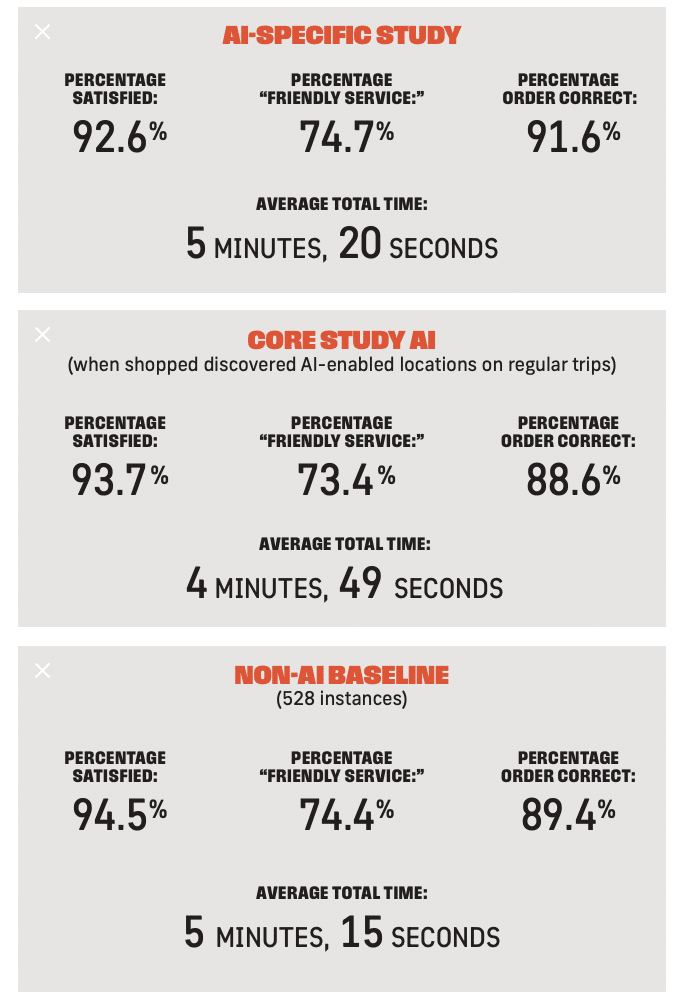
And here is a look at the dynamic of employees dropping hospitality in light of technology enablement.
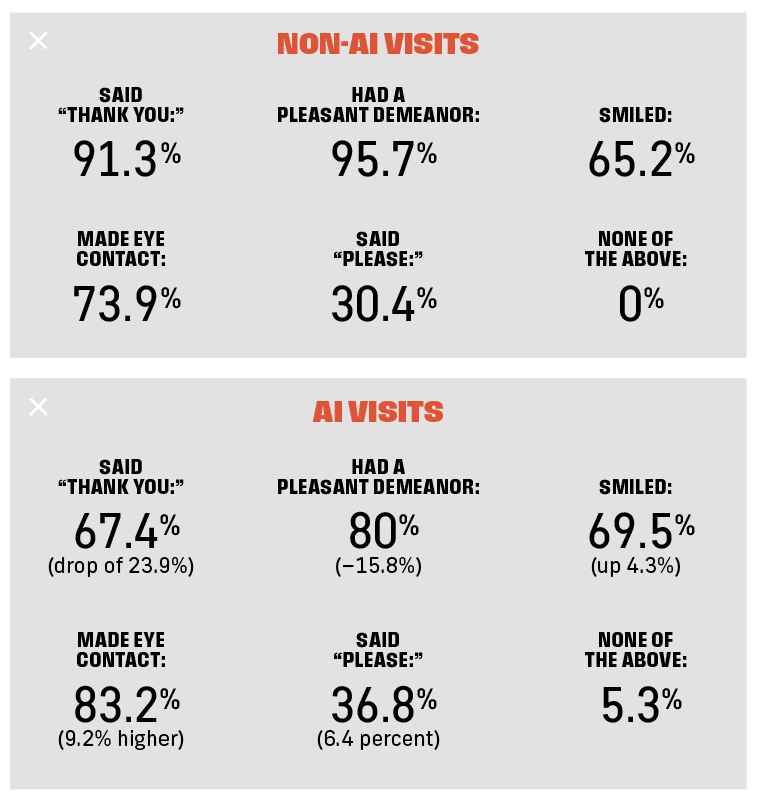
So, in some respects, employees are improving guest-facing KPIs with AI—just not the baseline ones.
Put differently, behaviors that require active verbal engagement decline sharply with an AI presence while passive physical behaviors hold steady or increase slightly.
What this illustrates, at least at this juncture, is when AI handles the ordering conversation, employees treat the interaction as more transactional. The “conversation” already happened with AI, so they default to silent fulfillment.
But as technology takes more of an ordering burden, there’s a growing need to protect the hospitality DNA of the drive-thru’s trigger point: what happens at the window.
This is hardly a glossed-over reality for Taco Bell, Mathews says. “I’ve never really viewed hospitality and technology as competing realities,” he notes. “The best technology creates space for better hospitality.”
Taco Bell is using tools and technology to strip friction, simplify operations, and create capacity so employees can focus on what matters most.
“When technology takes care of repetitive tasks or simplifies complexity, team members have more capacity to focus on customers. That’s where great hospitality lives,” Mathews says. “At the same time, hospitality isn’t just about a smile at the window. It’s about making guests feel understood and taken care of throughout the experience. When technology helps make that happen, that’s hospitality, too.”
“We believe the best experiences are both seamless and personal, and we’re deploying tools that are helping us deliver both,” he adds.
Two datasets in QSR’s Drive-Thru Report informed another angle of AI’s drive-thru maturity. At dedicated AI restaurants, the technology handled 81.1 percent of orders from start to finish. In the boarder study, where AI was encountered incidentally, only 24.8 percent of trips comprised full order handling: 68.1 percent prompted a greeting before transferring to a human.
Having AI just welcome customers, the Report showed, delivered minimal upside. The average speed of service was 5 minutes and 16 seconds versus 5 minutes and 25 seconds for non-AI drive-thrus. And the experience was disjointed. Many of the “greeting-only” encounters occurred at brands without confirmed AI deployments, hinting shoppers were identifying automated hellos or digital prompts as AI.
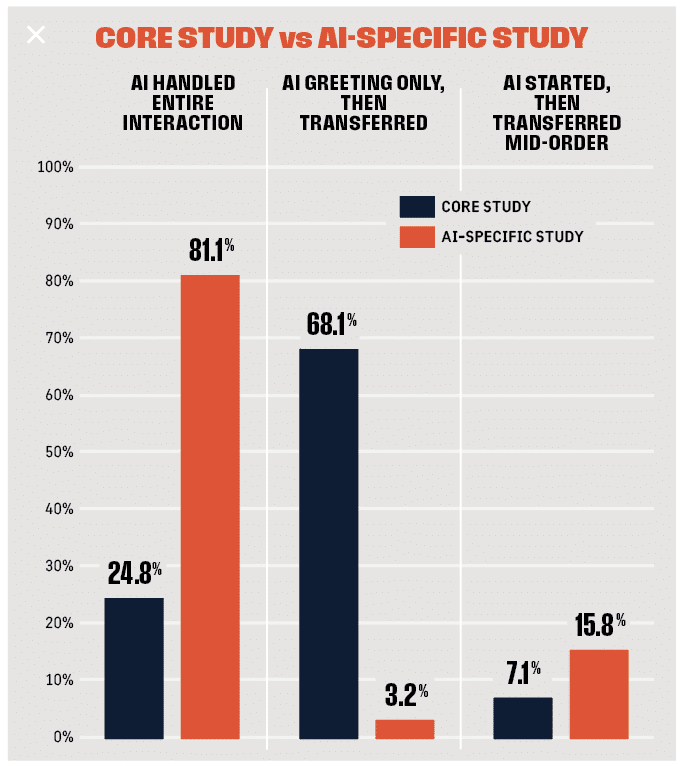
At mature AI stores, however, where the system handled the full interaction, speed of service improved 66 seconds to 4 minutes and 19 seconds.
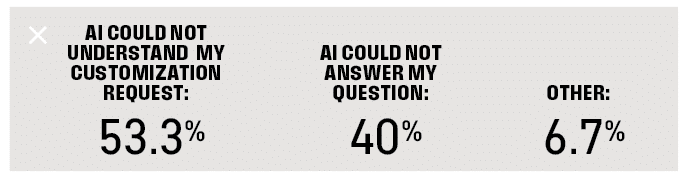
An Achilles heel, unsurprisingly, was customization. Among the 15 drive-thrus shopped in the AI-specific study, where technology began taking the order but pushed to a human mid-interaction, the reasons were:
And order accuracy varied significantly by customization type when AI handled the drive-thru order (orders correct percentage):
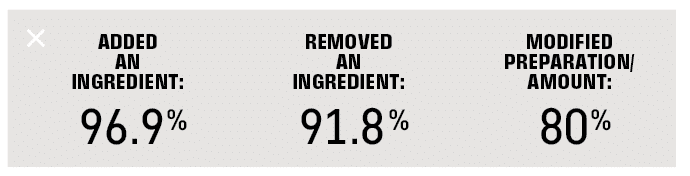
For comparison, non-AI order accuracy at the same restaurants was 95.7 percent. Additionally, among the 70 AI orders where the system confirmed back to customers (verbally or visually), seven were incorrect.
It is worth spotlighting when AI ran smoothly, satisfaction matched non-AI levels. Perhaps this offers a window into a more cohesive future, like Mathews outlined.
About 63 percent of AI-specific study interactions rated “easy” or “somewhat easy.”
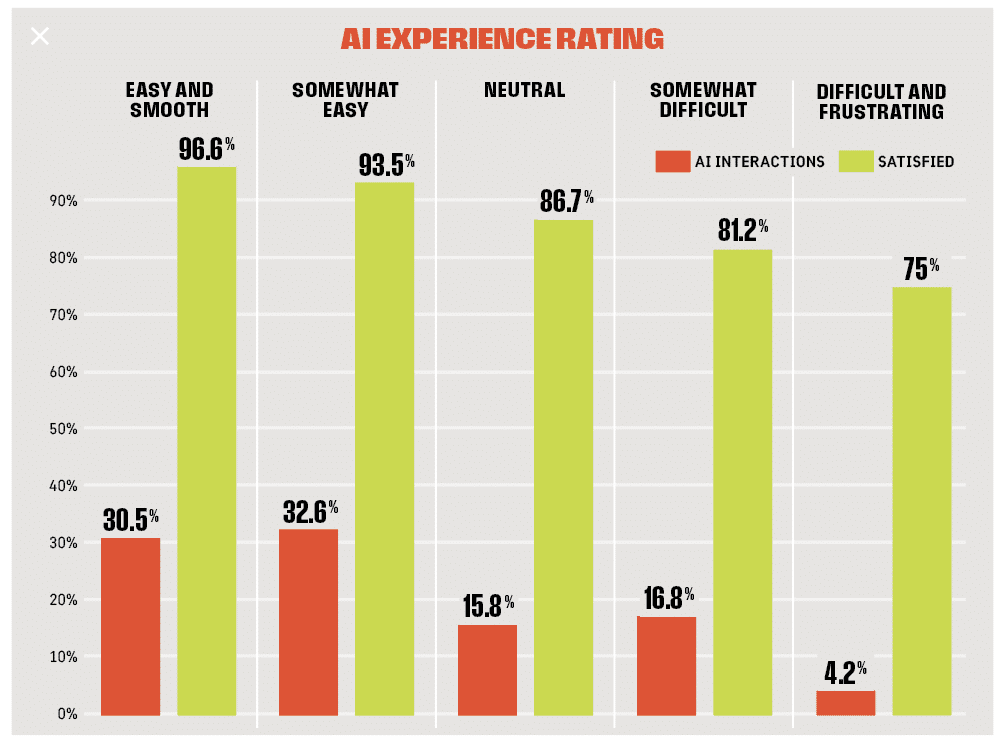
In sum, when AI was “easy and smooth,” satisfaction ran 96.6 percent, exceeding the study’s non-AI baseline of 94.5 percent.
When AI ordering is well executed at the drive-thru, it can, in fact, mirror or exceed human-only performance on satisfaction.
There was a paradox with speed perception, too. Across the combined dataset, AI drive-thru interactions were measurably faster. Yet they produced elevated “slower than expected” responses. In the core study, where the effect was most visible, 20.4 percent of AI visits felt “slower” versus 13.8 percent of non.
The effect was smaller at AI units (6.3 percent). This suggests it’s not as much as issue at restaurants where the technology is handling full orders smoothly.
Those AI-specific restaurants’ lower “slower” rates and high “as expected” performance (72.6 percent) might signal customers have adjusted expectations. Or, smoother end-to-end AI avoids the perception dent created by the greeting-and-transfer problem.
And the industry’s “stealth AI” phenomenon remained. Two-hundred visitors in the core Report (9.3 percent) selected “N/A or I am unsure” when asked about their AI interaction. This group—distributed across all brands, including those without AI—reported the highest satisfaction of any (97 percent) and a 77.5 percent “friendly” service mark.
So, what does this all say? When AI integrates seamlessly into the drive-thru experience, without drawing attention to itself, it produces better outcomes than AI customers explicitly notice and identify.
Might just the ideal AI implementation be one that enhances the experience invisibly?
A changing road to success
Despite the frantic pace of technology, Mathews believes an ironic truth awaits QSR brands. The most-advanced drive-thru will feel the simplest, and the most intuitive. “Customers won’t think about the technology at all,” he says. “They’ll just feel like Taco Bell—easier here, tastier there, and most importantly, unmistakably us.”
It’s an aim drive-thru restaurants across the category are chasing. In a multi-channel universe, how a brand shows up, not just how transactions improve, is vital to stoking conversations. “That’s the differentiator,” Mathews says. “Not that the drive-thru is smarter, but that it feels like Taco Bell.”
Over the past year, Taco Bell introduced new service models, coaching routines, and technology designed to help employees focus on delivering memorable moments. That includes tools like order tags that improve visibility and accuracy, recipe videos available on kitchen display screens, and, yes, AI-powered drive-thru ordering that streamlines order taking.
Taco Bell is also leveraging AI to help stores operate more effectively, including inventory management, food preparation, and order fulfillment.
Lastly, it’s given restaurant managers visibility into performance through data and technology, helping them make faster, more informed decisions.
“The goal is simple: remove complexity so team members can spend less time managing the process and more time serving memorable moments to guests,” Mathews says. “When expectations are clear and tools are intuitive, the rest is a better experience for both team members and customers.”
Mathews echoes AI has moved from predictive state to practical application. One of the biggest changes, he says, is how quickly it’s improved and how it’s responding to customer needs in real time.
How AI handles natural converstions and complex orders, as well as enable employees to focus on hospitality and order accuracy, is an unlock arriving quickly for restaurants if you know how to harness it. But restaurants can’t let automation shade equities.
“Looking ahead, I think the biggest opportunity is customer anticipation and brand differentiation,” Mathews says. “The more AI can help restaurants understand needs in the moment, support team members with better information, and create more relevant experiences for customers, the more intuitive and differentiated the entire experience becomes.”
Taco Bell has a unique card to play in this journey with Byte by Yum!, its connected platform that links everything from drive-thru ordering and loyalty to labor, inventory, and restaurant operations. Because the systems are connected, Mathews says, AI works across the entire experience instead of in isolated pockets. “Few restaurant brands have the advantage of a parent company investing in technology at this scale and building AI into the foundation of how restaurants operate,” he says.
Again, it dials back to a shift in expectations. Not all that long ago, drive-thru technology largely focused on removing friction. It was an aftershock of a pandemic where customers were encouraged to disengage.
That’s changed thanks to attrition and, simply, time, but also due to inflation rewiring what an experience is “worth.”
Mathews says Taco Bell increasingly focused on deepening connections. “The most exciting innovations help restaurants understand and respond to individual customer needs in real time,” he says. “Whether that’s recognizing a loyalty member, simplifying customization, surfacing relevant offers, or helping team members execute more effectively, technology is becoming less visible and more intelligent.”
“The real breakthrough isn’t any single tool,” Mathews continues. “It’s the ability to connect systems that historically operated independently. When loyalty, ordering, kitchen operations, and team members all work together, the experience feels less like a drive-thru and more like a conversation with a brand that knows you.
Consumers, he feels, don’t want QSR brands to make them choose between speed and accuracy.
It’s led to a more holistic view of drive-thru performance, at Taco Bell and around the sector.
Consider it a more deliberate examination of measures that tell brands if they’re creating seamless experiences where guests can customize confidently. Is the brand delivering an intuitive loyalty environment? Is it giving diners reasons to make Taco Bell part of their routine?
“The drive-thru is no longer just a transactional channel,” Mathews says. “It’s one of the most important relationship channels we have with our customers, and we’re measuring success accordingly.”
Intouch Insights released a QSR Technology Perceptions survey earlier in the year that showed while 62.7 percent of consumers felt innovation made dining more convenient, only 38.3 percent agreed technology influenced their decision to return. Both numbers declined, year-over-year.
“That suggests technology may be becoming an expectation rather than a differentiator, and that installing a new tool doesn’t necessarily mean customers believe the experience has meaningfully improved,” Beckett says. “The drive-thru of the future will be defined by the technology brands implement, but also by how effectively they measure and improve its performance.”
Into the results, and a clearer picture of success forms
If AI emergence is a rising element of the QSR Drive-Thru Report, so is one of its most fundamental enigmas—the reality speed is not the same as speed perception. Brands that won on quality and service in 2026 proved they can overcome significant time gaps.
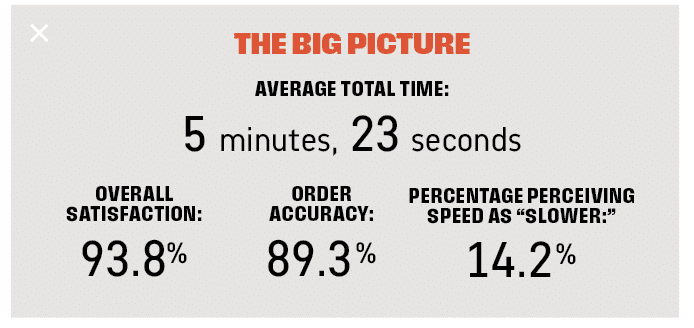
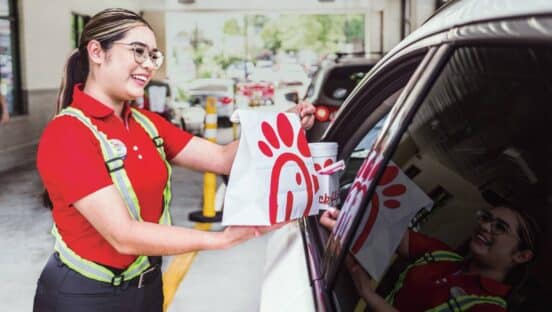
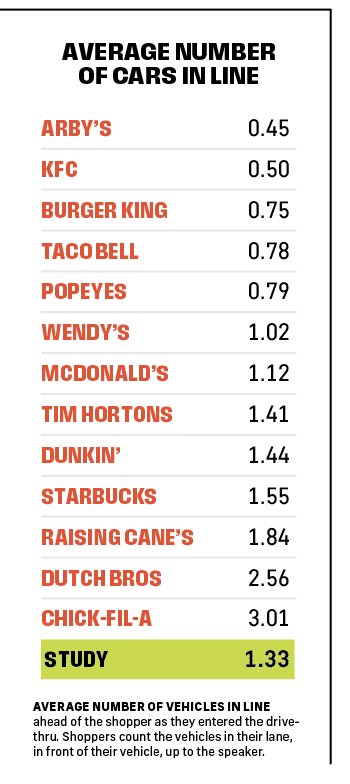
No brand paints this truth more than Chick-fil-A. Year over year, the brand comes in at the tail of the Report’s average total time results. Yet, customers don’t seem to agree, and it doesn’t weigh down the chain’s performance. The opposite is true.
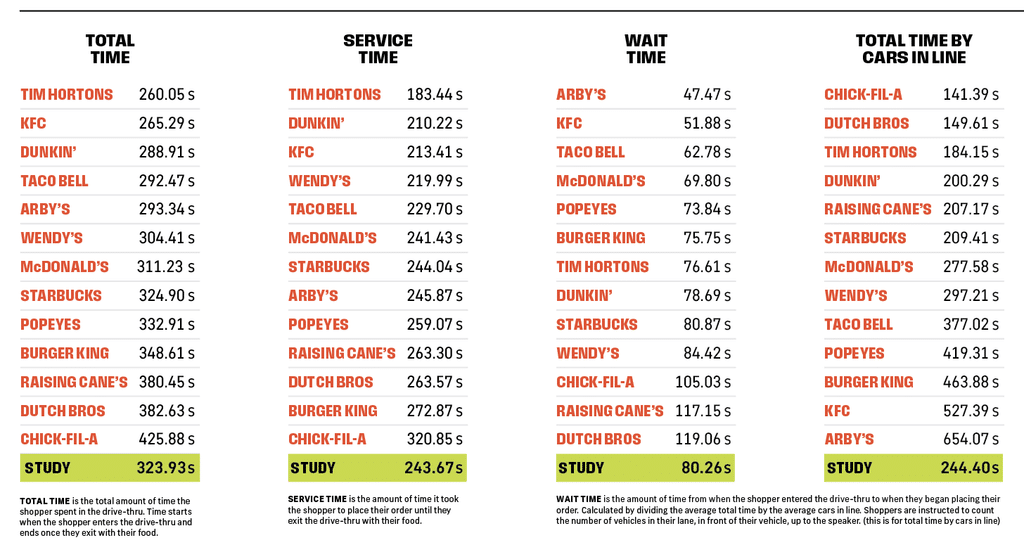
In 2026, Chick-fil-A clocked 7 minutes and 5 seconds, nearly 3 minutes longer than this year’s “fastest” chain in Tim Hortons (4 minutes, 20 seconds). However, its satisfaction scores led the field at 98.2 percent. And, notably, just 12.1 percent of visitors perceived speed as “slower than expected,” which was lower than Burger King’s 21.2 percent despite the brand averaging a minute and 17 seconds less in total time.
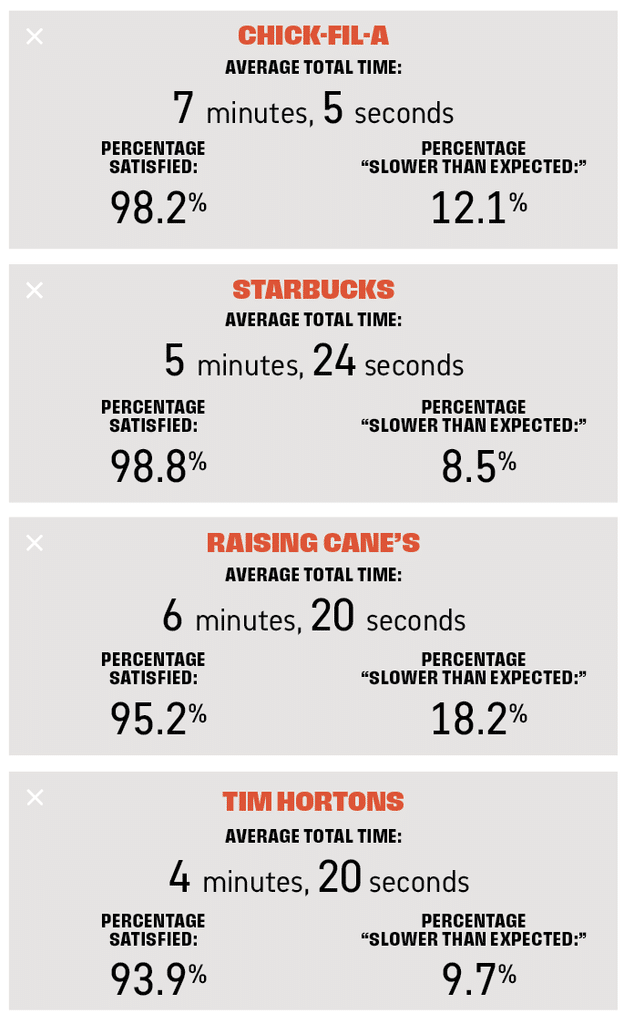
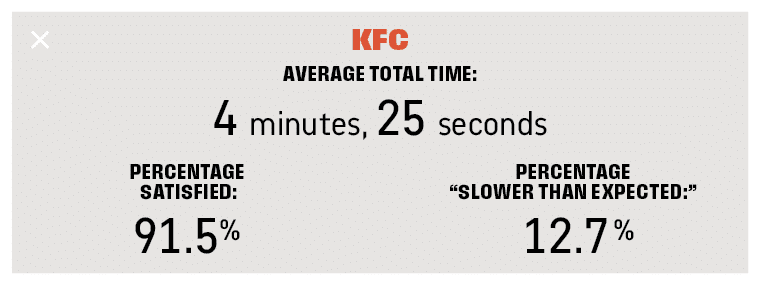
There is a lot that goes into this, including order-takers roaming the line and getting inputs in quickly, and the concrete point Chick-fil-A has more cars in line and is busier than the pack, but somewhere within the larger discussion is why the brand keeps raising the drive-thru standard. Chick-fil-A’s freestanding domestic drive-thru restaurants in 2025 generated median annual sales volumes of $9.088 million. One restaurant earned north of $20 million.
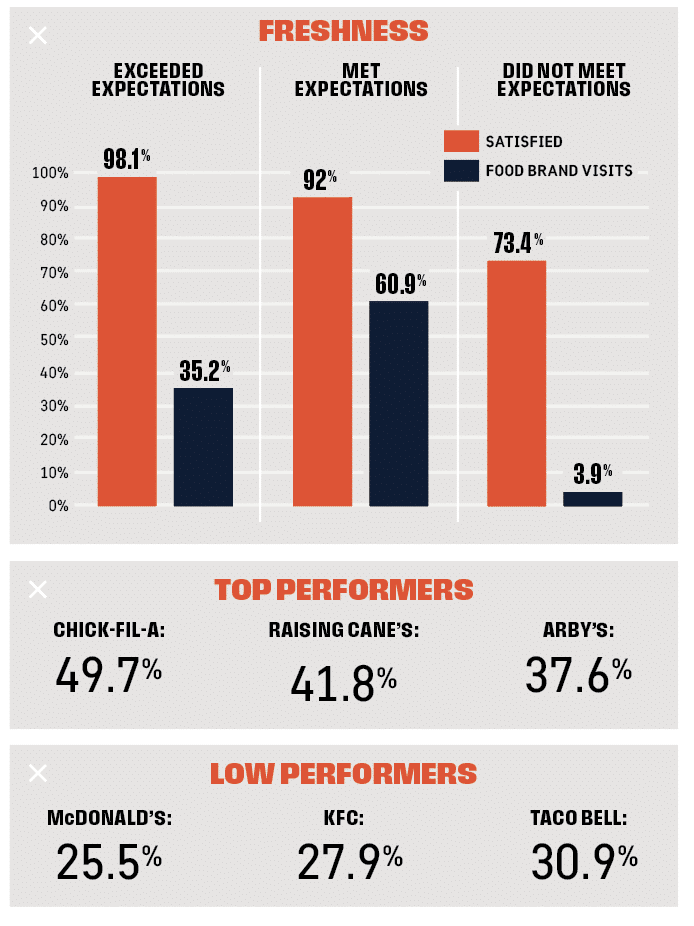
The brand in 2026’s QSR Drive-Thru Report posted a 70.9 percent personalization rate as 49.7 percent of visits exceeded freshness expectations (highest among brands). And just 0.6 percent of visitors rated the flow as “frustrating and inefficient” (lowest in the Report).
Longer times in today’s drive-thru do not equal lower satisfaction.
Monique Birkeli, Chick-fil-A’s senior director, hospitality and service experience, says the brand’s drive-thru has never been just about convenience. The chain sees it as an extension of Chick-fil-A’s service commitment.
“Our goal,” she says, “is to create memorable moments through small gestures of care—whether it’s a warm welcome, offering a menu recommendation or connecting personally. When these brief moments are delivered by our remarkable team members, they help build a sense of trust and connection.”
Chick-fil-A evaluates drive-thru experience based on speed of service, order accuracy, and customer feedback. Owner-operators are emboldened to customize hospitality to their markets, just as they do in-store.
For instance, Birkeli says, a guest might experience an employee serving as a “host” in the drive-thru at a Chick-fil-A like they would stepping inside, which helps with flow of traffic or checking in when there’s a longer wait. They also might notice an employee playing rock, paper, scissors, or handing out stickers. “It’s important that our local owner-operators go above and beyond to ensure guests feel cared for and enjoy each Chick-fil-A experience,” she says.
And Chick-fil-A continues to balance traditional principles with innovation. It’s expanding Mobile Thru lanes where customers who order ahead can roll through, as well as enhanced lane management systems designed to address capacity.
“In addition, we are investing in tools and operational insights that help local owner-operators better understand traffic patterns and make real-time adjustments throughout the day,” Birkeli says. “A few of our local owner-operators even use live drone footage to study their restaurant’s drive-thru patterns for efficiency and staffing to meet the individual needs of their guests. These enhancements allow restaurants to operate more efficiently while maintaining the accurate and caring experience guests know and expect from Chick-fil-A.”
Returning to the idea of “how speed feels,” the single most powerful predictor of satisfaction in this year’s QSR Drive-Thru Report was not how fast the visit was; it was whether the customer perceived it as so.
Visitors who felt speed was “quicker than expected” reported 96.8 percent satisfaction versus 82.3 percent for those who defined it as “slower”—a 14.5 percentage point gap.
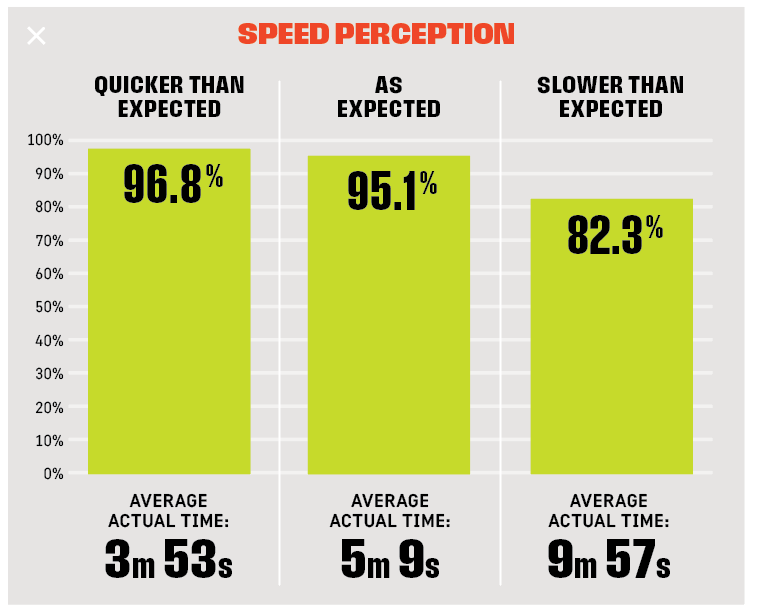
Just under 35 percent of visits were perceived as “quicker than expected.” Among those, 95 percent rated the flow as “perfectly smooth and efficient.” This tangible overlap indicated perceived speed was closely tied to the smoothness of the experience, not merely the clocked time alone.
So, when everything else went well, the drive-thru felt fast.
The brands with the highest “quicker than expected” rates—Chick-fil-A (41.8 percent) and Arby’s (41.2 percent)—also touted among the top “perfectly smooth and efficient” flow ratings (83 and 84.8 percent, respectively).
Birkeli reiterates a vital detail for Chick-fil-A is its owner-operator approach that puts stores in the care of local-minded leaders. She says many have developed creative ways to show care in the drive-thru, like offering samples while orders are being prepared. “These small moments of interaction, during a typically fleeting guest experience,” she says, “is what keeps our signature hospitality at the forefront.”
Birkeli adds Chick-fil-A is exploring AI and other emerging technologies but remains keyed in on how tools can reduce operational complexity, improve consistency, and give employees more time to serve customers. “We anticipate that the Drive Thru of the future will be even more intuitive and efficient as guests will continue to expect seamless experiences across every channel—whether they order through the Chick-fil-A App, use a Mobile Thru lane or interact directly with a team member,” she says. “For Chick-fil-A, convenience and connection remain of the utmost importance. While technology will continue to play an important role in improving accuracy and anticipating guests’ needs, we believe that human touchpoints will remain essential to the Drive Thru experience.”
She punctuates the future is not simply about speeding up. “It’s about creating an experience that feels personalized, efficient, and caring, from start to finish,” Birkeli says.
A flow of insights
The QSR Drive-Thru report also uncovered a “pull-ahead perception penalty.” Being asked to bring your car up at the final stop nearly doubled the “slower than expected” perception (12.1 to 21.2 percent) despite the average total time being comparable (5 minutes, 21 seconds not pulled versus 5 minutes, 36 seconds pulled).
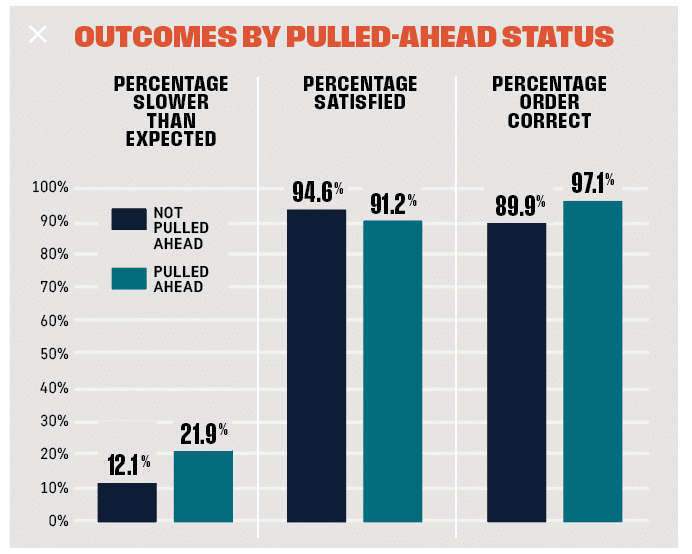
The act of getting pulled forward created a psychological signal of sorts the restaurant was behind, shifting consumers’ speed perception downward.
A buzzword pulsing continuously throughout the Report was “personalization.” Indeed, this has become a repeated motif throughout QSR as mobile technology levels the “customization” field. Consumers are used to having the ability to change and adjust orders on their own terms.
“Personalization,” however, as Mathews and Birkeli alluded to, is where many brands hope technology will lead them.
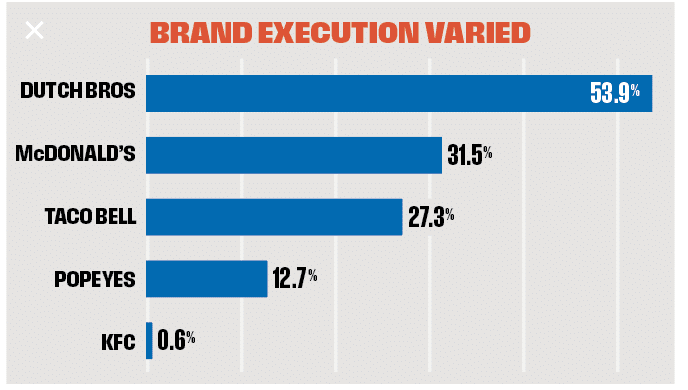
In the QSR Drive-Thru Report, there was a vivid “personalization premium” existing parallel to opportunity. Only 12.7 percent of drive-thru visits were personalized. Still, the impact was measurable.
When customers experienced any form of personalization during their drive-thru visit, being greeted by name, having their name on the bag, or being acknowledged as a loyalty member, satisfaction hiked from 93.2 to 98.2 percent.
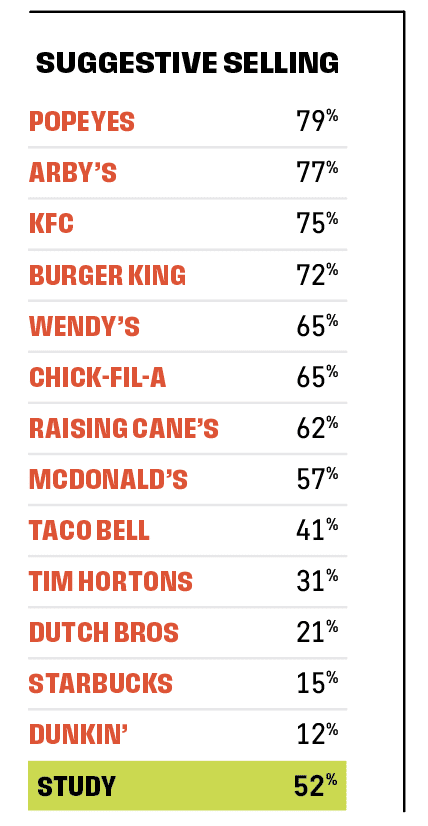
The rate of personalization varied dramatically by brand:
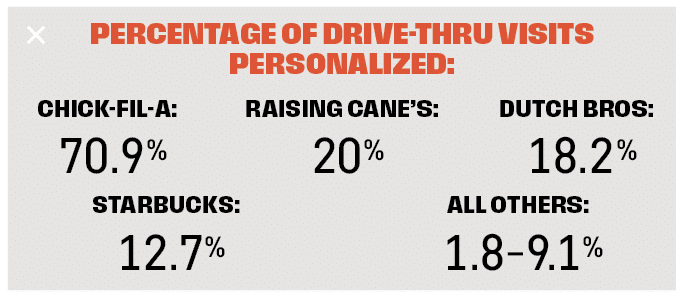
The canyon between the top four and the remaining nine was stark. Even simple gestures, such as greeting or welcoming a guest by name, or, writing their name on the bag, counted as personalization. And low-cost, high-impact efforts at that.
Following the KPIs
Vans Nelson, SVP of operations innovation at multi-concept giant Inspire Brands, says accuracy has always been a core driver of drive-thru satisfaction.
But, to the prevailing premise, what the Dunkin’, Jimmy John’s, Sonic Drive-In, Buffalo Wild Wings, Baskin-Robbins, and Arby’s owner has begun to see more of is an intentional balance between speed, accuracy, and overall experience. “It’s no longer about optimizing one at the expense of another. It’s about improving all three together,” he says. “To do that, we’re focused on practical, operational improvements that drive consistency. That includes tools like smart scales and AI vision to verify orders, more advanced kitchen display systems, and a continued focus on operational simplicity and team member deployment. When you reduce complexity and give teams better visibility, accuracy improves, and that strengthens the entire drive-thru experience.”
Inspire, too, is examining AI through an early innings lens. Nelson says we’ll likely see some consolidation and clear winners given the rapidly growing options. And operators are still learning how it could reshape guest-facing technology. “But we’re beginning to see that transition from pilot stages to scaled operational testing, which is really exciting,” he says. “And AI is expanding beyond the order point. We’re starting to see deeper integration into kitchen flow, labor deployment, and even predictive prep and inventory management.”
“Looking ahead, the opportunity is to unlock consistent accuracy at scale, improve personalization, and reduce routine tasks,” Nelson notes. “That allows teams to stay focused on execution and guest experience, while the system handles more of the predictive work in the background.”
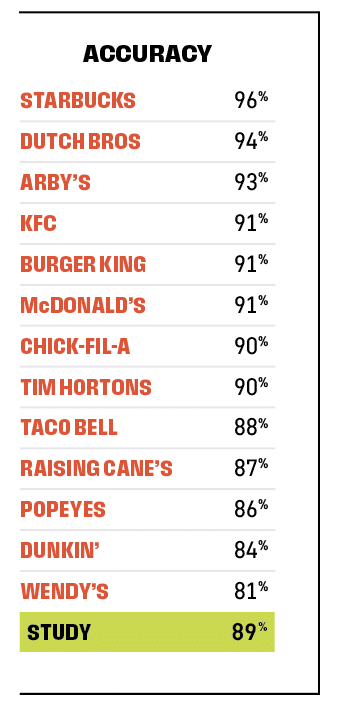
Beckett adds the strongest technology applications reduce ambiguity at key moments. This year, order accuracy reached 93 percent when customers were asked to confirm the order displayed on an order confirmation board compared with 88 percent when they were not asked to confirm it.
At locations without a usable order confirmation board, accuracy was 92 percent when the order was repeated back versus 76 percent when it was not.
“That distinction is important,” she says. “Technology moves the needle when it supports a reliable process: capturing the order clearly, confirming it with the customer, communicating it accurately to the kitchen, and ensuring the correct items reach the correct vehicle.”
More gaps and whitespace ahead
Nearly four in five drive-thru customers (79.5 percent) said mobile apps and loyalty programs were at least “somewhat influential” in deciding where to eat (32.5 percent said they were “very influential.”)
But only 12.4 percent of drive-thru shoppers encountered any mention of a brand’s program.
It lays a 67.1 percent percentage point gap to circle.
When loyalty was mentioned during the visit, satisfaction rose from 93.5 to 96.2 percent, and “excellent value” perception hiked from 14.3 to 21.1 percent.
Like anything, getting there—where loyalty feels a natural annex of the drive-thru—is going to take systems talking to each other, which is a topic with tentacles extending far beyond rewards.
Nelson says drive-thru innovation in general has progressed from a set of individual tools into something more connected. Today, the biggest unlock, he says, comes from integration: bringing together point of sale, kitchen systems, AI-enabled ordering, and queue management into one ecosystem.
“Dynamic, data-driven menuboards, better multi-lane orchestration, and increased beverage automation are all becoming table stakes,” he says. “These innovations help operators manage higher volumes while still delivering consistent execution.”
He adds AI voice and visitation technology is coming along. Companies that can bring both capabilities together and support a broader set of use cases will raise the bar further.
“The goal of our technology strategy is to enable more hospitality,” Nelson says. “When technology is used the right way, it allows us to shift resources and put more focus on meaningful, face-to-face interactions. Our team members want to create a great environment and connect with our guests, and we can make that even easier by taking tasks they perhaps don’t love off of their plates.”
Although throughput will always matter because it drives transactions, guest interaction is on par as a KPI. “The balance comes from using technology to improve speed and consistency behind the scenes so teams can be more present with guests where it counts,” he says.
The “old ways” still matter
The 2026 QSR Drive-Thru Report introduced a new question around food freshness perception. Among 10 food-focused brands (Starbucks, Dutch Bros, and Dunkin’ excluded), there was a sizable satisfaction gap.
The split from “exceeded” to “did not meet” was 24.7 percentage points. More than a third (35.2 percent) of visits beat expectations.
Hardly novel this year, friendly service once again provided the base of drive-thru satisfaction. When mystery shoppers rated the service they received as “friendly,” satisfaction reached 98.6 percent. On the other side, it collapsed to 26.8 percent—more than 71 percentage points of difference. That was the widest gap of any single dimension measured.
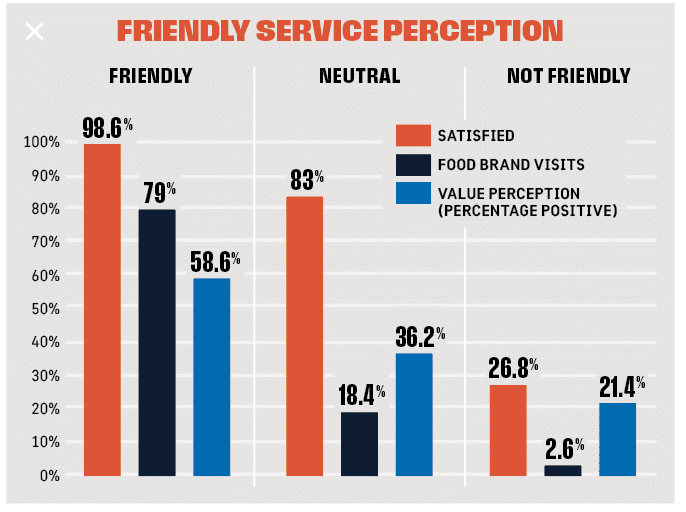
As seen, friendly service also lifts value perception. The perceived value of the same food changes based on how it was delivered.
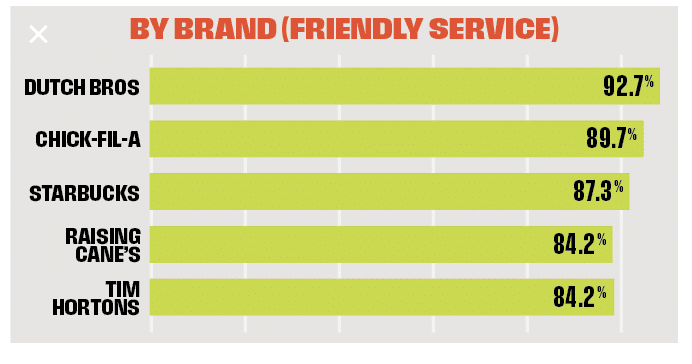
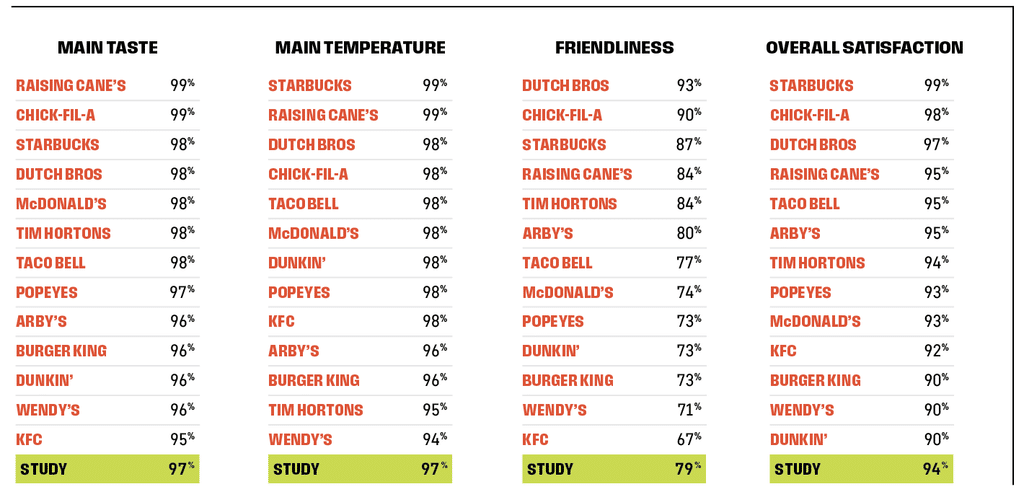
How a restaurant ensures “friendly” service is another recurring topic. It’s a culture aim; an operational, training one; part of the operator and manager selection effort; and countless other layers that run up and down an organization.
And it’s why Nelson, Mathews, and Birkeli kept coming back to technology as an enabler rather than a replacer of human-powered service.
At Inspire, the company’s Innovation Center is used to experiment with designs. It uses time-and-motion modeling to optimize kitchen layouts. By building different boxes and simulating tasks under various configurations, the company can identify, address, and reduce points of physical and cognitive friction in the back-of-house. And it all reroutes to people.
“When you simplify the work,” Nelson says, “teams can focus more on delivering a great guest experience. We’re doing that by giving automated and AI-powered systems the repetitive tasks. Over the years, we’ve invested in smart kitchen equipment that connects to the systems our teams use to make decisions. Real-time insights help our teams troubleshoot in the moment. The result is more consistent execution, faster training, and stronger performance, all of which directly impact the drive-thru experience.”
Like Mathews, Nelson sees this leading to a more connected and predictive drive-thru world. AI vision and timer systems will integrate into kitchens, helping synchronize demand with production to improve speed and accuracy. Digital menu boards will evolve toward more personalized, one-to-one messaging.
“At the same time, multi-lane formats will become more segmented to handle higher volumes more efficiently,” he says. “When you pair that with smaller, more flexible building formats, you end up with a system that is faster, more accurate, and more responsive to what guests want in real-time.”
Adds Beckett, “Drive-thru technology is evolving from a collection of individual tools into a connected operating system for the experience. Digital menu boards, order confirmation boards, loyalty integrations, AI ordering tools and improved communication systems can all contribute, but their value ultimately depends on whether they help the restaurant execute more consistently.”
The power of value
Mystery shoppers were asked in the QSR Drive-Thru Report to rate the value for money specifically of the meal they purchased at the drive-thru.
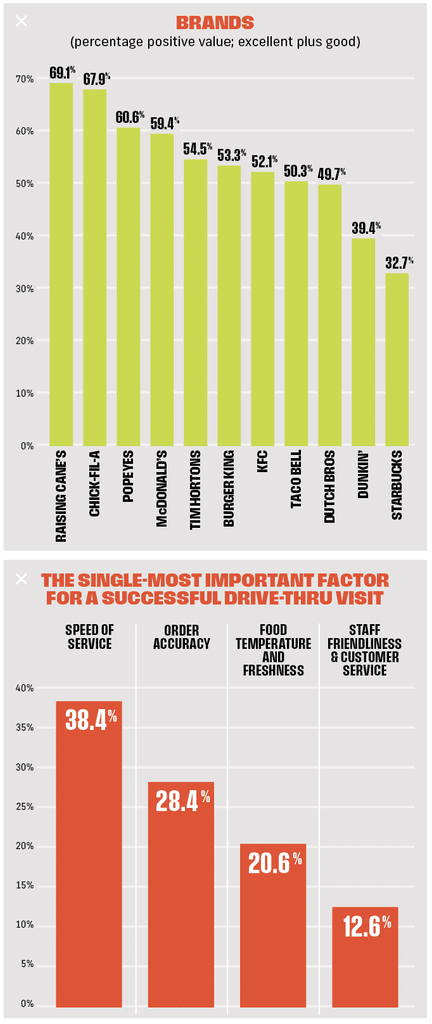
Speed perception influenced figures. Among visits where speed felt “quicker than expected,” 64.3 percent rated the drive-thru meal as a positive value versus 42 percent when it was “slower than expected.”
A drive-thru that feels faster leads to it feeling more valuable.
Bringing the debate full circle, speed was the No. 1 stated priority for customers when asked what they want in a drive-thru.
But this didn’t always align with reality. The largest gap on measured satisfaction came from service (71.8 percentage points), followed by freshness (24.7), and speed perception (14.5).
And staff friendliness produced the widest gap, as revealed before.
On a psychological level, customers seem to expect friendliness when choosing where to go but react strongly to its absence.
“The operational results demonstrate why accuracy needs to be measured alongside speed,” Beckett says. “In the 2026 study, 89 percent of orders were filled correctly and completely. When an order was accurate, 96 percent of customers were satisfied with the service they received. When an order was inaccurate, satisfaction fell to 73 percent. The takeaway isn’t that accuracy has replaced speed, but that saving a few seconds has limited value if the customer leaves with the wrong meal.”
Additionally, any sole issue in particular dropped satisfaction by 11 percentage points. For customers who visited a drive-thru with zero issues, satisfaction was 97.8 percent. If one thing went astray, though, from perceived slow speed to an inaccurate order, the number slid to 86.4 percent. Two or more issues and it plunged to 57.9 percent.
What this reveals is something QSR operators have long known—nine great trips and one poor one can lead to somebody not returning. The one-strike dynamic means operational consistency matters more than occasional excellence.
“Hospitality may not always be the first factor customers name, but they clearly notice when it’s missing,” Beckett says. “The right balance is to use technology to remove repetitive tasks and operational friction while protecting the moments when an employee can acknowledge and reassure the customer. Technology can take the order, process payment or help route vehicles, but employees still influence the final impression through the clarity of the handoff, their attentiveness and how they respond when something goes wrong.”
Drive-Thru Study Methodology:
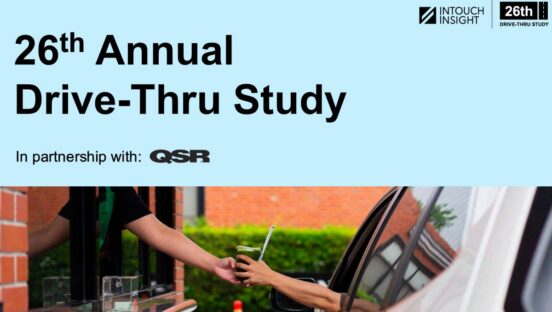
The 26th Annual Drive-Thru Study is based on 165 mystery shops per brand, conducted across the United States between June and July 2026. Shoppers visited drive-thrus at various times of day and days of the week to capture a balanced view of performance in real-world conditions. Thirty-five percent of trips occurred during the breakfast daypart; 28 percent during lunch; 8 percent during the afternoon; and 29 percent during dinner.
The 2026 QSR Drive-Thru Report was brought to you by our sponsors: