Black Rock Coffee Bar’s next wave of growth is getting more expensive. But the chain sees an opportunity in buildings other brands leave behind.
Average costs for its 2026 store class are coming in around $800,000 per location, accounting for tenant improvement allowances that offset the company’s investment. That compares with an initial expectation of $700,000 to $750,000 and approximately $650,000 last year.
The increase hasn’t slowed Black Rock’s opening ambitions. The company raised its full-year target to 40 stores from 38 during its third-quarter earnings call and expects to substantially increase California development next year. Instead, it’s balancing different build types to manage capital and expand the pool of sites it can pursue.
“We are actually balancing the capital in California with conversions, which are really helping,” CFO Rodd Booth said.
READ MORE: Black Rock Finds More Room to Grow Beyond the Morning Rush
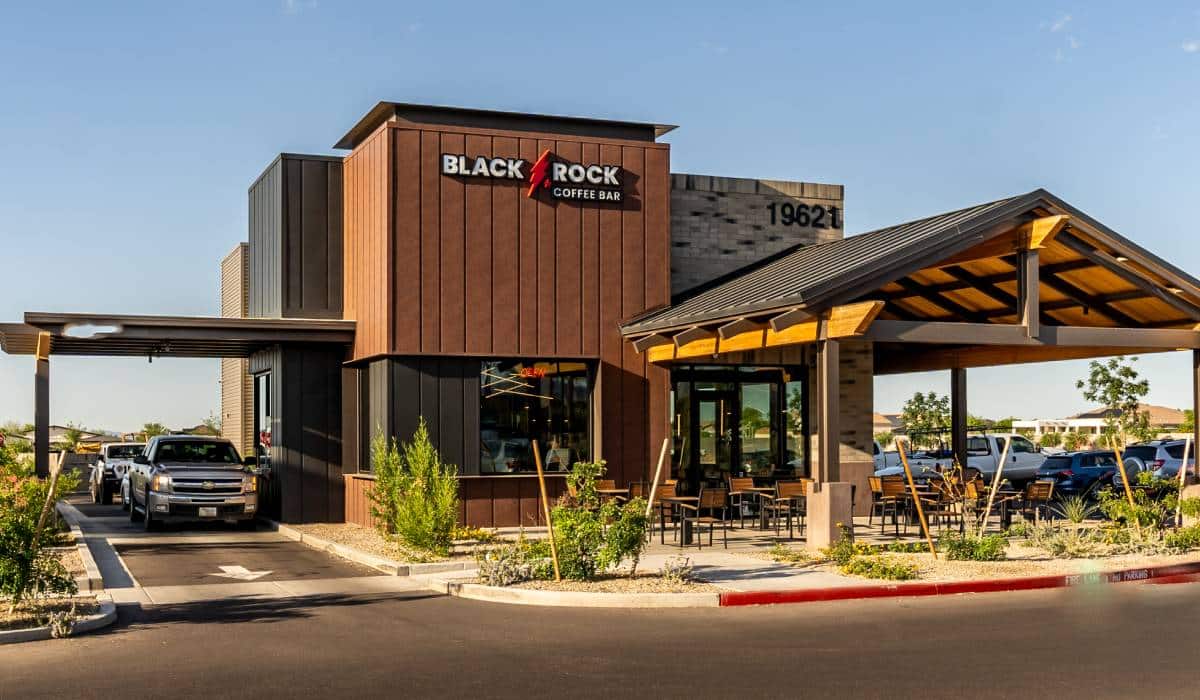
Second-generation buildings with existing drive-thrus are a particular opportunity. They allow Black Rock to preserve a feature it considers central to the brand—its lobby—without taking on the same capital requirements as other development approaches in a higher-cost market.
Booth said conversions are part of the strategy across Black Rock’s markets, not just California. But their value becomes especially apparent as the company builds its presence there. Black Rock expects five California openings this year and 15 to 20 in 2027.
“It allows us to prioritize the lobby, but also not go out and really see the capital grow substantially in terms of a per-unit cost in California,” Booth said.
That lobby also influences which properties Black Rock can make work.
Asked what makes a good conversion, CEO Mark Davis pointed to a difference between Black Rock and competitors built exclusively around drive-thru service. Having a dining room means the chain doesn’t need the same long vehicle stack as a concept without one, he said.
That gives Black Rock another option when evaluating existing buildings, alongside its ability to adapt to different site configurations. As other concepts close, Davis said, the development team is moving quickly to assess the spaces they leave behind.
“We’re able to make a variety of different sites work,” he said.
For landlords, the appeal extends beyond filling a vacancy. Davis said Black Rock’s flexibility and speed can help get properties through permitting, construction, and into operation sooner.
“When you think of yourself as a landlord, they want somebody that can come in, that can go through the permitting quickly, that can adapt and get that open and get it going,” Davis said. “And what that does for them is it allows them to charge rent faster.”
Becoming publicly traded last year has also helped generate interest from property owners, Davis added.
Moving quickly, however, still requires work before a lease is signed. Davis said Black Rock has improved its pre-lease follow-up to better manage conversion costs. He connected that diligence to cash-on-cash returns of 35 percent in the first year and 40 percent in the second.
Conversions are one part of the development mix. Black Rock also expects a near-term shift toward more reverse build-to-suit projects, which Booth said give the company greater control over planning and delivery.
The benefit there is predictability. Booth said opening cadence has improved each quarter, with reverse build-to-suit stores helping Black Rock gain more control over when locations come online.
The company opened 11 stores in Q3 across California, Arizona, Colorado, and Texas, finishing the period with 211. It has opened 35 for the year, with the remaining five expected in the coming weeks. Its updated target represents approximately 22 percent annual unit growth.
Those openings are requiring investment beyond construction. Entering markets such as Killeen, Texas; Prescott, Arizona; and the Los Angeles area meant flying in more employees and deploying larger opening teams to protect the guest experience.
Black Rock’s first Inland Empire location generated a record-breaking early response, Davis said. But supporting those openings contributed to higher labor and pre-opening costs. Management expects to gain efficiencies as the chain builds a larger presence in those markets.
The spending also extends well beyond this year’s class. Approximately $14 million to $15 million of Black Rock’s capital budget supports future-year growth, with a meaningful portion of 2027 openings already funded and underway.
The company’s store-lead pipeline for next year is in place, too. Ninety-eight percent of store leaders were promoted internally, giving Black Rock experienced employees to carry its operating standards into new locations.
Longer term, the chain continues to target 1,000 stores by 2035. Davis said the development and people pipelines are ready for 2027, with work already progressing on 2028.
“We’re concentrating on our best markets, targeting new deals in areas we believe support AUV growth,” he said.