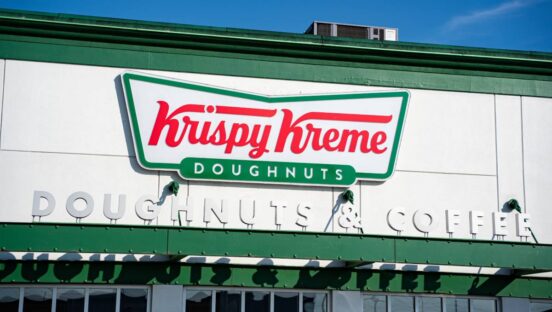
Krispy Kreme is discovering that selling more doughnuts doesn’t necessarily require putting them in more places. Sometimes, the better opportunity comes from making sure customers can find them in the right places.
A little more than a year after launching a sweeping restructuring effort, the company is seeing favorable results from its focus on profitable distribution, operational efficiency, and franchise-led expansion. U.S. fresh delivery returned to growth in the third quarter, margins improved, and the company raised its full-year revenue outlook.
The progress comes after Krispy Kreme spent much of the past year reworking its business model, including exiting approximately 1,500 underperforming fresh delivery locations, refranchising operations in Japan and the Western U.S., and reducing capital expenditures.
CEO Josh Charlesworth says the company is now better positioned to expand without taking on the same level of financial obligations that accompanied its previous growth plans.
“Unlocking that demand continues to be our priority as we pursue profitable U.S. expansion and capital-light international franchise growth,” Charlesworth said during the company’s third-quarter earnings call.
Global systemwide sales increased 1 percent during the quarter, and Krispy Kreme continues to expect growth of 2 to 4 percent for the full year, bringing systemwide sales above $2 billion.
Net revenue declined 12 percent to $328.8 million, primarily because of the refranchising transactions in Japan and the Western U.S. Organic revenue, which excludes the effects of refranchising and foreign exchange, was essentially flat.
Adjusted EBITDA fell 13.1 percent to $35.3 million, largely because the company recorded a $9.3 million cybersecurity insurance recovery in the prior-year period. Excluding that one-time benefit, adjusted EBITDA increased 13 percent, and adjusted EBITDA margin expanded 240 basis points to 10.7 percent.
The improvement was pronounced in the U.S., where organic revenue increased 0.9 percent, supported by fresh delivery and digital sales. Adjusted EBITDA in the segment reached $13.9 million, representing an 18 percent increase when excluding the prior-year insurance recovery. On the same basis, adjusted EBITDA margin improved 320 basis points.
Much of that progress stems from changes to Krispy Kreme’s production and distribution network.
The company has improved production planning, adjusted labor deployment, streamlined hub operations, and made delivery routes more efficient. Those efforts have increased sales per production hub by more than 10 percent year-over-year, allowing Krispy Kreme to make better use of its existing infrastructure.
The adjustments are important to the company’s fresh delivery business, which supplies doughnuts to grocery stores, mass retailers, convenience stores, and club stores.
Last year, Krispy Kreme determined that parts of its distribution network were not producing sufficient returns. The company responded by eliminating approximately 1,500 underperforming doors and shifting its attention toward higher-volume retail partners.
Krispy Kreme added 715 net new fresh delivery doors year-over-year, bringing its U.S. network to approximately 7,700 locations, including franchise operations. The newer doors have higher average weekly sales than the locations the company previously exited.
Fresh delivery returned to growth during the third quarter.
The company sees additional opportunities with Walmart and Target, where it currently distributes doughnuts in fewer than half of each retailer’s U.S. stores.
Charlesworth says the company’s relationships with large retailers have demonstrated the importance of customer traffic and prominent product placement.
“We’ve been adding distribution with them because they have higher traffic and because the partners really understand the importance of merchandising and prominence in store,” he said. “So we’re pleased with the momentum we’re seeing with them. And we still see plenty of opportunity.”
In grocery stores, front-of-store placement has proved valuable, and Publix has contributed to the company’s recent distribution growth. Krispy Kreme has also improved product visibility at Sam’s Club and is evaluating additional opportunities with Costco after completing its latest U.S. product rotation in August, including seasonal assortments and road shows.
Convenience stores present a more challenging environment. Charlesworth said reduced traffic, potentially influenced by higher fuel prices, has affected the channel, prompting Krispy Kreme to review its footprint and prioritize locations capable of supporting sustainable sales.
The company is also adapting its menu to appeal to customers seeking smaller portions and more variety. Its growing Minis category includes Doughnut Minis, Dots, and Mini Crullers, with the latter performing particularly well in fresh delivery.
The development is especially relevant as restaurants evaluate the potential effects of GLP-1 weight-loss medications on consumer eating habits.
Krispy Kreme’s research suggests that customers using GLP-1 medications are just as likely as nonusers to purchase sweet treats for holidays and special occasions. The company also found that GLP-1 users demonstrate higher purchase consideration for Krispy Kreme, despite generally having smaller appetites.
Charlesworth attributes that behavior to the brand’s position as an occasional indulgence. Consumers typically purchase Krispy Kreme doughnuts two to three times annually, often for celebrations or other special occasions. The company estimates that approximately 80 percent of its doughnuts are shared and 40 percent are purchased as gifts.
“We believe our focus on quality, occasional indulgence, and sharing positions us well as consumer habits evolve,” Charlesworth said.
Limited-time offerings and seasonal promotions are also contributing to demand. Krispy Kreme’s recent Pokémon collection performed well during the third quarter, and the company reported a successful Halloween period.
Value is another important consideration as consumers navigate economic uncertainty. Charlesworth said Krispy Kreme has seen strength in its dozen-doughnut business, particularly promotions that offer a discount on a second dozen.
Digital sales are contributing to U.S. growth, supported by improvements to the company’s ordering platforms, additional payment options, and an expanding loyalty program that now has more than 18 million U.S. members.
Despite opportunities in specialty coffee and beverages, Krispy Kreme continues to prioritize its signature product.
“Our focus is naturally on the fresh doughnuts. That’s what we absolutely excel in, welcoming consumers to our doughnut shops, bringing the doughnuts, the fresh doughnuts, to more convenient locations like our fresh delivery partners and also online in the digital channel, making it more convenient to pick up,” Charlesworth said.
Krispy Kreme is also shifting more restaurant development to franchisees.
Earlier this year, the company completed refranchising transactions in Japan and the Western U.S., helping reduce debt and move toward a less capital-intensive operating model. Franchisees now account for approximately 42 percent of global systemwide sales, up from approximately 25 percent in 2025.
The company recently announced an agreement with an existing franchisee to open 33 doughnut shops across the New York City metropolitan area over the next five years. Charlesworth noted that Krispy Kreme already works with more than 20 franchisees across the U.S., including WKS Restaurant Group, which is pursuing additional development in Western states.
International expansion is moving forward as well.
Krispy Kreme announced a development agreement with Gray Mackenzie Restaurants to open 120 doughnut shops in Pakistan over the next five years. The agreement marks the company’s fourth new international franchise market announced in 2026, following Estonia, Mauritius, and the Netherlands.
Existing international markets are contributing to expansion, too. Krispy Kreme reported 98 new shop openings through the third quarter, nearly all franchised, with India, South Korea, and the Middle East accounting for much of the activity. The company is also seeing continued development interest in Brazil, Spain, and Japan.
Charlesworth says Krispy Kreme’s established international infrastructure, including support teams in Dubai and North Carolina, helps franchise partners launch operations in new countries. The company continues to manufacture and service its doughnut production equipment in North Carolina.
“We have a very well thought through network across the world and supply chain that helps people open up new markets,” Charlesworth said.
Krispy Kreme is also experimenting with smaller restaurant formats to improve development economics.
A longtime franchisee is preparing to open a new Hot Light Express prototype in Las Vegas. The smaller-format shop will offer fresh, hot Original Glazed doughnuts, giving the company another potential avenue for expansion through its existing hub-and-spoke production network. The concept is in the early testing stage, but Krispy Kreme has already received interest from franchise partners.
Financial flexibility continues to be a priority.
Krispy Kreme increased and narrowed its full-year revenue guidance to $1.35 billion to $1.4 billion, compared with its previous outlook of $1.25 billion to $1.35 billion. The company maintained its adjusted EBITDA forecast of $140 million to $150 million and lowered its expected capital expenditures to $40 million to $45 million, down from $50 million to $60 million.
The company’s focus now turns to the fourth quarter, traditionally its busiest period, when holiday celebrations and seasonal purchasing occasions drive demand.
Charlesworth says Krispy Kreme is positioning itself to capture those opportunities through a more efficient production network, improved retail distribution, and continued menu innovation.
“The fourth quarter, it’s our peak season,” Charlesworth said. “We’re very focused on meeting that demand for the different celebrations and seasonal moments that people are looking for our doughnuts for.”