
Let’s start with a debate on consumer behavior: Are fewer restaurant goers visiting the drive-thru?
From January 2024 through June 2025, there have been consistent gains in dine-in, delivery, and takeout trends—the latter spiked 25.8 percent alone in October 2024, according to Revenue Management Solutions. Yet drive-thru remained in negative territory month after month, falling as deep as 13.3 percent last summer and still hovering between minus 5 and 8 percent in 2025. “These sustained declines,” RMS CEO John Oakes says, “suggest that consumer behavior is shifting in ways operators can’t ignore.”
Over recent years of our QSR Drive-Thru Report, we’ve seen this arrow tilt and rebalance following COVID-19. There was a surge in usage due to necessity and then a holding pattern as guest visits settled into habits. But multiple years of inflation spread transactions thin and sent diners in search of experience for value. Or, simply, drive-thru reached a point of parity in the marketplace—there are more options for convenience than pre-pandemic. And that reality is a maturing conversation as much as anything else. Did takeout exist before 2020? Naturally, but the tools to provide access were either in their infancy or riddled with friction.
MORE DRIVE-THRU COVERAGE:
Download Intouch Insight’s full guide to the Drive-Thru Report
Check out last year’s QSR Drive-Thru Report
Talking Drive-Thru with Inspire Brands’ Innovation Leader Vans Nelson
A Conversation on Drive-Thru with Burger King’s Operations Chief Peter Perdue
‘Quality of Interaction’ Continues to Guide Chick-fil-A’s Drive-Thru Super Power
Oakes says you can see these stakes show up at the drive-thru. “The brands that act now to improve the value equation—with smart pricing, reduced wait times, thoughtful AI, and seamless digital-to-physical experience—will be best equipped to grow when consumer confidence returns,” he says.
Nearly 24 percent of respondents in RMS survey data said they now buy pre-made meals at grocery stores more often, and 15 percent reported more frequent C-store visits for grab-and-go. Call it a race to convenience and value for the money. And where does that leave the drive-thru, which has long mixed 70 percent of sales at top QSR brands that define the category? “To compete, drive-thru operations need to deliver what their customers, primarily Gen Z and millennials, want,” Oakes says, “which includes a frictionless experience, good value and menu items that appeal, such as specialty drinks and snacks.”
This year, the QSR Drive-Thru Report, a partnership with Intouch Insight, expanded to include four additional brands in its mystery shopper study—Popeyes, Tim Hortons, Starbucks, and Dutch Bros—and provide a segmented look at how categories are performing compared to each other, as well as brand-by-brand. We also continued to delve into AI reflections and how automated voice ordering compares to typical setups, as well as the category’s overall lift toward a fresh vision as customers, to Oakes’ commentary, demand similar experiences in their drive-thru journey as they do in other digital orders.
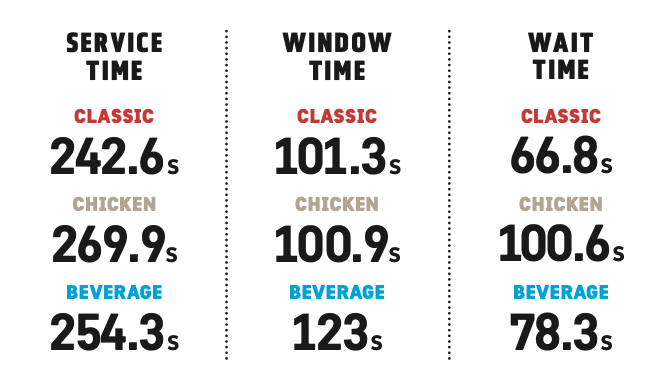
Here’s a look at how segments broke down:
“Classic brands” were the fastest of the restaurants measured across all metrics except window time.
When it came to accuracy, “beverage brands” topped, scoring 8 percent higher than chicken.
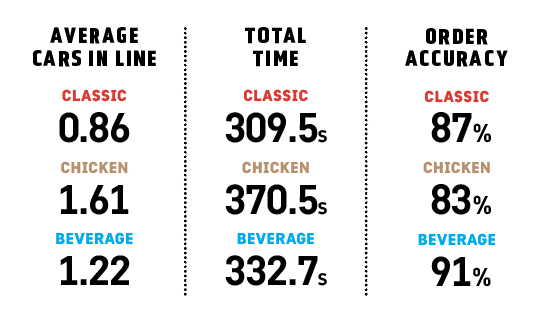
For friendliness and overall satisfaction, classic brands were the lowest, chicken the highest.
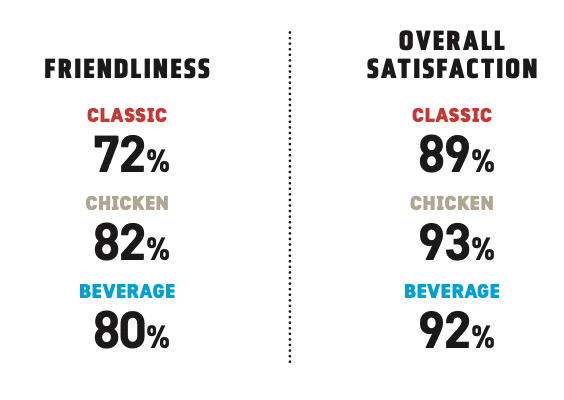
Like always, drive-thru KPIs fall into a nuanced, yet evolving world. As RMS data showed, the category rode tailwinds into higher guest expectations. And that can be a challenging space to compete in when traffic is down, and diners are guarding spend to combat higher costs.
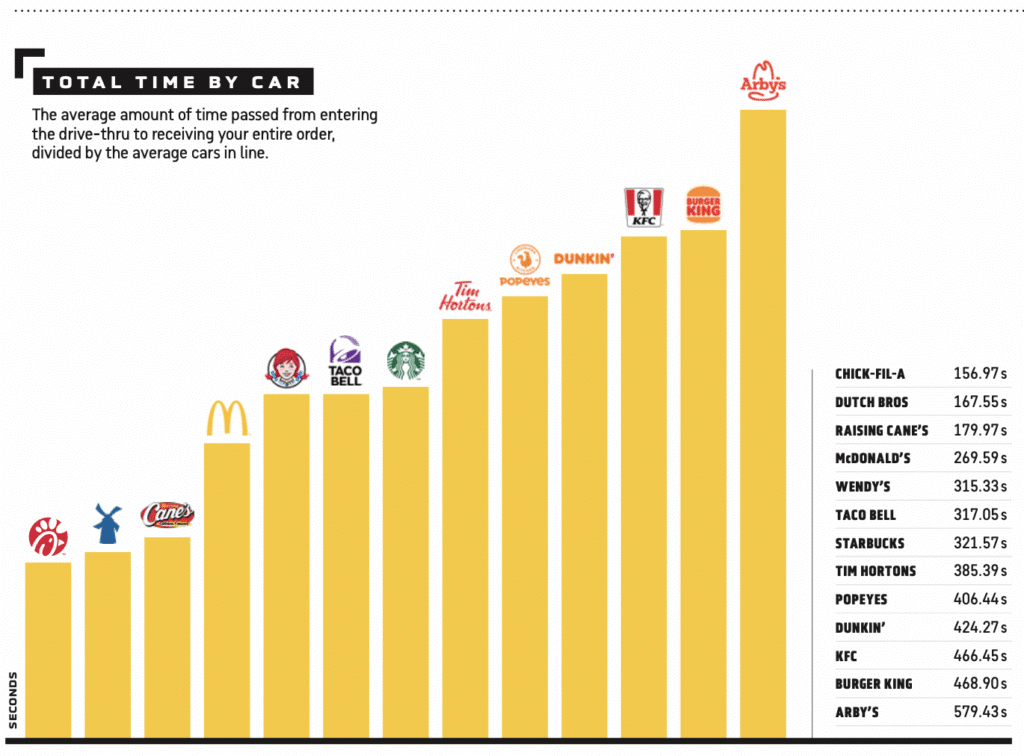
Taco Bell ranked as the fastest drive-thru, by total time, for the fifth consecutive year.
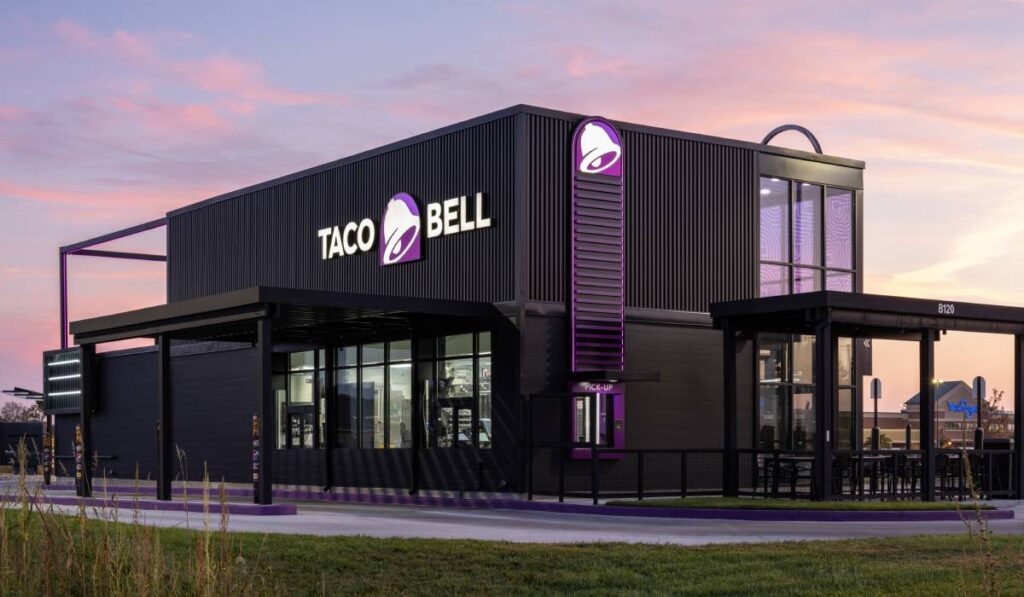
Dane Mathews, Taco Bell’s chief digital and technology officer, says it’s a holistic battleground. “Speed, accuracy, and friendliness remain foundational to success,” he notes, “but at Taco Bell, we see them as part of broader ambition: delivering exceptional hospitality.”
“Today’s drive-thru success isn’t just about how fast or precise the drive-thru is—it’s about how the experience makes you feel,” Mathews adds. “That’s why we’re focused on metrics that reflect both operational excellence and customer experience. Technology is helping us elevate all of these, but it’s the feeling you leave with that defines a truly great drive-thru.”
Even before COVID, the QSR Drive-Thru Report had begun to show a slant in preference toward accuracy over straight, clocked speed. Was this a reflection of mobile proliferation? Had consumers learned both to wait in idle time blocks with smart phones and to expect visual confirmation and accuracy in their purchasing, like retail? That’s assuredly true, but so is the coming chapter Mathews spoke to. It isn’t enough today to open the funnel and enable transactions. “Value” spread tentacles throughout QSR well beyond price and speed into experience—inside and outside stores. If dine-in continues to gain, restaurants will need to make drive-thru experience matter beyond the hand-off.
Monique Birkeli, senior director, hospitality & service experience at Chick-fil-A, Inc., refers to this aim as “quality of interaction.”
“Customers tell us they value both a fast experience and an accurate order, but we also know they expect a warm, friendly interaction with our team members,” she says. “For us, table stakes in the drive-thru today are clear: a remarkable experience that combines efficiency, accuracy, and hospitality every single time.”
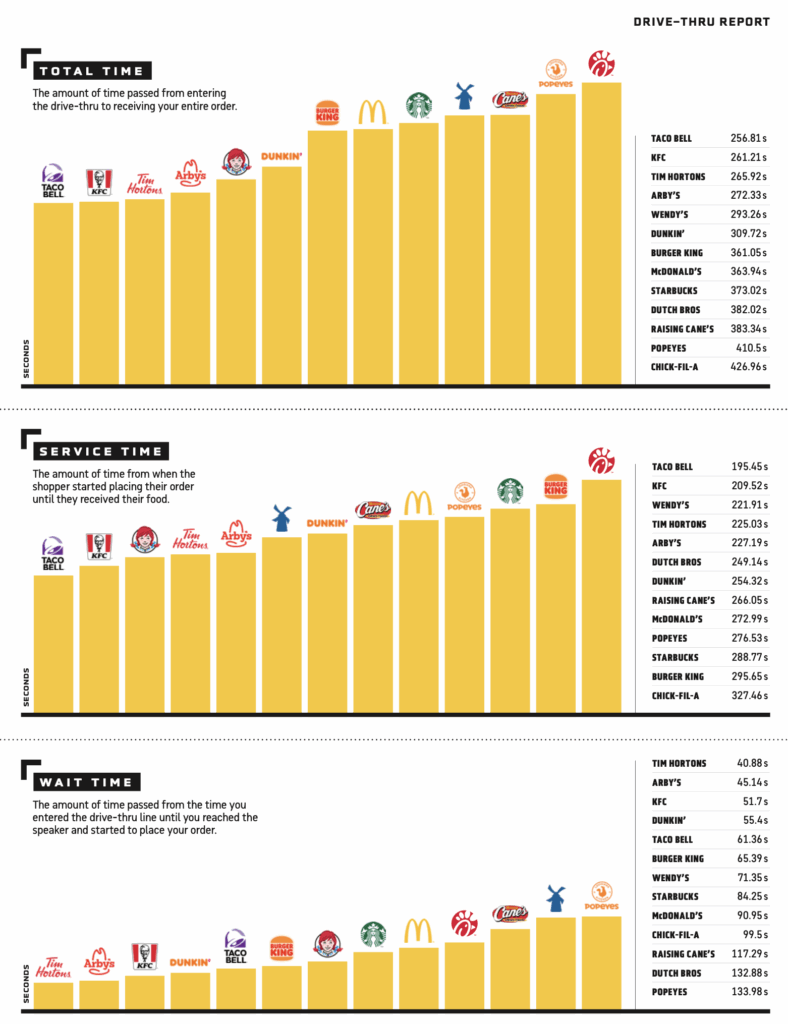
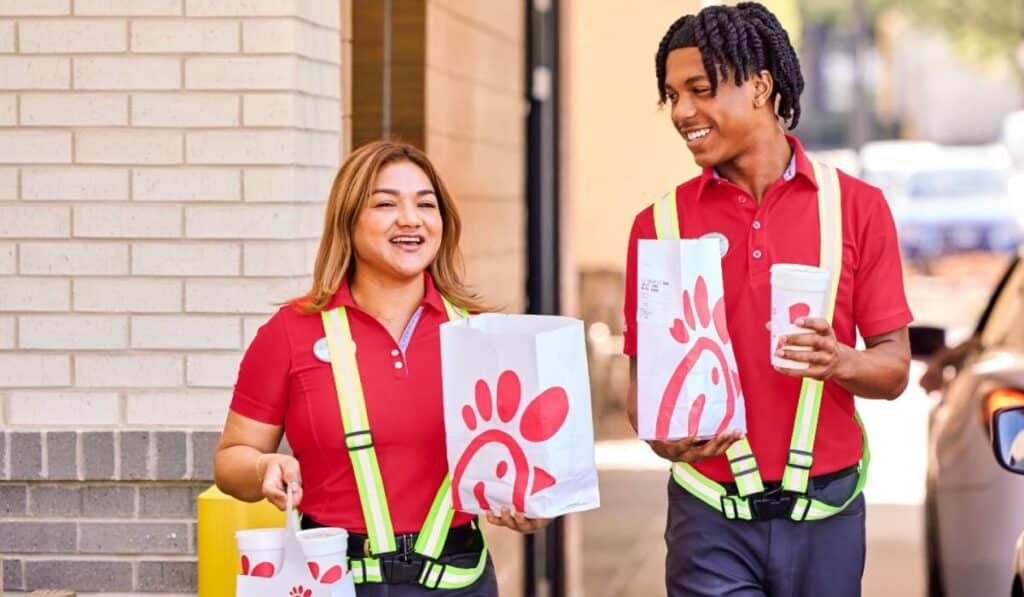
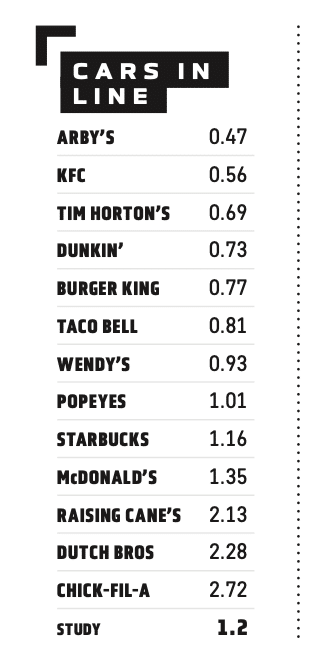
Chick-fil-A sits generally at the bottom of the speed of service chart for total time. Yet it’s a contextual swatch of data. Freestanding or drive-thru-only units averaged median sales of $9.227 million in 2024. More than 1,000 of the 2,179 Chick-fil-As measured, or 49 percent, beat the average sales volume of $9.317 million. One was at $19.319 million. So Chick-fil-A locations are, as a general truth, busier than other brands. And the flow of ordering differs with in-line order-takers versus a speaker box.
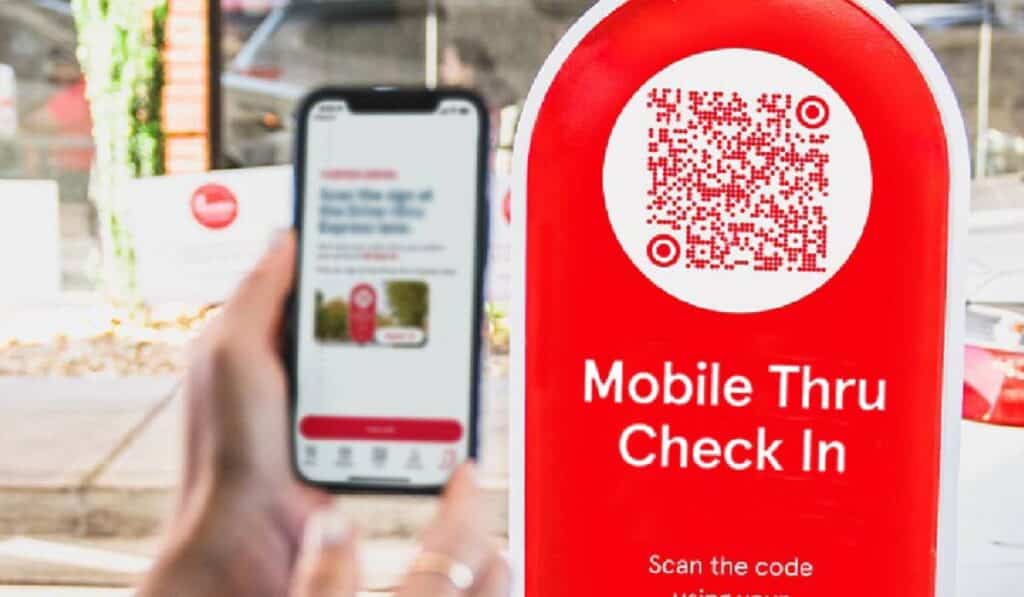
Birkeli says technology has become a way for Chick-fil-A to complement, not replace, the human connections diners expect from the brand. Innovations like face-to-face ordering tablets, dual-lane drive-thru designs, and “Mobile Thru Pickup,” which Chick-fil-A launched to enable app customers to roll through and speed up service (and improve accuracy). This, all while keeping interactions along the way, no matter which route, personal.
“Looking ahead,” she says, “we’re exploring how emerging technologies, such as intelligent queue management and enhanced personalization, could make the experience even more seamless, while keeping hospitality at the heart of it all.”
Friendliness proved again to be one of the most crucial triggers. When an employee was friendly, overall drive-thru satisfaction clocked in at 97 percent. At neutral, it slid to 82 percent and plunged to 22 percent for not friendly. Order accuracy was also 89 percent at the top, 81 percent for neutral, and 80 percent for not friendly.
Friendliness led to faster service at 323.8 seconds. That slowed to 366.9 seconds at neutral and 417.5 for not friendly.
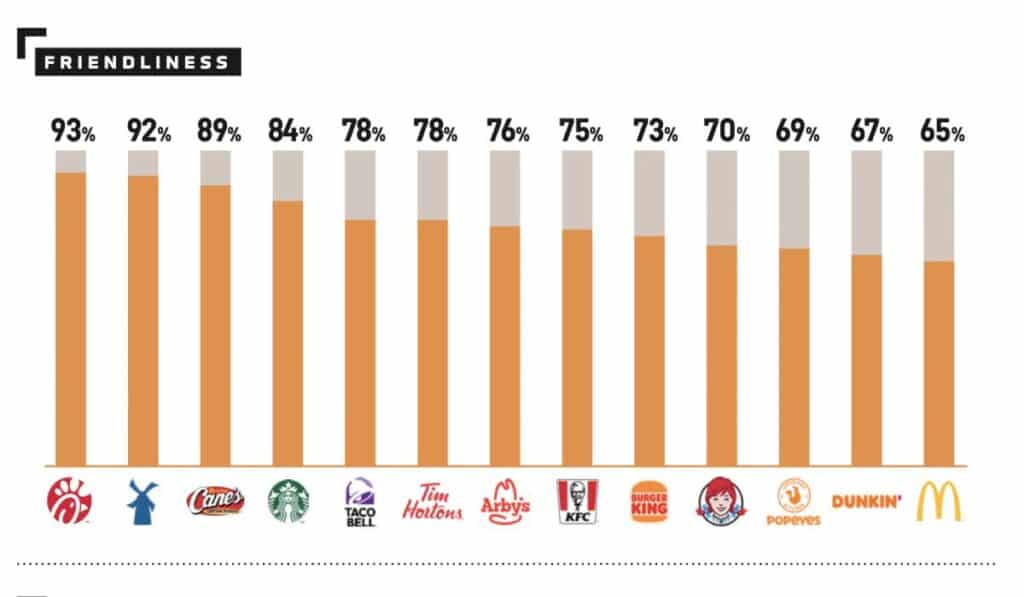
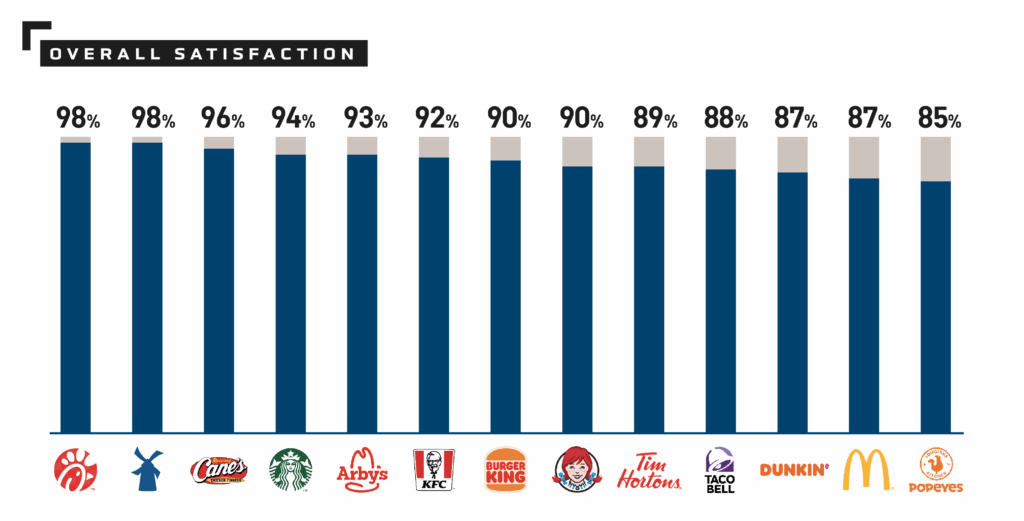
Unsurprisingly, drive-thrus considered “friendlier” created higher overall results.
More than 50 percent of Inspire Brands’ U.S. sales come in the drive-thru lane. Vans Nelson, SVP operations innovation at the Dunkin’, Baskin-Robbins, Arby’s, Sonic Drive-In, Buffalo Wild Wings, and Jimmy John’s owner, says that mix (70 percent for Dunkin’ across drive-thru, mobile ordering, or delivery) means the company, understandably, takes excellence in the channel “incredibly seriously.”
And like Mathews, Nelson starts the execution discussion with value. “Interestingly,” he says, “consumers define value differently. They might associate it with pricing, quality, service, or a combination of all three. For many of our guests, their time, experience, and cost are all part of the value equation, which makes the drive-thru an essential part of our brands’ success.”
It’s morphed toward a puzzle of service, accuracy, speed, convenience, and accessibility as competition mounts.
Peter Perdue, chief operating officer at Burger King U.S. and Canada, adds guests continue to seek food quality, accuracy, and service from hospitable employees in a clean environment.
“Cleanliness in the drive-thru can be just as important as inside the restaurant, including the premises of the restaurant, the drive-thru speaker box, the signage, and windows,” he says.
Nelson notes speed of service will always be a priority, especially for brands like Dunkin’, where the goal started with a slogan to “keep America running.” Accuracy, though, climbed the KPI ladder in recent years. Nelson says an increasingly digital world, with smarter technology, has rendered order accuracy a “minimum expectation.”
“[Consumers] expect to see their order on a digital menu board and be able to make changes in real-time, and team members expect a system for preparing and organizing orders that is detailed, intuitive, and seamless,” he says. “It is only by providing a transparent ordering experience for our guests and an efficient fulfillment process for our team members that we can meet those foundational requirements.”
Dutch Bros, which eclipsed 1,000 locations in 2025 and believes it has a total addressable fleet of more than 7,000 U.S. units, topped the accuracy pack in its first year on the Report. Overall, accuracy in 2025 was 87 percent compared to 89 percent in 2024 (worth considering the new brands factored in).
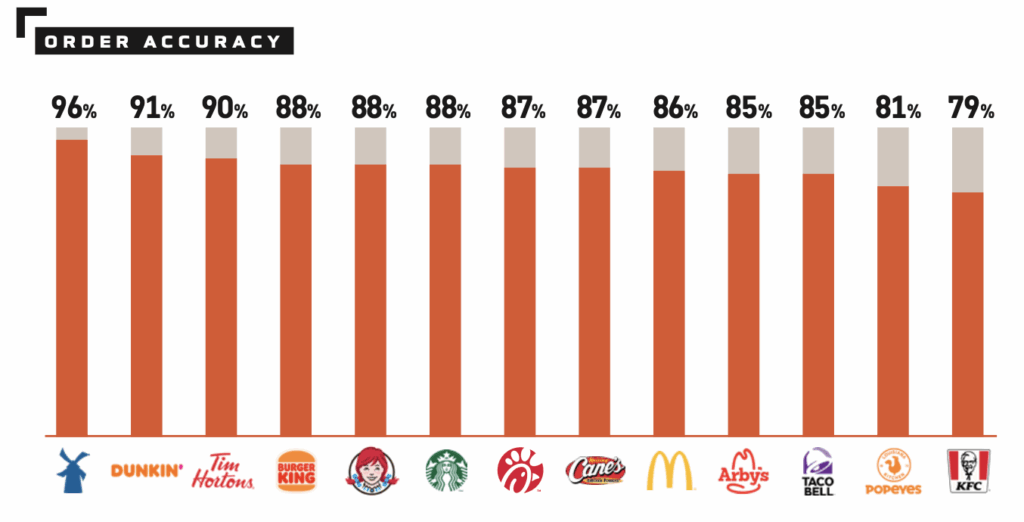
The metric, akin to speed, has multiple levers to consider. While the presence of an order confirmation board, for instance, had little impact on order accuracy, using it to its full potential did, in fact, impact scores. Order accuracy was 26 percentage points higher when the display of the OCB was correct. Brands scored only 64 percent when the board was not correct, indicating employees typed the order in wrongly. So, by having customers confirm if the OCB is accurate, Intouch Insight said, operators can catch errors early.
Quality speakers mattered as well. Order accuracy was 16 percentage points loftier when the interaction via the speaker was clear and understandable compared to when it wasn’t. It was 12 percentage points better when the shopper did not have to repeat their order. And it was 11 points higher when the volume was loud enough to hear the employee.
Speakers materially impacted speed, too. Total time was a minute and 25 seconds faster when the shopper did not have to repeat their order. It was 54 seconds better when the interaction via the speaker was clear and understandable. And total time improved by 29 seconds when the volume was loud enough to hear the employee.
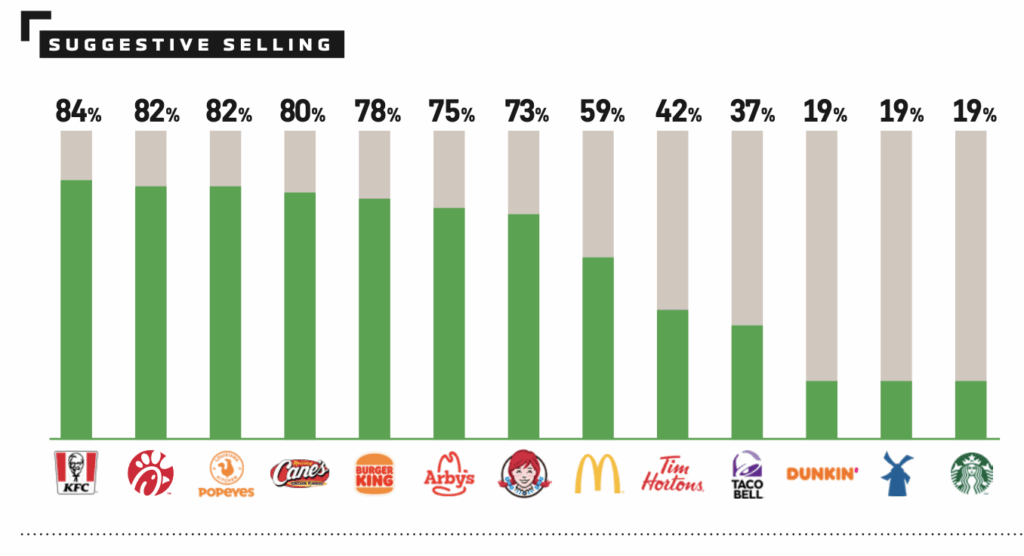
Suggestive selling improved speed of service, but only when offered after placing an order. The study average was 335.4 seconds. Time lowered to 327.5 seconds when suggestive selling was offered afterward. When a suggestive sell was offered with greeting, it was higher at 364.2 seconds.
The quick-serves visited in this year’s Report were most accurate during the afternoon (1:31 p.m. to 4 p.m.) at 90 percent. Lunch was 87 percent, breakfast 88 percent, and dinner lagged at 86 percent.
Perdue says Burger King has new frontiers of technology available to address the many facets of execution, but remains focused on maximizing what’s available today, such as OCBs. It wants outdoor assets to present food in a way that’s craveable and easy to navigate, and for screens to have no downtime, with accurate sync deployments throughout the year when stability updates and new menu experiences are released. “And we want our guests to be able to hear our team members clearly and accurately, and likewise, we want our team members to be able to hear our guests clearly when ordering at the speaker box,” he says. “Our focus is to ensure technology serves its purpose and allows for clear and accurate communication between our team members and guests.”

Accuracy has, without doubt, become as valuable as speed in drive-thru performance. It was 85 percent in 2019, 84 percent in 2019, and 87 percent in 2020. Since, it’s come in at 85, 85, 86, 89, and 87 percent, respectively from 2021–2025.
Innovation in the lane
While the bar has been raised and drive-thrus work to fend off rising channels, they do have more systems to meet the call.
Nelson says Inspire performs time-motion studies and complexity analysis to measure the impact of drive-thru on overall guest experience. “Getting guests in, out, and on their way as frictionlessly as possible with an accurate, delicious order remains our focus and what guests expect from us,” he says.
Mathews mirrors Nelson’s note on collecting data and responding. Taco Bell has a “test-and-learn” mentality, he says, to identify technology that drives improvement, like Voice AI, ConnectMe (omnichannel integrated loyalty), and digital menu boards—all of which work together to create a faster, smarter, and more relevant drive-thru experience.
“These tools reduce friction and enhance the customer journey in real time,” he says. “The next frontier is full ecosystem orchestration, where every digital touchpoint, from loyalty to kitchen operations, works in harmony.” Taco Bell has an ace in this game with Byte by Yum!, a unified, AI-powered restaurant technology platform the KFC, Pizza Hut, and Habit Burger & Grill parent company unveiled in February. It enables Taco Bell to deliver scalable innovation by unifying everything from point of sale to inventory.
What’s unfolding across the wider drive-thru lexicon, though, is an internal and external makeover. Byte by Yum! is being joined, regarding Taco Bell, by more digitally equipped locations and some flashy outliers, like the two-story Defy restaurant in Brooklyn Park, Minnesota.
Chick-fil-A, too, has a double-decker asset it calls the Elevated Drive-Thru concept. Introduced in late summer 2024, the store separates its kitchen above from four lanes below, with a proprietary conveyor system to deliver meals to consumers in their cars. It was built to house 75 vehicles at once.
Additionally, at select stores, Chick-fil-A says it’s deploying drone technology to take a sky-high approach to studying drive-thru operations. “With the help of drone footage and our teams’ analysis, the operator can use the ‘game film’ to study their restaurant’s drive-thru traffic patterns and improve efficiency during peak times,” Birkeli says.
The Mobile Thru feature, which gives customers a chance to order ahead and get into designated lanes, has spread to more than 300 restaurants. And, to further alleviate capacity and reduce wait times, Chick-fil-A says it’s working on refining face-to-face ordering by positioning employees with tablets deeper out in the line.
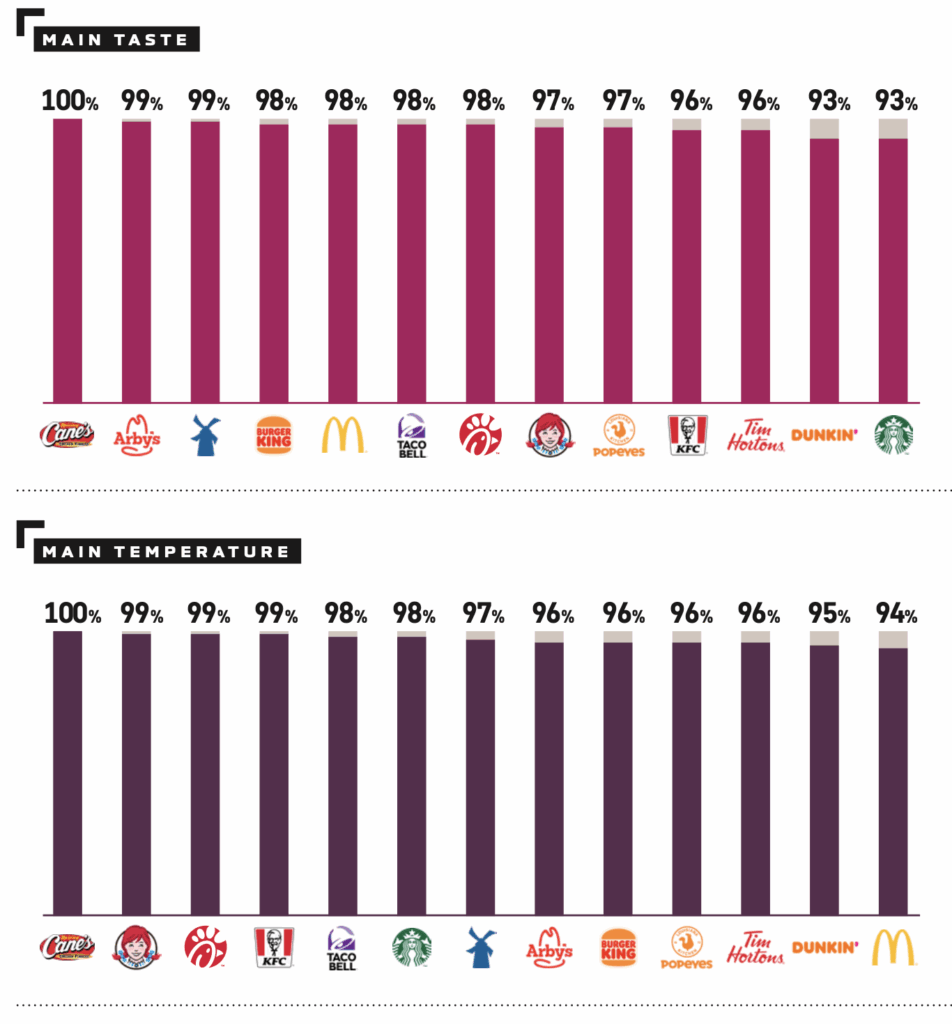
“Lastly, we are in the process of adding enhanced signage and portable menu boards in all restaurants by the end of the year to make it easier for customers to see their options before ordering,” Birkeli says. “While less technology-driven, this simple, thoughtful update has improved the overall experience by reducing confusion and helping customers feel more confident about their choices as they enter the drive-thru.”
So much of the drive-thru experience is a blend of perception and execution. How can fast food continue to reimagine the journey as convenience paths widen?
Mathews highlights ConnectMe, Taco Bell’s new loyalty experience mentioned before. Customers check in via code with an employee, which allows them to earn points and access rewards without needing to order ahead on the app.
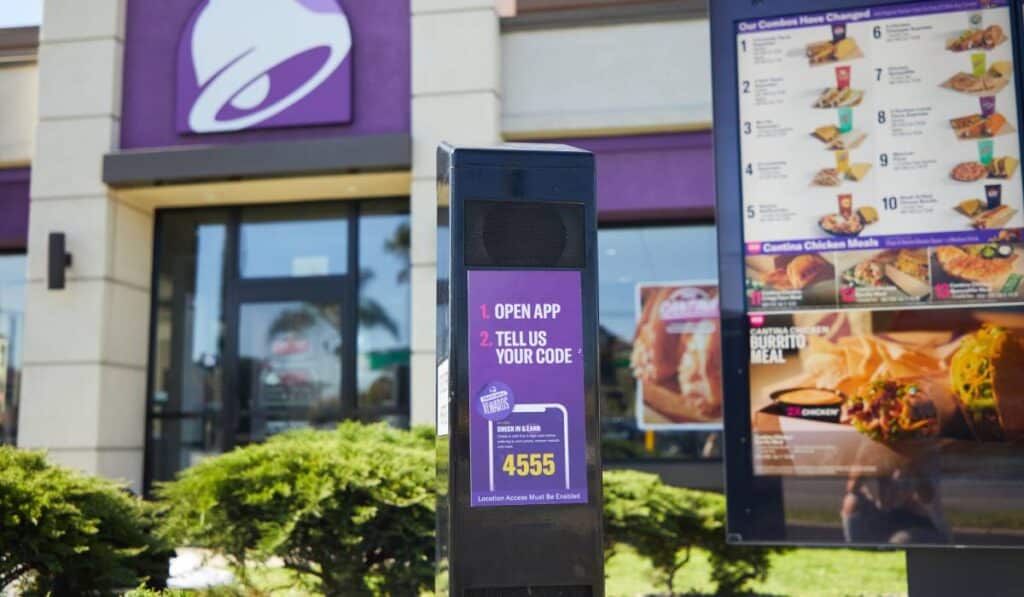
It’s another example of the drive-thru growing up to keep pace. Mathews says the system democratizes loyalty while maximizing Taco Bell’s ability to personalize the drive-thru, enabling features such as drive-thru reward redemptions, name recognition, tailored offers, and even hands-free payment for customers with stored credit cards. It’s available in more than 7,500 Taco Bell drive-thrus. “… it’s subtle in execution but transformative in deepening brand connection through routine moments in the most ubiquitous channel,” he says.
Nelson adds the most powerful drive-thru tools tend not to be the flashy ones. Back-of-house technologies, including intelligent inventory management, automated scheduling, and conversational point-of-sale systems, are essential to delivering experience to guests and team members.
A smooth and intuitive in-app ordering flow, he adds, improves guest metrics. When ordering ahead these days, customers need to know where, when, and how they can secure their food. “So we think of the drive-thru experience beginning well beyond the traditional parking lot,” Nelson says.
“I’m excited to see the drive-thru lane get even smarter,” he continues. “Geofencing for mobile orders can make our timing more accurate and efficient, driving throughput optimization. We’re already seeing automation like chatbots enhance the guest and team member experience, so design upgrades such as robotics and food delivery systems embedded in the building will be exciting.”
Inspire has been upgrading digital menu boards so it can tap real-time updates and order confirmations. All are critical, Nelson says, to building trust during the ordering process.
The company is also actively testing drive-thru transport systems to unlock throughput capacity and execution for on-arrival and third-party channels. Beverage systems are being reimagined as well, Nelson says, to strip complexity and simplify employee involvement. And Inspire is piloting next-generation drive-thru timers powered by AI camera vision to track the guest journey and provide insights.
A common thread among brands this year was an understanding of the thread between performance and how easy it is to work in a restaurant.
Nelson says the most effective way to ensure guest satisfaction is to do the same for employees. “When team members are well-equipped with technology, fully staffed, and thoroughly trained, they can excel and thrive in every interaction, resulting in significantly more positive guest experiences,” he says.
For example, with AI investments like smart scheduling and inventory management, an Inspire GM can spend more time with their team and customers and confront challenges. They can build relationships with guests rather than get stuck running payroll.
“Simple design features, such as mobile order pickup lanes and digital menu boards, are also critical to making every interaction between a guest and team member smooth and effective,” Nelson says. “Eliminating potential frustrations and making every guest’s intention clear is a major driver of team member satisfaction. At Inspire, we design, build, and operate every drive-thru with hospitality at the heart—and our key performance metrics clearly reflect that commitment.”
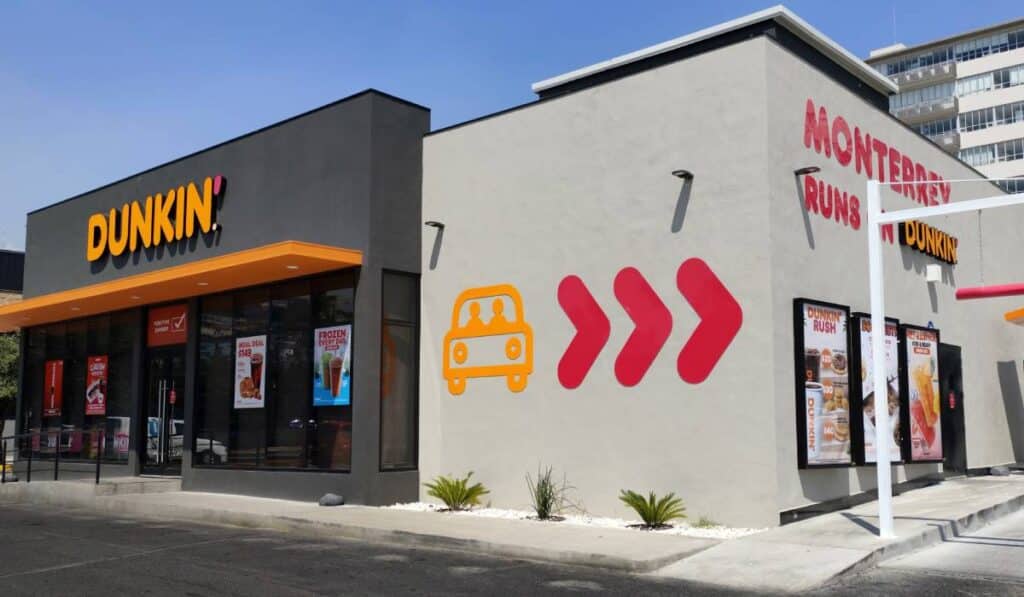
Mathews says every technology advancement at Taco Bell is made in service to helping employees deliver exceptional service, “thus improving customer experience.”
Voice AI (as we’ll get more into shortly) doesn’t merely take orders, Mathews explains—it eases the workload for employees so they can spend additional time engaging with guests. ConnectMe powers a diner’s preferences and relationship with Taco Bell to then be leveraged by team members, “unlocking a new level of hospitality right at the drive-thru window,” Mathews says. Byte by Yum! provides tools to reduce complexity and place the focus back on customer-facing opportunities.
Chick-fil-A’s Birkeli adds she’s been inspired by how operators take the brand’s signature hospitality in-store and apply it at the drive-thru. The goal being to meet a guest’s unique needs by channel while still delivering the same Chick-fil-A experience across every interaction, without compromising on speed. “Hospitality is truly woven into everything we do,” she says. “We design technology and processes to support our team members, enabling them to spend more quality time engaging with customers—whether through a warm greeting in line or a thoughtful interaction at pickup.”
The Elevated Drive-Thru, in McDonough, Georgia, incorporates dedicated pull-aside lanes for employees to ensure customers have everything they need before they leave. Chick-fil-A also introduced doors near the drive-thru pickup area where team members can step outside and hand meals directly to customers. That creates a more personal, seamless interaction, Birkeli says, than passing food through a traditional window.
“Alongside technology advancements, operators are also bringing local engagement and community-building into the drive-thru, much like they’ve done for years in their dining rooms,” she notes. “From seasonal celebrations to thoughtful touches during special events, operators continue to find ways to create meaningful experiences for our customers at every touchpoint.”
Burger King is in the process of rolling out a PAR point-of-sale system with hopes of having a more reliable and productive tool, Perdue says. This will help employees solve problems for customers currently too difficult to manage, such as product outages due to equipment maintenance or inventory depletion. “We’re always trying to avoid offering a product to guests that isn’t available, knowing the frustration and confusion this can lead to on both ends,” he says.
And echoing others, Perdue feels the most near-term value with AI comes with solutions that make employees’ jobs simpler.
Burger King recently developed an employee and restaurant manager tool that takes a variety of data feeds and helps teams prioritize service or activities and see, live, things they can do to better serve the guest. One application is a large language model that produces data around employee interactions with customers. It helps Burger King understand if there are items diners ask for that aren’t available. “From there, the restaurant can use that data to implement a sold-out solution, improving the guest experience and operations,” Perdue says.
The (ongoing) story with AI
AI voice order taking at the drive-thru has peeked through the Report in recent years. But it was more of a theoretical disruptor than something you could measure. Most of the consumer survey points were hypothetical—questions like, “would you consider” or “are you open.” Plainly, there weren’t enough touchpoints to gauge performance, both from a sentiment standpoint as well as whether it was actually working. That is starting to change, however. Like we spotlighted in QSR’s Emerging Experience Report from earlier in 2025, Intouch Insight mystery shopped AI and core locations to juxtapose results.
Starting with ordering, speaker quality was slightly higher at AI restaurants, but more customers had to repeat their orders.
Clear and understandable speaker
- AI locations: 98 percent
- Core locations: 93 percent
Speaker volume
- AI locations: 96 percent
- Core locations: 95 percent
Had to repeat order
- AI locations: 34 percent
- Core locations: 22 percent
Suggestive selling
- AI locations: 71 percent
- Core locations: 58 percent
Taco Bell has fast become one of the front-line drivers of drive-thru AI. Its Voice AI has rolled to more than 500 drive-thrus, making it the largest such activation in the industry, Mathews says.
He explains AI earns its place in the restaurant business by creating transformational outcomes for customers and employees. That’s usually how you make a case in QSR. For Taco Bell, automating order taking frees employees to focus on more “meaningful moments of hospitality and customer interaction,” Mathews says.
“Behind the scenes, AI is enhancing back-of-house operations, too, from smarter inventory management to streamlining workflows,” he adds. “We’ve even seen reduced team member turnover in high-usage AI locations, proving that thoughtfully implemented AI can not only support team members, but improve restaurant culture.”
Customers, he continues, get more relevant communications and guidance finding food options across the menu, faster. “Over time,” Mathews says, “AI will be at the center of orchestrating Taco Bell’s drive-thru transformation for both customers and team members.”
AI is a less visible (compared to Taco Bell), yet no less revolutionary part of the workings at Inspire. Nelson says the company’s approach is to discover solutions integrated into real-time decision making, workflow optimization, employee experience, and guest interactions.
Inspire sorts AI through two lenses—“Big” and “Little.”
“Little AI” quietly drives speed, efficiency, and improved interactions. It is often operational and includes things like conversational point of sale, predictive staffing and scheduling, prep optimization, real-time offer targeting, equipment diagnostics, and product inventory management.
More often, Nelson says, people hear about “Big AI” moves—transformative systems that customers and employees see and interact with. Imagine drones, chatbot ordering, robotic frying equipment, and drink machines. “These innovations are exciting to develop because they reshape how guests engage with our brands and how our team members serve them,” he says.
However, much of the current impact stems from “Little AI,” where seemingly small unlocks and adjustments elevate restaurants by improving efficiency and enhancing service.
“As AI continues to transform the industry, we remain focused on leveraging its potential to build a more seamless operational ecosystem—and to keep raising the bar across our restaurants,” Nelson says.
Returning to the larger Report, AI locations and core restaurants surfaced similar wait times. Service metrics for AI stores, though, were 21 seconds faster.
Wait time
- AI locations: 81.8s
- Core locations: 80.8s
Service time
- AI locations: 232.8s
- Core locations: 254.6s
Total time
- AI locations: 314.6s
- Core locations: 335.4s
AI restaurants mystery shopped also scored higher in overall satisfaction despite having lower friendliness and order accuracy scores. Scores for food quality were similar.
Overall satisfaction
- AI locations: 97 percent
- Core locations: 91 percent
AI tone
- AI locations: 68 percent
- Core locations: N/A
Overall friendliness
- AI locations: 72 percent
- Core locations: 78 percent
Order accuracy
- AI locations: 83 percent
- Core locations: 87 percent
Main item temperature
- AI locations: 99 percent
- Core locations: 97 percent
Side item temperature
- AI locations: 95 percent
- Core locations: 95 percent
Main item taste
- AI locations: 97 percent
- Core locations: 97 percent
Side item taste
- AI locations: 96 percent
- Core locations: 95 percent
In the Report, there was a 21 percent employee intervention rate because AI couldn’t answer a question, comprehend customization, or an item was out of stock. So, there is still room to grow.
AI took my entire order
- Frequency: 72 percent
- Order accuracy: 81 percent
- Overall satisfaction: 97 percent
- Friendliness: 72 percent
AI began taking my order but was transferred to an employee
- Frequency: 21 percent
- Order accuracy: 95 percent
- Overall satisfaction: 95 percent
- Friendliness: 73 percent
A clear piece of runway for AI voice ordering is to improve accuracy (scored 4 percentage points lower than core stores at 83 versus 87 percent). Sixty-two percent of incorrect orders were due to customization.
Overall, AI will slot in alongside drive-thru staples as the category expands.
Mathews says the “drive-thru of the future” will belong to brands designing it today. In many ways, Taco Bell is already operating it.
“We believe this experience is human first, hospitality-powered, and enabled by software,” he says. “We see the potential for the drive-thru experience to move from speed and convenience to intuitive and memorable. As we go forward, our unique, innovative spirit will blend technology and human experiences in ways that enhance the everyday.”

Nelson adds Inspire’s horizon is being curated through a blend of technologists and seasoned operators. By balancing the two, the company is harnessing the power of AI, automation, data integration, and personalization, combined with the operational knowledge of GMs and operators.
It’s nearing a system—being ideated at Inspire’s Innovation Center—where drive-thrus recognize returning guests, remember their favorite items, and recommend tailored add-ons.
“As we improve the digital experience through our apps and loyalty programs, we are maximizing the value of our guests’ time,” Nelson elaborates. “We’re also working on some really exciting real estate innovations that maximize the use of square footage and are equipped for a digitally driven experience. At Inspire, my role is to ensure that when guests choose our brands, they can expect a smooth, clear, and personalized ordering experience that translates to a matching fulfillment experience.”
Customers will take the category where it heads next, Birkeli says. “The drive-thru of the future starts with customers at the center—combining convenience, personalization, and care in one seamless experience,” she says of Chick-fil-A. “Future KPIs will still include speed, accuracy, and friendliness, but also measure how well we anticipate and meet individual customer needs, creating an experience that feels personal even during the busiest restaurant hours.”
And no matter what evolves or ideates, “convenience” is the reason the drive-thru exploded across America many decades ago. That won’t change, even if the parameters do. “Parents don’t want to have to unbuckle the kids and take them out of the car seats on each trip, and they want an enjoyable break with good quality food, at a fair price with trustworthy ingredients and served with helpful and friendly service,” Burger King’s Perdue says. “And all our guests want reliable and consistent experiences from Sunday through Saturday, at breakfast, lunch, and dinner. Our KPIs will remain anchored to serving individual or large groups well—with excellent quality, friendliness, and efficiency. Less than a 5-minute overall speed of service is appropriate when offered with a high level of quality and friendliness. The future of the drive-thru in a lot of ways means getting the basics right.”
Drive-Thru Study Methodology:
- 165 mystery shops per brand
- June-July 2025
- Shops were distributed across various times of the day for a representative sample of consumer purchasing
- patterns throughout the day
- Geographically distributed across the U.S.
Brands included:
- Classic: McDonald’s, Burger King, Wendy’s, Taco Bell, Arby’s
- Chicken: Chick-fil-A, KFC, Popeyes, Raising Cane’s
- Beverage: Dunkin’, Starbucks, Dutch Bros, Tim Hortons
Voice-AI Ordering:
Additional 40 mystery shops at three brands for a total of 120 shops.
Definitions:
- Wait Time: The amount of time passed from the time you entered the drive-thru line until you reached the speaker and started to place your order.
- Service Time: The amount of time from when the shopper started placing their order until they received their food.
- Total Time: The amount of time passed from entering the drive-thru to receiving your entire order.
- Window Time: The amount of time passed from arriving at the food pickup window to receiving your entire order.
- Total Time by Cars in Line: The average amount of time passed from entering the drive-thru to receiving your entire order, divided by the average cars in line.
SPONSORED BY: