
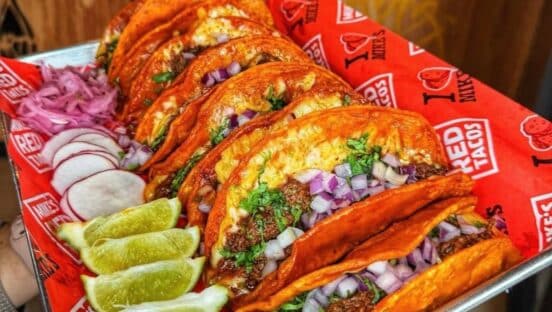
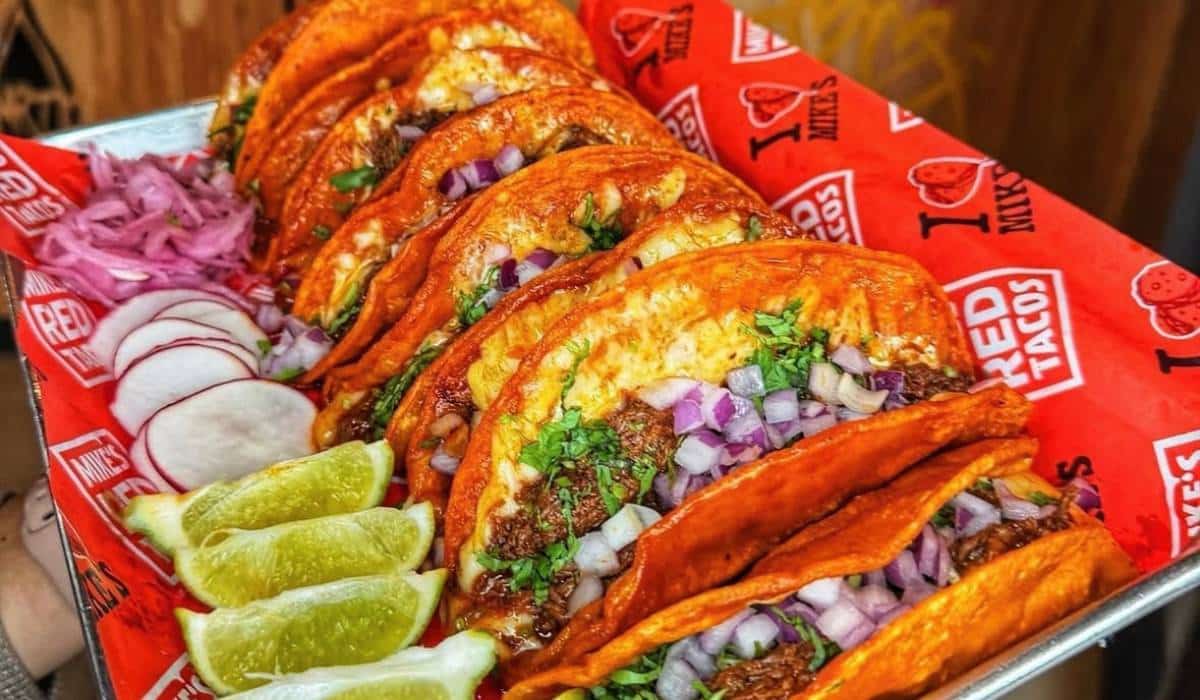
Three-unit Mike’s Red Tacos did not begin with a sweeping national plan. It started with a food trend, a friendship, and a suggestion to think bigger.
CEO Andrew Feghali had known founder Mike Touma for roughly a decade when Touma approached him with an observation. Birria was gaining traction, and he believed the Mexican specialty could follow a path similar to hot chicken. Feghali brought experience from a franchise portfolio of roughly 100 restaurants across Little Caesars, Jersey Mike’s, and Dave’s Hot Chicken, where he was the first franchisee.
The pair spent several weeks visiting birria concepts and sampling the food. Touma initially envisioned selling birria tacos from a trailer stationed outside one of his retail shops. Feghali saw room for a full restaurant.
“I said, OK, I think that’s cool. I think you should think a little bit bigger, and open a restaurant. I think you’re onto something interesting here,” Feghali says.
Touma later asked Feghali to become his partner. They leased a food truck, and Touma developed the brand, selling tacos on Saturdays in a friend’s parking lot beginning at 11 a.m. and continuing until the food ran out. He eventually opened the first brick-and-mortar restaurant, which landed on Yelp’s list of the top 100 restaurants in the U.S. within a few months. That early recognition offered proof that the concept could attract diners outside its initial following. It also gave the partners a foundation for turning a single restaurant into a franchise opportunity.
Feghali then organized the investment group behind the franchise platform, called Four Wall Partners. The idea gained traction faster than its partners anticipated. The company has sold roughly 350 franchise commitments and has several hundred more in its pipeline, Feghali says.
That acceleration changed his role. Feghali had been an active board member offering strategic guidance to the corporate team. As the company added employees and awarded large territories, partner and mentor Bill Phelps encouraged him to become CEO. Feghali was initially reluctant.
He was content serving as an investor and board member. Conversations with Phelps changed his perspective. He came to see the position as a way to serve the company’s stakeholders and advance Four Wall Partners’ mission of transforming lives across its franchise systems. With close friends joining the corporate team and becoming franchisees, Feghali felt responsible for giving the brand its best chance to succeed and honoring the trust placed in him.
The personal stakes were clear. Touma was a longtime family friend who trusted Feghali to assemble the deal, and new hires had left good jobs or declined other opportunities to join the company.
“The executive team are folks that have come on board that have left great jobs or passed on other great opportunities because in large part they trusted me,” Feghali says.
Operators signed because of the food, category, and business model, he says, but personal trust also influenced their decisions. Taking the CEO job became a way to honor the people committing careers and capital to the venture.
“I really feel like it’s more of a service role than something that I had wanted,” Feghali says. “I didn’t have aspirations of becoming CEO of an emerging franchise brand.”
Mike’s has its own identity and origin story, though Feghali acknowledges parallels with Dave’s. Each specializes in a segment of a much larger category. Dave’s helped propel Nashville hot chicken into the national conversation. Mike’s sees similar potential for birria within fast-casual Mexican.
Feghali says consumer awareness and menu penetration for birria are tracking on a trajectory similar to hot chicken several years ago. More valuable than that category comparison is the franchise playbook he witnessed as Dave’s first operator.
Phelps told Feghali early in their relationship that he wanted franchisees to become wealthy. The statement stood out because Feghali had rarely heard a franchisor speak so directly of operator prosperity. The logic was practical. Successful operators can recruit stronger employees, offer better pay, build stores faster, and invest more in their organizations.
Dave’s routinely examined franchisee return on invested capital, store costs, and guest sentiment. It also questioned common restaurant conventions instead of accepting them by default, Feghali says. Digital menu boards, for instance, might be widespread, but their cost still warrants testing.
“It’s really the mindset of never settling and questioning everything,” he says. “It sounds so simple, but it’s these uncommon things that you’ll find across the industry.”
Mike’s is preparing its corporate structure ahead of restaurant openings. Feghali says staffing an emerging chain according to its current size is a common recipe for failure. His company is hiring for the organization it expects to become one or two years from now.
President and COO Vincent Montanelli spent years at Wetzel’s Pretzels, including stints as COO and brand president, and helped grow the chain from roughly 80 locations to 400. CFO Stephen Jennings brings decades of restaurant experience, including prior CFO roles with Marie Callender’s and Ruby’s Diner.
Chief development officer Patrick Cunningham previously worked at Little Caesars. Senior vice president of operations Lance Salsman has experience with Blaze Pizza, Taco Bell, and Pizza Hut. Vice president of real estate Nate Zelazoski joined from Five Guys.
Each was handpicked from Feghali’s network or recommended through a direct connection. Touma also has a formal corporate position as founder and chief brand officer. He oversees the traits that distinguished the concept from its food-truck days, with particular attention to product quality and authenticity.
“He’s really our north star,” Feghali says. “Everything that Mike does is in service of preserving the authenticity of the brand and of the food, and he is just a stickler on making sure that whatever we do, we keep that quality.”
Feghali views his history as a franchisee as an advantage in the CEO seat. His decisions start with protecting the people who have made meaningful commitments to the company, whether they work for the franchisor or operate its restaurants. He also has access to experienced advisers on the team and board, reducing the need to solve every franchising problem alone.
That operator-first outlook is guiding franchise sales. Mike’s is seeking experienced, well-capitalized multiunit groups, especially those familiar with emerging concepts. Every approved franchisee has met the team in person, sampled the food, and spent time with Touma. Feghali considers enthusiasm for the product essential. The preferred partners are customers who want the restaurant in their communities and are eager to introduce it to friends.
The commitments give Mike’s a large runway, but Feghali does not view contract totals as the chief measure of progress. The company is privately held, giving it room to match openings with its capacity. Stores will move forward when qualified franchisees secure suitable real estate, hire capable operators, and demonstrate that they can uphold the guest promise.
“We’re going to open restaurants at a pace that we’re comfortable with, full stop,” Feghali says. “It’s not a sprint, it’s a marathon.”