

The fact Yum! Brands divested Pizza Hut earlier this month, splitting the chain from KFC for the first time in nearly four decades, should signal the company is prepared to make bold moves, CFO Ranjith Roy said.
Could that include adding another concept to accompany the chicken giant, Taco Bell, and fast casual Habit Burger & Grill? Sure, if it makes sense, Roy shared at the Barclays Annual Global Consumer Staples Conference. “We’re open to the idea,” he said.
But meanwhile, Yum! feels it has plenty to occupy its calendar with what’s already here. Roy said portfolio discipline sits atop the company’s near-term targets. And if you examine the number of opportunities ahead, “we could spend all day right now accelerating growth at KFC, Taco Bell, and Habit, and we wouldn’t have much time to spare,” he explained.
Roy noted 2027 will be an “extraordinarily exciting year” for Yum! Brands as investors and competitors get their first clean look at life post-Pizza Hut, which comprised about 10–12 percent of its operating profit.
Naturally, though, Pizza Hut took ample time, resources, and focus to manage a 15,500-unit system generating $10 billion in annual systemwide sales. The sale came after several years of declining domestic performance and shrinking units counts. In Q1, U.S. same-store sales slid 4 percent and systemwide figures 6 percent. Across fiscal 2025, Pizza Hut’s comps declined 5 percent and systemwide 8 percent on top of another calendar of red performance in 2024.
Pizza Hut finished the period with 6,121 U.S. restaurants, down from 6,551 five years earlier.
Yum! agreed to deal the 1958-founded chain—excluding Mainland China—for $1.5 billion to LongRange Capital. Yum! China assumed control of the other part for $1.2 billion.
It marked the first time in 54 years Pizza Hut was private. It was 14 years old in 1972 when it began trading. Atari released Pong that year.
More largely, Yum!’s roots track to 1977 when PepsiCo was a decade into plans to diversify beyond beverages after merging with Frito-Lay. It bought Pizza Hut and, a year later, tacked on Taco Bell. KFC joined in 1986.
Yum! materialized in 2002 following PepsiCo’s 1997 shift toward drinks and snacks and the decision to spin-off its brands into Tricon Global Restaurants. Long John Silver’s and A&W arrived five years later and Yum! was created (those latter two were sold in 2011 and Habit acquired in 2020).
History aside, though, Roy said Pizza Hut exiting the portfolio means Yum! can divert its energy into an “acceleration of growth.”
CEO Chris Turner, who elevated to the role about a year ago (October), succeeding 37-year company veteran David Gibbs, has been out talking about raising the bar, Roy said. That includes the battle for the future consumer, propelling unit economics, and expanding the reach of Yum!’s proprietary tech platform, Byte, which was introduced in February 2025 as an online and mobile app ordering, point of sale, kitchen and delivery optimization, menu management, inventory and labor management, and employee tool unifier across the system.
“There’s a number of work streams underway at the company right now that will start to play out over the course of the rest of this year and 2027,” Roy said. “And just the freedom to be able to pursue them with more focus, having a more concentrated portfolio is very exciting.”
So, regarding the notion of buying another chain, the lead focus for Yum! will first be asking, has it raised the performance of its existing brands? Even sans Pizza Hut, it’s a portfolio spanning 34,747 KFCs (Q2 close), 9,046 Taco Bells, and 388 Habits. “Our first priority is investing in our current businesses,” Roy said. “We’ll continue to do that. We’ve done that historically. We’ve never starved the businesses of investment.”

Where investments are headed, where consumers are taking restaurants
Roy’s presentation opened with a high-level view of consumer sentiment. Over recent months, two words kept surfacing as Yum! observed global trends: resilient and discretion.
Whether it’s wages, low unemployment, or other external anvils, the QSR customer has held up better than some expected. This, however, isn’t so much a “where are they spending” debate as a “how” and “when” one, Roy said.
Yum!’s diner, not dissimilar to other restaurant brands, has reported strength across the high-income bracket. Less so for households earning less than $100,000 per year.
Additionally, it’s a consumer making choices, he explained. “And the divergence in performance in our industry, I think, has never been higher than it is right now,” Roy said.
People still want to eat out and are using restaurants as an affordable luxury. Yet they continue to make distinct choices about what they want (and don’t want). That chasm of performance continues to show, especially in the U.S.
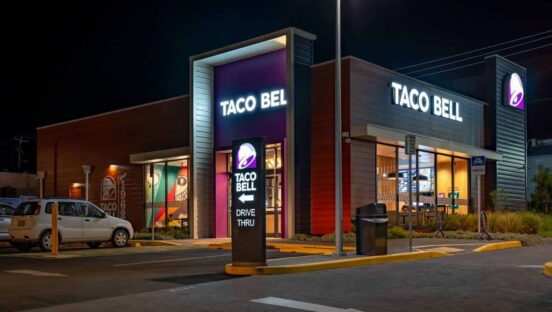
Just look at Taco Bell, Roy said. It posted mid- to high-single digit same-store sales growth in Q1 and Q2 (8 and 7 percent, respectively) and is clearly grabbing share from competitors and benefiting from this spending landscape. “And a lot of it comes down to really not just the consumer being strong, but us thinking about consumer sentiment, consumer love for our brand, what offerings are relevant, how do we enhance our digital offerings to bring in younger consumers,” Roy said. “And as a result of that, we saw transaction growth and dollar sales growth across all income cohorts in the U.S., with, of course, the strength being in the higher income and slightly lower growth in the lower-income consumer.”
As Yum! keeps gathering data, it’s witnessed the gap in inflation in food away from home versus at home narrow. The restaurant industry, in general, Roy said, has become more competitive with grocers and other options. It suggests QSR today finds itself in a “slightly” more constructive pricing lexicon than the last couple of calendars when hikes were more pronounced.
But the reality for Yum!, he said, is the business has not changed much. In the U.S., Taco Bell has long boasted a value mentality. It didn’t participate in the post-COVID hyperinflation cycle where guests regularly claimed brands took too much pricing.
In turn, Roy said, Taco Bell’s perception remained intact. And it’s not only price; Taco Bell’s overall value is a formula of relevance and experience that stays top of mind within the company’s HQ.
Rather than racing back to consumers, Taco Bell these days finds itself fielding queries on how it’s going to lap strong results. Roy, who’s been with Yum! since 2024, when he started as chief strategy officer and treasurer, and was appointed CFO in September, said Taco Bell isn’t worried as much about measuring against its own bar as it is chasing a 2030 target of pushing $2 million average-unit volumes to $3 million. Through the first half of the year, he said, Taco Bell was tracking ahead.
“In order to achieve that, you’ve got to have a very solid plan and a multi-year step change in performance, which they were well on the way of doing,” Roy said.
Taco Bell’s “magic formula,” which is something Yum! often espouses on, is partly enchanted because it’s replicable.
At this point, it’s a brand and operating model (26.2 percent restaurant-level margins at company stores in Q2) that can do what it does, Roy said, and attract more consumers, more occasions, and more frequency every year for “many to come.”
If the brand paces toward $3 million AUVs, there’s a solid chance it’s same-store sales will keep growing.
Roy said Taco Bell doesn’t get bogged down in traffic and check conversations, or trying to regain balance. It instead works to bring that “magic formula” to life daily, which starts with brand buzz. Taco Bell must promote a young, relevant company that resonates across demographics. And it has to keep triggering innovation around cultural relevance with products consumers care about.
“So, how do we keep a very strong innovation pipeline that keeps consumers wanting to come back?” Roy said.
The third ingredient of Taco Bell’s cauldron is value. The chain’s Luxe lineup (a name that doesn’t propound “cheap” when it promotes “value”), offers 10-plus items at less than $3, like a cheesy wrap for $1.19. It then ladders to $3, $5, $7, and $9 boxes. That empowers Taco Bell, Roy said, to drive check while also touting a compelling perception.
The last element is digital. About seven years ago, digital transactions comprised a low single-digit percentage of sales. Now, it’s nearly half of Taco Bell’s business, and trending upward.
“If we can drive digital that results in a better consumer experience, more frequency, better upsell, higher check averages,” Roy said. “And so, when you talk about traffic versus check, we don’t think of it as pricing necessarily driving that. It’s all those elements of the magic formula driving more consumers to the brand, which is traffic and each consumer coming in, buying more, which drives check.”
Roy also touched on what he tabbed a “quiet growth story inside of Yum!” Taco Bell, unlike KFC, is a U.S.-heavy brand, where 7,803 of its stores are stateside. Those 1,243 international restaurants (the split for KFC is 31,323 international and 3,424 U.S.), however, were just 500 or 600 “several years ago.” Yum! doubled the base.
Given its broad and massive footprint, it’s simply a story that got buried in the mix.
Roy said a few things are changing to support Taco Bell’s trajectory. One is, historically, there was a perception Mexican-inspired cuisine didn’t have legs overseas. “I think that’s changing rapidly,” he said.
It’s becoming “cooler everywhere” and evidence emerges in the kind of franchise partners Yum! has attracted in different markets and how those openings are performing, from the U.K. to Spain to India. Roy said there are a number of countries with double-digit same-store sales. “And we haven’t seen that happen consistently for multiple quarters,” he said. “And lapping that, year-over-year. We haven’t seen that historically. So, something has changed. And I think part of that is where the world is going.”
The other factor is what Taco Bell has done to control its destiny with added field resources and taking global learnings to market.
KFC, comparatively, as long as it’s selling fried chicken, can drop anywhere and be successful.
“A lot of parts of the world, people don’t even know how to eat a taco,” Roy said. “They think it’s cool, but it requires some education. The magic formula of Taco Bell that works so well in the U.S., it’s not as easily understood by local teams and franchise partners.”
Call it a combination of how the world is shifting and how Taco Bell is executing differently.
In the end, Roy sees $3 billion in system sales for Taco Bell International by 2030, with headroom. “I personally believe the potential is a lot higher,” he said. “And the signs we’re pointing to unlimited potential for Taco Bell in the future internationally.”
“Taco Bell has the opportunity to be the category of one internationally in Mexican-inspired cuisine,” Roy added. “And make no mistake, Mexican-inspired cuisine, even in the U.S., is cool now. I mean, some of the states we look at … tortilla chips now outsell potato chips in the U.S. Salsa and hot sauce outsell ketchup. It’s not a Hispanic consumer. It’s the consumer, period, who thinks this is cool. And that trend is happening around the world.”
KFC, a global story with shifting realities
Alongside Taco Bell’s inherent strength, Roy addressed KFC’s trajectory. It’s a forking path, like it usually is.
Roy said he’s somewhat surprised by a question he hears on KFC Global’s thoughts around rising chicken competition. While the degree of concern catches him off guard, he wants one point to be clear: “We are paranoid about competition,” Roy said.
Every time a Wingstop or Chick-fil-A, etc., opens a store, he explained, everyone walks around the hallways of Yum! talking about how it’s going to win.
“But make no mistake,” Roy said, “the scale of global KFC is tremendous.”
KFC, which in June launched a new chapter to “set the standard for the modern chicken QSR,” opened 660 gross new restaurants across 55 countries in Q2. That’s effectively debuting 220 stores every month, or the equivalent of spawning a fresh mid-market private equity investment all around the world every 30 days. Yum! can keep doing so, Roy said, giving it scale advantages no competitor will cross the canyon on.
“And you couple that with the extreme paranoid in the company that we are no togging to be complacent about our leadership, we’re going to go and earn it every day, and that includes modernizing the brand, innovating and continuously changing how we do business,” Roy said. “I think the combination of that is extremely powerful.”
KFC is opening a restaurant, somewhere, about every three hours. But it’s a trivia premise that doesn’t currently include the U.S., where a turnaround remains underway.
Roy said the U.S. is “not the true representation of KFC anymore.” Yum! is making changes to become more competitive, but internationally, “KFC is just a beast.”
Yum! has been candid about the hurdles ahead for the U.S. The brand has a legacy of bone-in chicken dating decades. Roy said, in some respects, KFC’s marketers were almost too successful in the 1980s and 90s when the bucket icon was born and there was a focus on large, shared value and families dining together.
That’s not where the domestic chicken industry sits today. There’s been about 20 years of share loss in the U.S. for KFC and the company started to reroute with new leadership. It appointed Catherine Tan-Gillespie brand president in February 2025, promoting from a CMO and CDO role. Before, she was president and GM of KFC Canada. Tan-Gillespie landed in 2015 as CMO of KFC’s South Pacific region.
Tiffany Furman, former CFO of Habit, was named U.S. chief growth officer last July and Melissa Cash, following 20 years with Wingstop and Wendy’s, came on as CMO in September 2025.
After putting “the best players on the field,” Roy said, KFC U.S. worked on alignment with franchise partners for its 2026 marketing calendar and secured additional investment from operators.
KFC U.S. has posted positive same-store sales growth for three consecutive quarters amid its “Kentucky Fried Comeback,” complete with more Colonel-centric marketing. When Tan-Gillespie arrived, it had reported seven straight negative periods.
“We’ve got a long way to go,” Roy said. “This performance is not sufficient to bring KFC all the way around. But you think about the legacy of the brand and the 20-plus years it took to get here, we are not going to turn it around in four quarters. But our hope is certainly to do it a lot faster than 20 years.”
Roy was also asked whether Taco Bell’s ongoing outperformance could find its way to KFC’s playbook. He said an obvious place to start is CEO Scott Mezvinsky, who came over in January 2025. Mezvinsky was president of Taco Bell North America and International and, prior, held positions from GM of KFC Iberia, where he hit record same-store sales growth and unit expansion in 2019 and 2019, to CDO and VP, Development, and Operations of KFC’s Latin America and Caribbean market. He joined Yum! in 2004.
Roy said KFC will grow in a “KFC-specific way,” but there are elements of Taco Bell’s magic that can rub off. Perhaps bolder marketing. Stronger innovation. A greater focus on value. “All of those things are coming to life in KFC,” he said.
KFC expects a record year of net unit development in 2026. Last fiscal calendar, it opened 2,986 gross new restaurants across 105 countries. The net was 1,916.
Roy said paybacks are fueling global optimism. In the Middle East, where AUVs are $1.5 million, it’s two to three years. China is closer to two years.
Bridging the gap, though, is where KFC can ignite. “Where is the opportunity for us? I think the opportunity for us is really in other markets where maybe the paybacks are not as phenomenal,” Roy said. “I think we brought up places like Latin America, where we recently changed franchisees, number of operational changes, and now unit growth is accelerating. We want to replicate that in places like Western Europe.”