
Dizzy Bird founder Rashad Moumneh spent years building his first restaurant concept before the pandemic forced him to ask a difficult question.
If he were starting from scratch, would he build the same business again?
The answer eventually became Dizzy Bird, a Southern California fast-casual concept built around spatchcock rotisserie chicken, grilled wraps, and an identity Moumneh describes as the “anti-fried chicken restaurant.” After proving the concept across two locations, the brand is preparing to open its first larger-format restaurant and begin franchising.
Founder: Rashad Moumneh
Headquarters: Costa Mesa, CA
Unit Count: 2 (with the third opening soon)
Year Founded: 2023
Annual Sales: $7.8 Million
Moumneh’s career began after he left his corporate job in late 2014, early 2015. The former Taco Bell employee launched a food truck serving falafel, eventually attracting an angel investor and opening a brick-and-mortar Mediterranean restaurant in 2017. A second followed in 2018.
COVID disrupted that trajectory. Moumneh also saw a competitive problem in that too many concepts occupied similar territory.
His search for something more distinctive led him to rotisserie chicken. The product was ubiquitous in supermarkets and widely consumed, but Moumneh couldn’t identify a brand that owned the category nationally. His Lebanese background gave him a natural connection to grilled chicken and the marinades and flavors that could differentiate it from grocery-store rotisserie products.
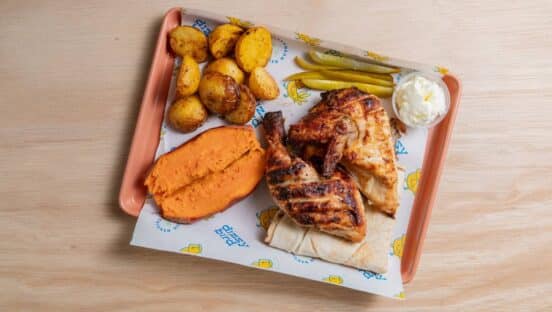
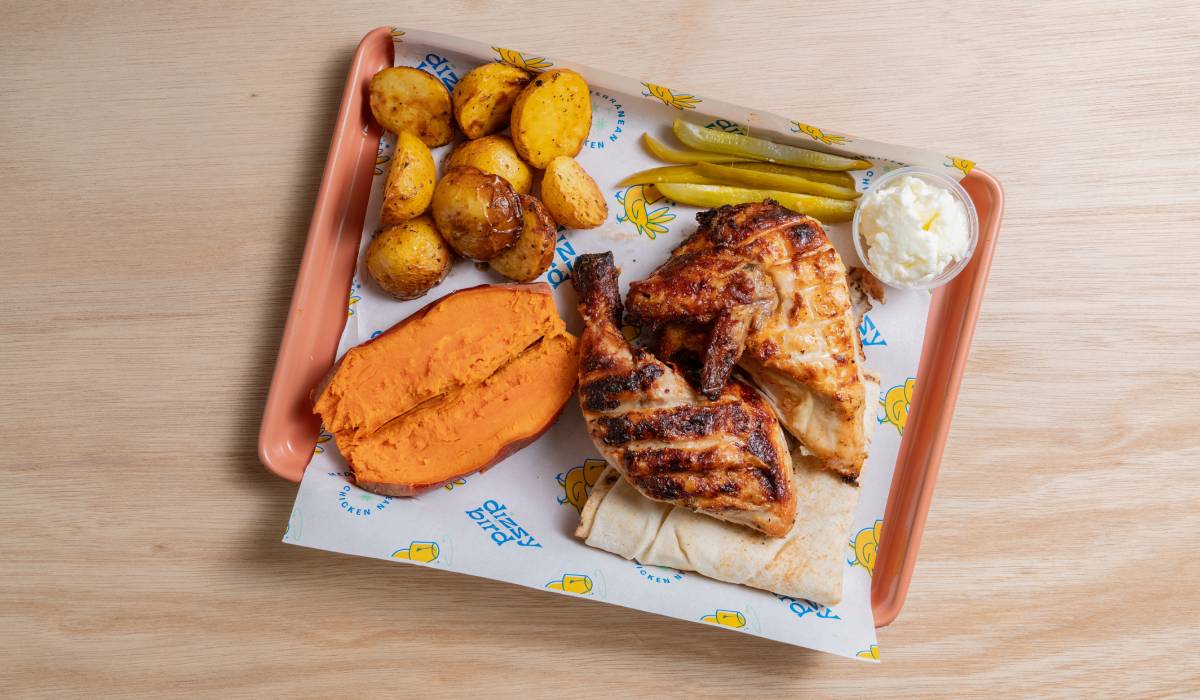
He spent years developing the recipe, eventually settling on spatchcock chicken and marinades that infused more flavor. Dizzy Bird also made grilled wraps a key part of the menu, with every wrap served hot and grilled over an open flame.
The first Dizzy Bird opened in a mall food court in 2023 as a test. It quickly outsold Moumneh’s previous restaurant, which was converted into the second Dizzy Bird in 2024.
Moumneh believes the appeal starts with an underserved demand for protein-forward meals that don’t rely on fried chicken.
“I think we fill a need that’s underserved, which is good-for-you, protein-forward meals and specifically chicken, specifically grilled chicken, not fried chicken,” he says. “I think that’s, at a very high level, part of our success. But after that, the product has to be good.”
Dizzy Bird doesn’t position itself specifically as a Lebanese or Mediterranean concept. Moumneh learned from his first restaurant that leading with a cuisine classification could narrow how customers perceived the food. Chicken gives Dizzy Bird a more universal entry point, with his heritage providing the culinary perspective behind it.
The restaurants themselves put the cooking process on display. Guests can see chickens rotating over open flames, employees basting and chopping them, and wraps cooking on the grill. Moumneh credits that visual component with helping an unknown concept attract attention in a food court surrounded by established national chains. Roughly half of transactions across the two restaurants now originate outside the four walls through digital and third-party channels.
Customer behavior has also given Moumneh confidence that Dizzy Bird can travel outside its current footprint. Some guests visit with unusual frequency, including customers who eat lunch at the restaurant and then order additional chicken to take home. Others are traveling from Los Angeles and San Diego specifically to visit the brand.
That demand has tested the limits of Dizzy Bird’s smaller footprint, particularly at its roughly 1,250-square-foot location, where Moumneh says the restaurant is operating near capacity. The performance has helped validate a concept that, only a few years earlier, was still being tested inside a mall food court.
Demand is pushing Dizzy Bird into a much different type of restaurant.
Its upcoming Playa Vista location near Los Angeles will occupy roughly 3,000 square feet in a mixed-use development anchored by Whole Foods. That’s considerably larger than the brand’s roughly 1,250-square-foot inline restaurant and its original food-court stall. The added space will accommodate more dine-in demand and give Dizzy Bird a training restaurant as franchising begins.
The company recently completed its franchise disclosure document and has already drawn interest without conducting franchise sales outreach. Moumneh says prospective operators have discovered the opportunity by visiting the restaurants and seeing the traffic firsthand.
Franchising wasn’t always the plan. Moumneh initially favored company-owned development, informed partly by his experience at Taco Bell. His thinking changed as Dizzy Bird proved itself and he considered the advantages of having restaurant owners directly responsible for day-to-day performance.
He also saw an opportunity to avoid mistakes he believes emerging franchisors sometimes make, particularly collecting fees without building sufficient infrastructure for operators.
“If I do it correctly, I could build a brand very strongly,” Moumneh says.
Dizzy Bird plans to concentrate initial franchise development locally and regionally so its supply chain and franchise support infrastructure can grow alongside the restaurant base. Moumneh’s primary filter for prospective franchisees is a long-term outlook and compatibility with the brand, followed by market knowledge, real estate capabilities, and financial resources.
“We’re looking for people that are going to be happy,” Moumneh says. “We’re going to be happy and they’re going to be happy working with us 20, 30 years from now.”