
As CEO Roland Gonzalez explains it, Church’s Texas Chicken had to get its house in order. But now, the brand is no longer on the cusp; it isn’t a turnaround anymore. “We’re full steam ahead and we’re going to accelerate,” says Gonzalez, the chain’s former COO, who recently completed his first 100 days atop the brand.
Consider a recent back-and-forth: Gonzalez asked around to see if anybody could comb the record books. When was the last time Church’s opened net positive units in the 20-plus range? Somebody answered, “at least 10 years.”
According to QSR 50 data going back to 2008, it’s actually 15, when Church’s expanded by 24 restaurants in 2010. The brand steadily slid the other direction since. It retracted by 27, 25, and 72 locations in the past three years, respectively, moving from 1,000 outlets at the start of 2022 to 873 going into 2004 (150 corporate and 714 franchised).
Yet, as Gonzalez noted, a different narrative has emerged. He came over to Church’s in 2023 with more than a decade of industry experience, including tenure as EVP and COO of Virtual Dining Concepts and head of global operations standards and strategy with Burger King parent Restaurant Brands International, where he led a team of 15 executives and oversaw 20,000 restaurants. Gonzalez, also a former professional baseball player who once led the nation in steals in 2008 at The University of Texas Rio Grande Valley (you’ll need to look up “Roly Gonzalez” to find his stats), believed a lot of Church’s whitespace resided from the ground up. The chain didn’t lack for value affinity or equity—it was founded in 1952, the same year as KFC.
MORE: Inside Church’s Texas Chicken’s 75-Year Journey Through the Eyes of Its Founder’s Granddaughter
But there were canyon-sized gaps between Church’s top performers and those struggling. That reality slanted two directions: One, consistency was a lead concern; and secondly, there was potential when restaurants ran correctly with the right assets.
Gonzalez says becoming CEO was one of those “wow” moments where he allowed himself a second to reflect. Then, at the same time, gravity hit. To this point, his career had lifted in incremental steps. Each promotion accompanied a few more people to manage, a bit more budget.
But becoming CEO felt like a seven, eightfold jump in every aspect. “And so, you have to use all the things you’ve learned to get you to that point and start leaning on them,” Gonzalez says.
He likens it to his baseball career and the first time he saw his name on the lineup. All the work led here, but it was fleeting. How do you deliver?
Come hear from Roland at this year’s QSR Evolution Conference in Atlanta. Reserve your spot today!
Gonzalez says he understands now why a lot of COOs evolve into CEOs. He’s worked cross-function for years readying for this opportunity, collaborating with leaders from supply chain to marketing to franchisees. “Relationships in this business—because it cuts across so much scale and so many different functions—is really, really critical,” Gonzalez says. “I had a lot of liberty to develop the strategy domestically and globally from an operations perspective. So being in this seat is more of an extension of what I was already doing. I can now just make it my own.”
So getting back to the task, Gonzalez says Church’s structural base was rebuilt. Unit-level profitability increased about 40 percent at corporate locations through a couple-of-years stretch. The brand, in June, broke a weekly record for sales and was headed another thanks to a few efforts landing simultaneously, including the return of Smokehouse Chicken. “We’re hitting double-digit sales in our company restaurants,” Gonzalez says, “primarily driven by traffic, and our franchisees are not too far behind. So I think we’re going to be breaking more records this year.”
Naturally, resetting expectations is a positive turn. But the fact Church’s did so, Gonzalez says, during a climate when customers continue to pull back and a vast majority of brands are reporting flat to negative same-store sales on soft guest counts, made it more encouraging. “What gets us really excited is we’re doing it through traffic,” he says. “It’s super, super rare to have the traffic [now] and the lion’s share of our sales growth has been through traffic.”
Even so, Gonzalez’s message as CEO stayed insular. While measuring against peers is, of course, vital, the theme at Church’s remains “us versus us.” There are ample levers to pull and ignite the concept based on where it was a few years ago, which, Gonzalez explains, was best described as “neglected.”
Church’s was founded in San Antonio, Texas, by George W. Church. “Church’s Fried Chicken to Go” was a walk-up stand a block south of the Alamo that offered two pieces of chicken and a roll for 49 cents. Over the years, it drifted, as previous management got into. It started to skew premium and mirror competitors from a footprint and perception standpoint.

Gonzalez witnessed Church’s retrenching firsthand as COO. Leaning into the brand’s quick, value-focused roots (the original vision was serving the underserved the best chicken at the best value) resonated, he says, since there wasn’t an issue with loyalty. If Church’s showed up as the brand’s fans recognized, they came back.
“There’s a sense of nostalgia in many ways,” Gonzalez says. “The more that we lean into our core being great quality chicken at a great price and part of the communities, we just take off.”
Getting back and going up
As he began to plot the future, and how to get deeper on Church’s principles, Gonzalez thought of the person closest to George W. Church—his granddaughter, Laura Garrett.
He reached out and they discussed Church’s history. During the exchange, Garrett mentioned she had become a bit distant over the years. Yet more recently, changes piqued her interest. “She said she’s never been more excited,” Gonzalez says. “That confirmed that we’re headed in the right direction.”
A roadmap is only as good as its foundation, though. Or, in this restaurant case, even the best promotion, Gonzalez says, will fail if customers have a bad experience. As shared before, he had been working on this for a while before the CEO opportunity surfaced following Joe Guith’s (now with CKE Restaurants) departure. “Variation” was a word on Gonzalez’s COO brain. Could Church’s narrow that separation between high-performers and the bottom 10 percent while also raising its game?
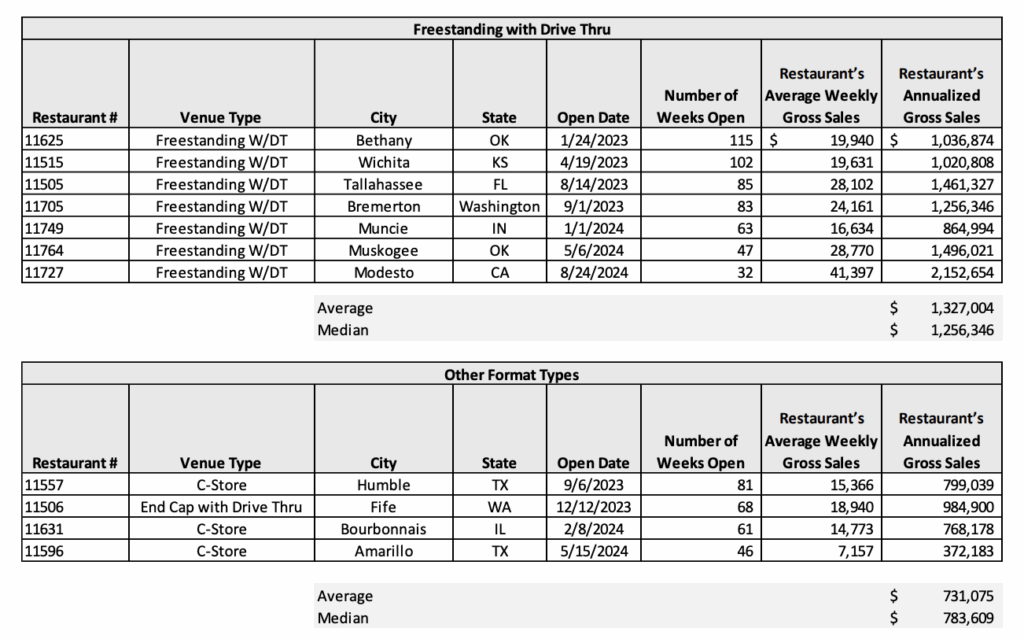
Part of the answer boiled down to the asset conversation. In its recent FDD, Church’s shared results of 11 newly built franchised restaurants with the “Blaze” image that opened in 2023 and 2024. The company requires all newly built franchises to launch with Blaze, which is a contemporary model debuted in 2022. There are different distinctions: The Blaze Compact, which is 1,000 square feet and has no dining room, costs $1.114.650 million to $1.636.300 million to get open; the 1400 Blaze (1,400 square feet) is $1.302.224 million to $1.808.972 million; the conversion Blaze runs $738,538 to $1.310.700 million; and the end cap Blaze is $644,366 to $1.273.300 million.
Here’s how those newly built franchised Blaze stores performed.
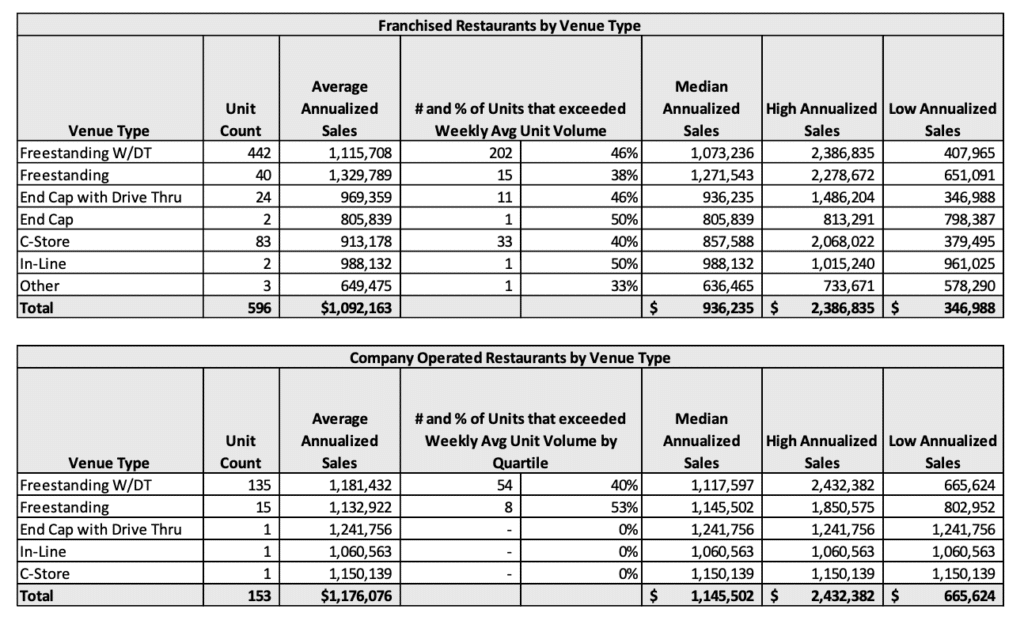
As of December 31, Church’s counted 714 franchised restaurants and 159 company units that met its requirements to be included in data. The chart below covers 596 franchises and 153 corporate restaurants. “Other” refers to end cap, food court, conversations, and C-store snap and attached restaurants.
The quick view is the freestanding franchised drive-thru median annualized sales of $1.073.236 million measured to $1.256.346 million on Blaze comps.
Using that same date, Church’s presented data from 642 domestic freestanding franchised and company units—with and without drive-thrus operating for the allotted time needed.

These next 43 were reimaged to the Full Blaze model during 2023 or 2024.

And here’s drive-thrus, of which 588 counted.

Franchised drive-thrus:

Gonzalez says Church’s addressed its widening split by optimizing kitchens and speed of service. It conducted 300 Blaze remodels a year for the last three. It’ll do 120 or so in 2015, bringing the U.S. system to roughly 60 percent updated. “That for Church’s has been an Achilles’ heel for a long time,” Gonzalez says. “When you have a brand that’s 73 years old that’s going to happen. It’s not uncommon to have a reimage that gives you a 15 or 20 percent lift because they’ve been so old.”
“When you combine that with the value-centric focus—other people are trying to hit $5, $6 price points and we come in with two pieces of chicken, a biscuit, and a jalapeño for $3.49—that’s very attractive.”
Gonzalez says he’s often quizzed on how Church’s can hit such low price tiers and remain profitable. It centers on supply chain optimization. Gonzalez says the brand approached tariff uncertainty and macro concerns as a chance to become opportunistic. It captured price for the next 12 months and beyond. That gave franchisees, Gonzalez says, confidence in promotions and planning. “To their credit,” he says of operators, “they jumped on board and understand if you raise $1 more and you’re raising it for $4.49 per transaction, you’re making more money, but you just cut in half how many transactions you’ll have. So your actual gross is going to be lower. Getting everybody on that same train has been a competitive advantage.”
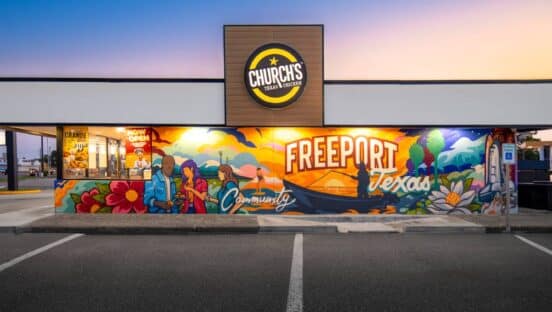
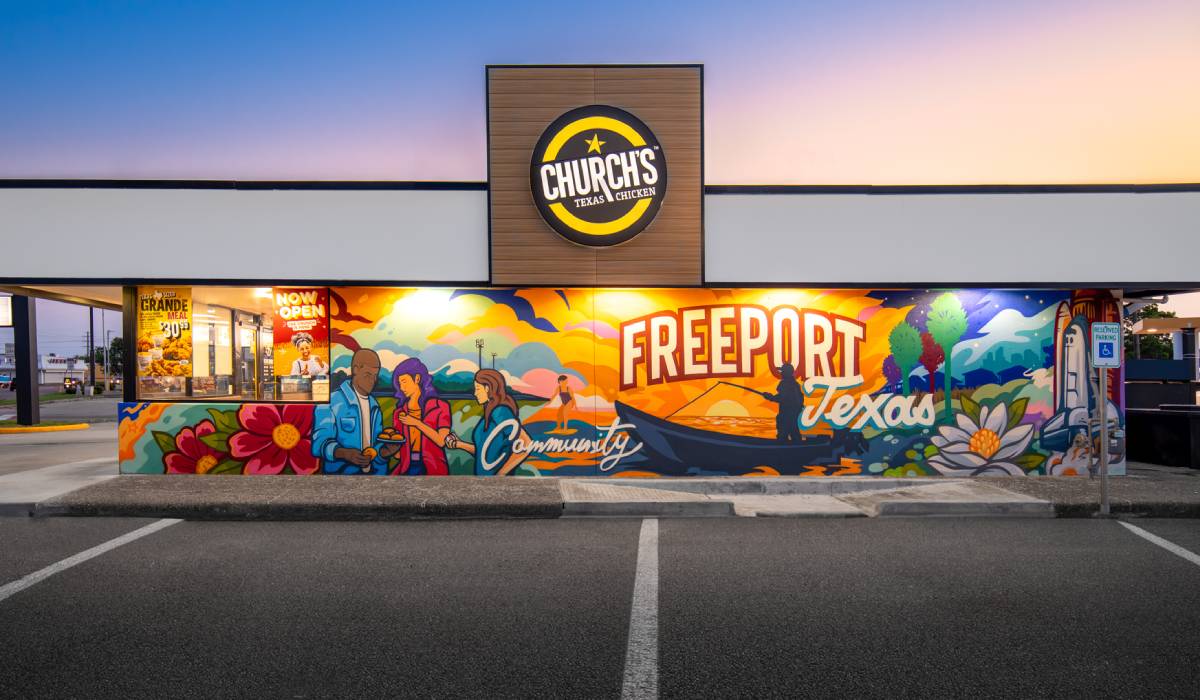
The Blaze design has gone so well, Gonzalez continues, Church’s hasn’t really had to tweak much. What it has begun to do, however, is localize reimages. So artists come in and create murals that showcase specific location’s market connection. As a Hispanic, Gonzalez says, he’s seen the realities and headlines of spend decline. But he believes Church’s bucked trends because guests and team members are “the salt of the earth and we’ve been part of their community for such a long time they feel welcome, they feel safe, and we’ve really leaned into that part as well.”
Where legacy evolves next
As Church’s amplifies its history, it’s also thinking ahead. Artificial intelligence has allowed stores to forecast in the back of the house, from cook times to volumes. Kitchen optimization, in general, is something Gonzalez feels technology has only glanced the surface on. More investment will be coming as stores strive toward accuracy. Gonzalez adds units have already lowered speed of service 30 seconds, year-over-year. “It’s the first time,” he says, “and I’ve worked with a lot of different brands, where I’ve seen traffic increase while speed of service has [improved].”
The goal will be to keep giving operators more tools. AI is being used to drive more sales internally by optimizing buckets like media spend. It’s helping squeeze dollars out of the ad fund by using filters to make smarter decisions. The same is true of content creation.
A couple of weeks ago, the company trained at Church’s Atlanta support center on how to prompt AI correctly. “Nirvana for us is, imagine if we create our own AI platform where you can ask this tool a question? What’s driving either results up or down? Predictive modeling where you create your own AI and pump all your data into it,” Gonzalez says. “That’s what we’re trying to build here.”
Resurfacing growth, Church’s projects 34 franchise openings in 2025 as well as seven company (potential closures not factored in).
In 2025, it opened four company restaurants, reacquired one from a franchisee, and closed two. Franchisees opened seven, seven more were terminated, nine were not renewed, and 20 ceased operations for other reasons.
So Gonzalez is right to scour the history books. It’s simply been a while since Church’s had this kind of momentum.
In April, the company said it had more than 900 new restaurants planned for the coming years, inclusive of its “Texas Chicken” international arm. This included deals in Germany, Hungary, Georgia, Azerbaijan, and Morocco. Church’s said it could expand internationally by more than 50 percent over the next four years and lift system sales to $2 billion by 2028. Gonzalez sees at least 1,500 locations. Church’s, which has more than 700 stores outside the U.S., will soon approach 30 countries.

Domestically, Houston reentered the picture. Philadelphia will come on later this year. Gonzalez said the U.S. trajectory rolls on a similar five-year view where it could build a four-digit pipeline. Data suggests Church’s estimate to be a conservative one, he adds.
“That’s a huge turning point for us,” Gonzalez says. “We’ve been, over a time, declining. But now, this is not only how we stopped that last year—this year we’re growing, on track for 20-plus net restaurant growth. And we’re building an even stronger pipeline thereafter.”
Gonzalez credits Church’s 40 percent improvement in franchisee profitability as a main culprit. Better returns and lines of sight give current and prospective operators a reason to invest. “The unit-level economics are much stronger. You have existing franchisees who want to grow and then you have a lot of new franchisees knocking on the door going, ‘what’s going on at Church’s?’”
“I think we’ve been a little quiet,” Gonzalez says, circling to the opening point. “… I really want to shout on the rooftop, hey, this is the best time to get into Church’s.”
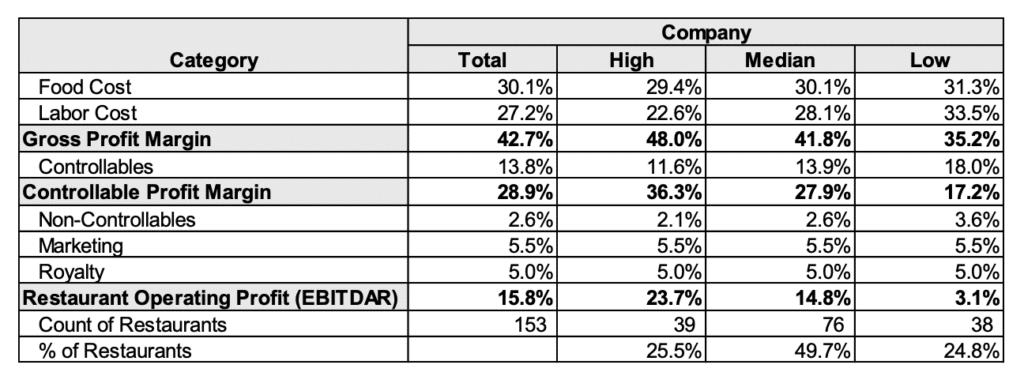
Gonzalez had led with transparency throughout the comeback. There’s a tool at Church’s today where operators can see how they compare to other stores and what the optimal P&L looks like. For the company, it helps leaders narrow down food costs and labor, or anything else, where corporate can identify and take action.
Church’s is also unique in a sense where its footprint and labor model enable it to generate strong returns on $1 million AUVs. Once you get over that mark, Gonzalez says, flow-through is at least 35–40 percent for every dollar you get after.
Digital expansion also factors in. In the US, with the release of its new Real Rewards loyalty program and incremental promotion of third-party delivery, Church’s more than doubled its digital mix to about 13.5 percent since the beginning of 2024. The program, on the verge of its first birthday, has more than 1.3 million subscribers and a 4.9 rating in the app store.
When Gonzalez first started, Church’s digital take was about 7 percent. And the chain hasn’t unlocked catering yet to the degree he believes it can. So digital could be over 20 percent at some, not-so-distant, point. “And I have even higher aspirations for that,” he says. “I think we can double that as well.”
Digital checks tend to be more profitable thanks to a higher average. That’s led to profitability gains for the franchisees fueling Church’s return to growth, too.
Some locations have also expanded hours of operation, which happened first on the company side, with certain franchisees following suit. “We think late night is another great unlock for us,” he says.
Overall, as long as profitability remains Church’s compass, growth will follow, Gonzalez adds. As a leader, he wants to unlock the brand by removing guardrails on people’s talent.
And if these measures continue to progress amid larger headwinds, imagine what happens when the tailwinds come.
“We will keep shooting up,” Gonzalez says.