Domino’s is attracting more customers, gaining market share, and expanding its delivery reach. But those successes are not translating into the sales growth the pizza giant wants, creating an immediate challenge for new CEO Joe Jordan.
The chain reported U.S. same-store sales growth of just 0.3 percent in the third quarter, despite higher order counts across delivery and carryout. Customers are still purchasing pizza, including lower-income consumers facing financial pressure, but they are ordering fewer items per transaction.
According to Jordan, who recently succeeded Russell Weiner as CEO, the priority is turning that customer traffic into higher sales and stronger franchisee profitability.
“I believe growing orders is the most important thing a brand can do in the current environment,” Jordan said during the company’s third-quarter earnings call. “Consumers remain under pressure, but they continue to choose Domino’s. More orders bring more customers into our system, support our franchisees and create opportunities to drive greater frequency over time.”
READ MORE:
Why Domino’s Sees Order Counts as its Primary Growth Engine
Domino’s CEO Russell Weiner to Retire, Joe Jordan Named Successor
Domino’s Says Pizza Rivals Can’t Sustain Value War
Domino’s U.S. retail sales increased 2.1 percent during the quarter, supported primarily by new restaurant openings. Carryout same-store sales rose 1 percent, and delivery declined 0.3 percent. Pricing increased 1.2 percent, but smaller transactions offset some of those gains.
CFO Sandeep Reddy said the decline in items per order became more pronounced during the third quarter, particularly across carryout and first-party delivery. Although average ticket trends improved sequentially, the company expects consumer spending pressures to persist through the remainder of 2026.
Jordan said lower-income customers continue to respond to Domino’s value offerings, suggesting demand has not disappeared. The challenge is encouraging those customers to purchase additional items without compromising affordability.
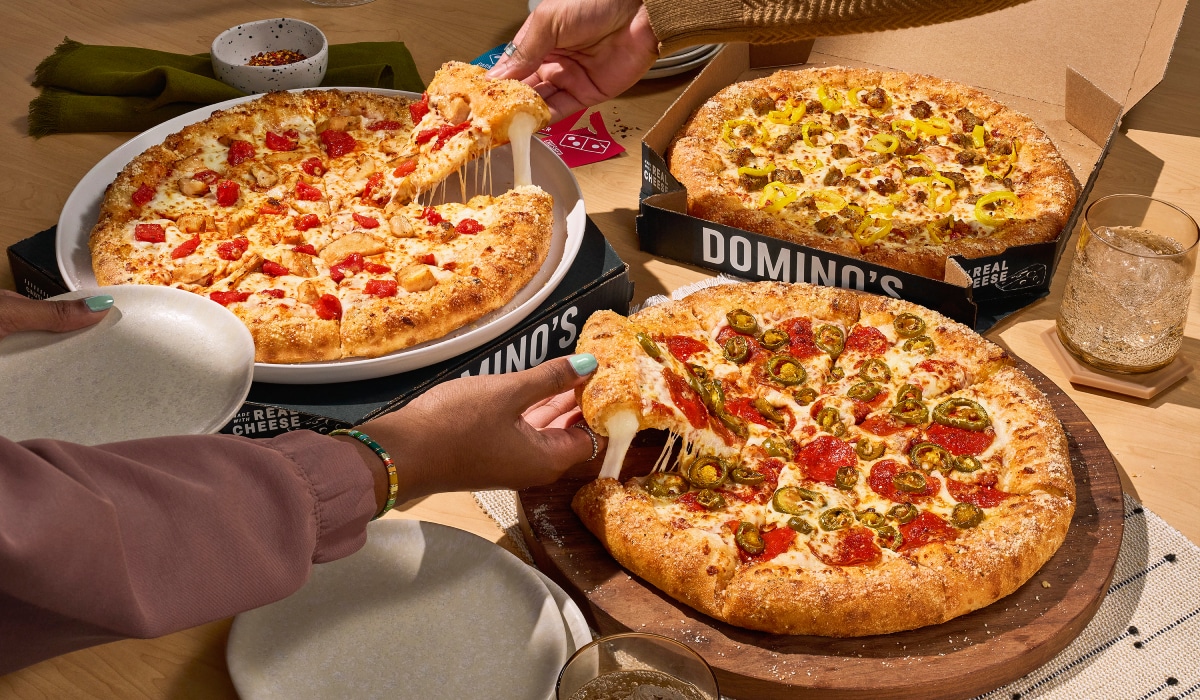
The company has continued using its Best Deal Ever promotion to drive traffic, recently incorporating stuffed crust pizza to introduce customers to a higher-priced product. Jordan said the promotion has encouraged repeat purchases, potentially creating opportunities to improve average checks.
Domino’s is also investing in more targeted promotions through its website and loyalty program. The company wants to move existing loyalty members into higher-frequency purchasing groups, encouraging additional visits through personalized offers.
“Our loyalty program continues to work really hard for us,” Jordan said. “And a big focus there now with the scale that we have on that program is continuing to move our customers up in frequency bands.”
One of Jordan’s biggest opportunities involves expanding the occasions in which customers consider Domino’s.
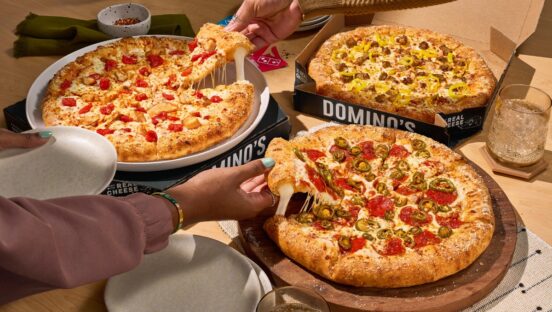
The company recently introduced the Domino—a Detroit-style personal pizza. It’s product aimed at what Jordan calls the “me/we” occasion, where customers eat together but prefer individual meals.
Traditionally, pizza has benefited from group orders. However, Jordan sees opportunities to compete with other quick-service categories by accommodating individual preferences without sacrificing the communal experience.
The Domino launched during the final week of the third quarter, leaving little time to influence results. Nevertheless, the company sees it as an important opportunity to attract customers who might otherwise choose burgers, sandwiches, or other individual meals.
That opportunity is particularly relevant on third-party delivery platforms, where customers regularly compare Domino’s against restaurants outside the pizza category.
Jordan said the company accelerated the Domino’s launch after identifying opportunities involving higher-income consumers, transaction sizes, and aggregator demand.
“Pizza is a mature category. We know that. 1 percent to percent growth. How can we continue to drive outsized growth?” Jordan said. “We need to think about how we can push pizza into places that it hasn’t been before and get occasions where pizza hasn’t traditionally been considered.”
Domino’s believes it has become the leading pizza brand on DoorDash and Uber Eats, although Jordan said its share of those platforms still trails its position in the overall pizza market.
The company estimates roughly 50 percent of third-party delivery sales are incremental, meaning those transactions are not simply replacing orders through Domino’s existing channels.
Reddy said the company deliberately prioritized profitable orders during its aggregator expansion instead of pursuing faster growth that could damage restaurant economics.
Additionally, despite positive traffic trends, weakening franchisee profitability is beginning to affect Domino’s restaurant development.
The company lowered its 2026 U.S. net opening forecast to 125–150 restaurants, citing pressure on its development pipeline and franchisee earnings. Domino’s added 26 net U.S. restaurants during the third quarter.
Reddy said the slowdown is primarily related to franchisees delaying future openings, not restaurant closures. Domino’s has recorded only single-digit annual closures in recent years, and the company continues to see long-term potential for more than 8,500 domestic locations.
However, restoring franchisee profitability has become essential to returning development to its previous pace.
“Until we get franchisee profits to move in the right direction, there will be incremental pressure going forward,” Reddy said.
Jordan pointed to previous periods when restaurant development recovered quickly following improvements in store-level economics.
The company is pursuing several initiatives to improve those economics, including balancing transaction growth with average checks and improving operational consistency.
Domino’s is testing its Dom.OS platform and an orchestration agent intended to improve restaurant execution. Jordan believes reducing inconsistencies in food quality and service can improve customer retention and purchasing frequency.
The company’s supply chain is another source of support. Procurement productivity and route optimization contributed to improved performance during the third quarter. Domino’s shares U.S. supply chain profits equally with franchisees, providing another potential avenue for restaurant-level financial improvement.
Domino’s international business also faced challenges during the quarter.
International retail sales increased 4.3 percent, supported by restaurant expansion, including 149 net openings during the quarter. Same-store sales grew 0.2 percent.
Performance at Domino’s Pizza Enterprises, which operates across several international markets, continued to weigh on results.
Domino’s now expects international same-store sales to be approximately flat for 2026, with meaningful improvement at DPE not anticipated until 2027.
Jordan recently visited France to meet with DPE CEO Andrew Gregory and expressed optimism over efforts to restore customer traffic through stronger value offerings and higher restaurant volumes.
The company continues to expect approximately 800 net international openings this year.
Domestically, Domino’s maintained its forecast for low-single-digit same-store sales growth in 2026, although it now expects results near the bottom of that range. Global retail sales are projected to grow in the low- to mid-single digits, and operating income is expected to increase in the mid-single digits on an adjusted basis.
Despite the revised outlook, Jordan sees significant opportunities for Domino’s to gain share in pizza and compete more effectively across quick service.
“Consumers choose us very often for consistency and convenience. That’s a big part of the value that we offer to consumers. And too often, from my perspective, we are inconsistent,” Jordan said. “So by improving our operational consistency, we can also drive significant gains for our franchisees.”