Adrian Deasy grew up around restaurants. His mother managed them for years, and he swore he would never go back.
Instead, he became a mechanical engineer, working across automotive, motorcycles, aerospace, and plastics. One day, he found himself looking at a drive-thru coffee line where guests were waiting 20 minutes for a drink. The engineer in him couldn’t let it go. With smartphones in customers’ hands, he thought there had to be a way to automate the experience and bring it down to 30 seconds or less.
“There’s something about foodservice that brings you back,” he says. “Once you can automate it—once you don’t have to be there all the time and handle a bunch of employees and customer complaints—it’s a much more enjoyable business to run.”
That idea sparked Octane Coffee, an “employee-free” automated drive-through concept built around mobile ordering, robotics, and GPS-based production timing. Its Brookfield, Wisconsin, location is the company’s only open store.
Deasy began working on Octane in 2017/2018, assembled an automated system in 2019, and raised roughly $500,000 in venture funding during 2020 and 2021.
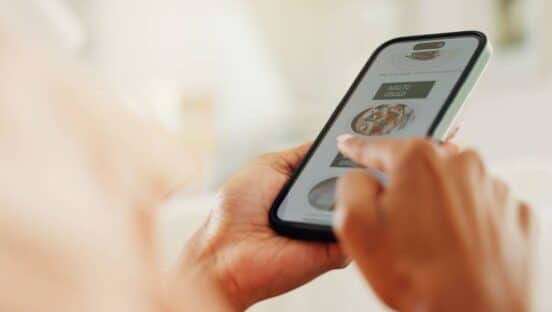
At Brookfield, customers order through Octane’s app. The system tracks their location and compares their estimated arrival with the production time for their customized drink. The goal is to finish the order just before they reach the pickup window.
“We time everything so the drinks are being finished seconds before they pull up,” Deasy says. “It is as hot and ready or cold and ready as it can be.”
Customers scan a QR code in the app, take their drinks through the window, and leave. Deasy says regulars typically finish the handoff in 10 seconds or less. The system is designed to produce more than 200 drinks per hour, or about one every 18 seconds at the window.
Octane’s store is a prefabricated 30-foot shipping container. Plumbing, wiring, coffee equipment, and robotic hardware are installed before it reaches the site. The building measures 240 square feet, and the wider layout uses roughly 3,000 square feet. Once placed and connected to utilities, Deasy says it can be making coffee within a day and a half.
The menu includes cold coffees, energy drinks, lemonades, teas, sodas, slushies, nitro cold brew, and dirty sodas, alongside espresso and hot beverages. Recipes are programmed digitally, allowing Octane to test and deploy drinks without training employees on a new preparation process.
The labor model is central to Octane’s proposition. A “Java tech” visits the store for about an hour each day to clean, restock, and troubleshoot. Deasy says Octane could add ambassador-style workers to help customers or provide a human presence, but those workers would not make or hand out drinks.
“Let the robots do the hard and stressful stuff, and put humans where they can do good work,” he says. “Let them do customer service. Let them do hospitality.”
He contrasts that approach with a typical coffee-shop interaction.
“As soon as you place an order at a coffee shop, they turn around, they’re making a latte,” Deasy says. “You’re looking at the back of their head. They’re a cog in the machine at that point. You’re not interacting.”
The system required trial and error.
“There are plenty of people who are saying, ‘It’ll never work,’” Deasy says. “And to those people, I say, ‘Here it is. It’s running. It just took a lot of belief and a lot of spilled coffee and messes.’”
Problems generally trace back to people, not machinery, he adds.
“Nine times out of 10, if we have something wrong with the system, it’s always human-related,” Deasy says. “The robots don’t mess up.”
Octane is pursuing two growth paths. The consumer-facing business is working with a franchise partner and could open franchises in Q4, pending an FDD filing. It also plans two or three company-owned locations over the next year to test manufacturing, service, and remote support.
The second arm focuses on automation for other beverage and foodservice operations. Octane is talking with coffee chains and beverage concepts about retrofits in existing locations. The idea is to “take the guts out of the shipping container” and install them inside an existing location, fitting automation into current footprints without new builds.
For now, Octane remains a one-store test with ambitions beyond coffee. Deasy says Octane operates not just at tech’s cutting edge but the “bleeding edge,” pushing hardware and software capabilities beyond off-the-shelf norms.
“As engineers, we definitely have a culture of continuous improvement. We’re always trying to make things 1 percent or 2 percent better,” he says. “How can the hardware be more effective? How can the customer experience be better? How can we leverage technology to give someone a unique, personalized, special experience that no one else could ever recreate at scale?”