


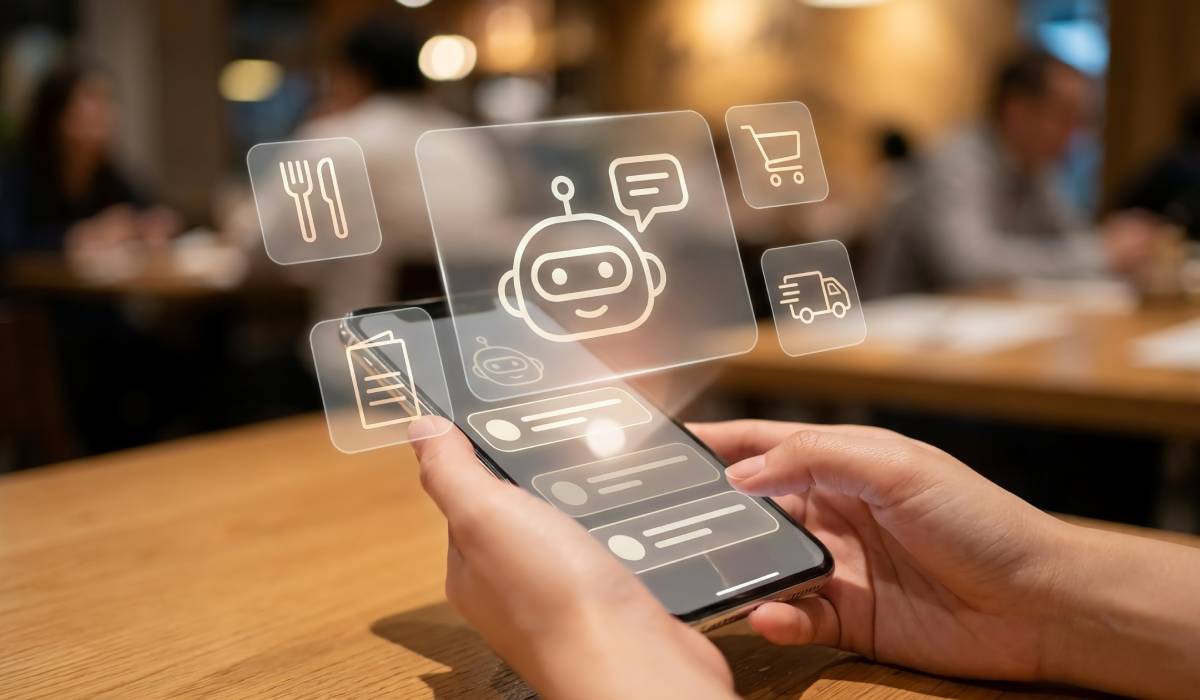
Artificial intelligence is playing an ever-increasing role in the quick service restaurant ordering experience. AI is changing the way customers find menu items, place orders and interact with restaurants, from personalized recommendations and conversational ordering to predictive technology.
The technology is moving beyond the experimentation phase for QSR operators. AI is being integrated by ordering platforms to make transactions faster, more personalized, and easier to manage.
Personalized Ordering Experiences
Personalization is one of the most visible applications of AI in restaurant ordering. Artificial intelligence can help to give more relevant recommendations by looking at previous orders, preferences, time of day and purchasing patterns, as opposed to giving every customer the same menu experience.
For example, when opening a restaurant ordering platform, a customer who regularly orders vegetarian dishes might see relevant menu items highlighted. If a customer regularly buys a combination, they might get suggestions for what else to add to their usual order .
AI-Powered Conversational Ordering
Conversational interfaces powered by AI are transforming the way customers engage with restaurant ordering systems. Instead of navigating through multiple menu categories, customers can express their needs in plain language.
A customer could ask for a meal with certain ingredients, ask what options are available or change an existing order, all through a conversational interface.
This technology can help QSRs simplify the ordering journey while creating another channel for customers who prefer conversational interactions versus traditional app navigation.
Smarter Recommendations and Upselling
AI may also help QSRs to offer more relevant upselling recommendations. Traditional upselling usually relies on predefined combinations or generic recommendations, but artificial intelligence can offer more contextual suggestions.
For example, a burger order might be accompanied by a recommendation based on combinations that people tend to order together. Recommendations also can be based on past purchasing behavior.
Voice and AI-Assisted Ordering
Voice technology is another growing channel for ordering restaurants. Customers can order via AI-driven voice interfaces, without having to manually navigate through menus.
The technology has promise in mobile applications, websites, drive-thru systems and other ordering channels. Outside of drive-thru operations, AI-assisted voice ordering might help fulfilll routine requests while employees attend to other duties.
But it’s all about accuracy after all. Voice technology is convenient, but it can be easily undermined by misinterpretations of customisations or incorrect orders.
Predictive Technology Behind the Scenes
The role of AI does not end with the submission of the order. Predictive technology can help restaurants to forecast ordering patterns and prepare for changes in demand. Historical ordering data can reveal patterns around busy times, popular menu items, and seasonal demand. Such insights can help to better prepare and avoid the lack of availability of popular items in peak periods. For multi-location QSR operators, these insights can also assist in better planning of operations.
Faster Customer Support
AI is increasingly being used to assist customers after they place an order. Frequent questions about order status, estimated delivery times, menu availability, and other routine concerns can be answered with automated systems.
When deployed properly, AI-powered support offers immediate answers and allows human agents to focus on more complex customer issues.
Privacy and Accuracy Will Remain Important
As AI becomes more involved in the restaurant ordering experience, privacy, transparency, and accuracy will become increasingly important. QSR operators need to know what customer data they are collecting, how they are using it and how they are protecting it.
AI recommendations should be relevant, not invasive. Accuracy is just as important, as inaccurate recommendations, misinterpretations of allergy related questions or modifications to orders can all have a negative impact on the customer experience.
Therefore, implementation of AI should include proper testing, monitoring and supervision by humans to ensure reliable ordering experiences.
The Future of QSR Ordering
AI is not taking over the basics of ordering at restaurants. Customers still want ease of use, accurate menus, transparent pricing, speed of service and reliable fulfillment.
Rather, AI is emerging as a layer that can make these experiences smarter and more personalized. As QSR tech continues to develop in 2026, restaurants that intentionally use AI are able to create ordering experiences that are faster for customers and yield useful operational insights.
Keep the emphasis on solving real problems for customers and the business. AI works best when it makes ordering simpler and more convenient, not when it adds more complexity.
Katherine Roy is a Digital Marketing Specialist with an interest in restaurant technology, digital commerce, and emerging AI applications. She writes about how technology and digital strategies are shaping modern business and customer experiences. Bytesflow develops digital solutions for businesses looking to build and scale on-demand platforms.