
This year, QSR magazine introduced Fast Casual FutureMakers, a new annual report showcasing brands and founders pushing the category forward in real time.
The 2026 class features three emerging concepts, each representing a different path to growth and innovation.
First up was Big Dave’s Cheesesteaks, recognized as the “Rising FutureMaker” for its purpose-driven expansion and disciplined approach to scaling. (Read more here) Next was Greenlane, awarded the “Disruptor FutureMaker” for its work in the drive-thru salad space (Read more here)
The final entry is La La Land Kind Cafe, named our “Community FutureMaker.”
***
Francois Reihani was just 20 years old when he opened his first restaurant. After transferring to Southern Methodist University in Dallas, the entrepreneurial-spirited student built a quick-service poke concept from scratch. He secured backing from friends and family, recruited a chef from Nobu, and landed a spot in one of the city’s busiest centers.
The restaurant was packed from day one, and by most measures, it was a major success. Still, Reihani found himself confronting a hard question: Was he actually happy?
“It felt like my life was all about making a bunch of money,” he says. “As much as I loved the hospitality side of things, it just wasn’t very fulfilling.”
That unease led Reihani to get involved with Dallas CASA, an organization supporting kids in foster care, at the suggestion of a friend. At his first meeting, the discussion centered on youth aging out of the system.
MORE: La La Land is Ready to Bring its Mission-Driven Brand to the Masses
The first speaker was a young man who described being removed from drug-addicted parents at age 10 and placed in a foster home that was “in it for the money.” Labeled a problem child, he was sent to an institutional facility, spent much of his childhood there, and was released at 18 with little support. Two young women followed with similar stories, leaving Reihani stunned.
He went home and began researching the issue, struck by both its scale and its invisibility. Each year, an estimated 20,000 to 23,000 young people age out of the U.S. foster care system, often without permanent family support and facing heightened risks of unemployment, homelessness, and incarceration.
“One of the biggest problems is that nobody even knows it is a problem,” Reihani says. “If I talk to 100 people, maybe one of them has any idea about this. So, I felt extremely moved to do something.”
His first instinct was to create opportunities within his existing restaurant by hiring youth aging out of foster care. When his partner and investor declined to support the idea, Reihani took a different route, launching a nonprofit called The We Are One Project.
“Long story short, it was me being delusional,” he says. “I was thinking, ‘Oh, I’m going to solve this whole problem just by giving them housing, therapy, help with school, and job placement.’”
The reality was far more complicated.
“It was failing by the end of the first year,” Reihani says. “One of the main reasons was that as hard as we tried, we could rarely ever get them a job, especially a job that lasted.”
Even when participants were hired, often by large fast-food chains, the jobs rarely lasted more than a few weeks, underscoring how unprepared many were for the workforce.
“The fast-food chain on the corner doesn’t really care to deal with that,” he says. “You have a kid taking three buses to get to work who doesn’t understand the fundamentals of a job yet. They’re not going to be willing to teach them that on-site.”
Around that time, Reihani sold his stake in his first restaurant and assumed his hospitality chapter had closed. But the nonprofit’s failure revealed a key insight: youth didn’t just need jobs, they needed supportive environments. That realization pulled him back into foodservice and led to La La Land Kind Cafe, a purpose-driven coffee shop brand built to employ and mentor youth aging out of foster care.
Coffee was a deliberate choice. Reihani saw coffee shops less as a product and more as environments, places naturally suited to conversation and human connection. That’s something he felt was missing from his first restaurant, and it prompted broader questions about why that openness fades with age.
“There’s such a simplicity to life until you start to grow up, then it gets more complicated and people lose that spark,” Reihani says. “Why isn’t humanity closer together? Why don’t people care about each other? Why are strangers strangers? Those are the types of questions my brain was contemplating.”
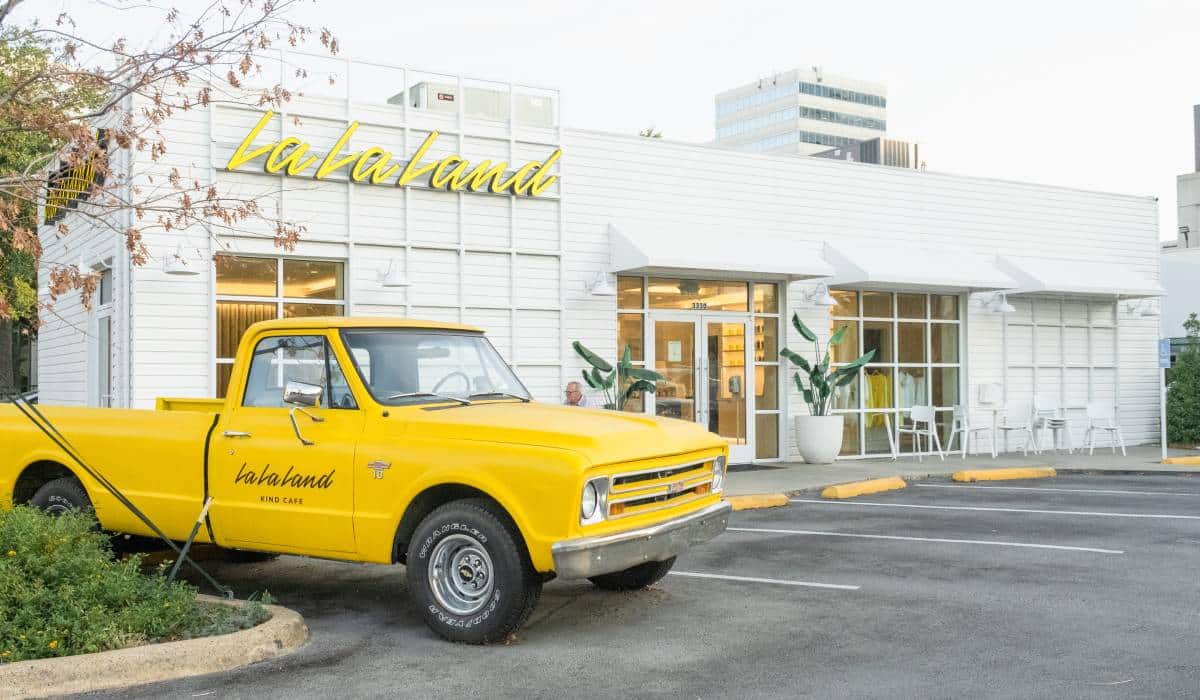
La La Land’s design reflects that mindset, with mostly white interiors and pops of yellow meant to evoke joy and optimism, intentionally muted from what he describes as the “darkness and bickering” of the outside world.
The environment also supports the mission. Working as a barista felt like an attractive, accessible job for young adults entering the workforce.
“I wanted this to be a cool and fun job for our youth,” Reihani says. “Most importantly, I wanted them to be able to feel comfortable in a warm environment and connect with other human beings.”
Building the internship program proved far more complex than opening the cafés themselves. Early on, Reihani was deeply involved in interns’ personal lives, picking them up, dropping them off, and helping navigate daily crises. He realized that level of involvement unintentionally created dependency and undermined accountability. At the same time, store managers were expected to handle both operational performance and significant emotional challenges.
The breaking point came when interns were trained briefly and placed directly on schedules. When some didn’t show up, other baristas had to cover shifts, creating resentment and internal conflict. They also learned that clustering too many interns in one location limited growth and attention.
“There were so many different challenges that we figured out,” Reihani says. “These kids go through a lot—more than people think—and that comes with them to work for the first couple of months.”
Today, the internship program operates as a structured 12-week paid experience with both professional and personal tracks. Interns train in-store while also working with a youth director on housing, education, transportation, therapy, and future planning, and each is paired with a mentor. At the end of the program, they can stay with La La Land or transition into another career path.
The current spring cohort includes 21 interns across 14 stores. That’s the largest group to date. While the scale initially gave Reihani pause, he says the team is confident in the model and plans to grow it carefully.
Don’t expect to see a lot of fanfare as the program continues growing. Marketing the mission has never been the focus. Reihani says La La Land was built with the mission first and not as a café with a charitable add-on, and that distinction helps preserve the culture as the company grows. He adds that the mission is a big part of creating a strong internal culture and can play a big role in motivating employees at all levels of the organization, but only if it’s real. The brand operates in a “no bullshit environment,” where impact isn’t bolted on for optics but baked into daily operations.
At the same time, he acknowledges that it’s easier for corporate and area leaders to see the long-term impact than it is for baristas on the front lines, who are managing long lines, impatient guests, and the emotional demands of hospitality.
That’s why he’s focused on what he calls “Project Culture”—finding tangible ways to support and reward store-level teams so they can actually feel the difference they’re making. Those employees, he says, ultimately decide whether La La Land’s “more yellow” exists in practice or just in theory.
Looking back on the journey and everything he’s learned along the way, Reihani has clear advice for others in the restaurant industry who want to build businesses with impact baked into the core. First, he says, be prepared for scrutiny. Expect people to question your intentions and challenge whether the impact is real.
Second, and most important, he believes building a mission-driven brand requires a level of conviction that borders on delusion. You have to believe deeply in what you’re building, he says, because if you see every risk and headwind too clearly, it’s easy to talk yourself out of moving forward. Over the years La La Land faced criticism, pressure, and repeated suggestions to save “hundreds of thousands, if not millions of dollars” by abandoning the program altogether.
“Everybody is going to tell you that it won’t work,” Reihani says. “We heard that a thousand times before we opened the first store and even afterwards. But if you believe in what you’re doing, you can’t give up. You have to be relentless.”