
The race to smaller restaurant footprints has a limit. Checkers & Rally’s learned that lesson with a 570-square-foot prototype unveiled last spring.
“We tested it and found that it was just slightly too small,” says Eileen Himber, senior manager of franchise development. The company adjusted the design to about 700 square feet—still 300 square feet smaller than its prior prototype, but with more room to protect operational flow.
That distinction is increasingly important as quick-service brands chase lower development costs, more flexible real estate, and faster, convenience-led service. A small building can widen a franchisee’s options, but leaders behind three drive-thru-centric concepts say it cannot simply be a conventional restaurant with square footage stripped away. It must be designed around its menu, employees, channels, and guests.
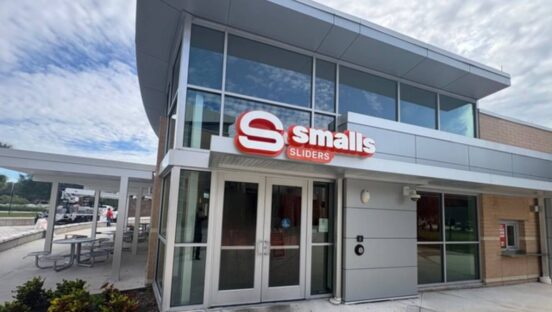
Smalls Sliders utilizes a modular real estate and construction strategy built around 750- to 800-square-foot repurposed shipping containers called “cans.” They are prefabricated off-site and dropped onto compact half-acre plots.
“We don’t really think about it in the sense of shrinking a restaurant,” says chief development officer Ryan Crumley. “Rather, we built the can around the kitchen and the team so that they can do one thing exceptionally well.”
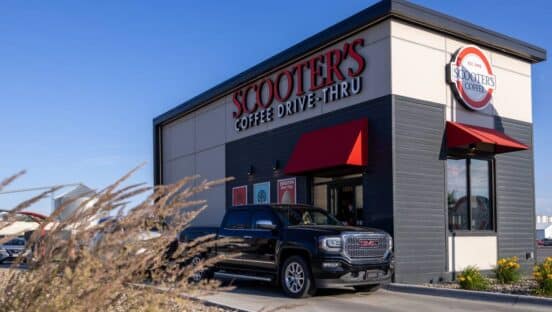
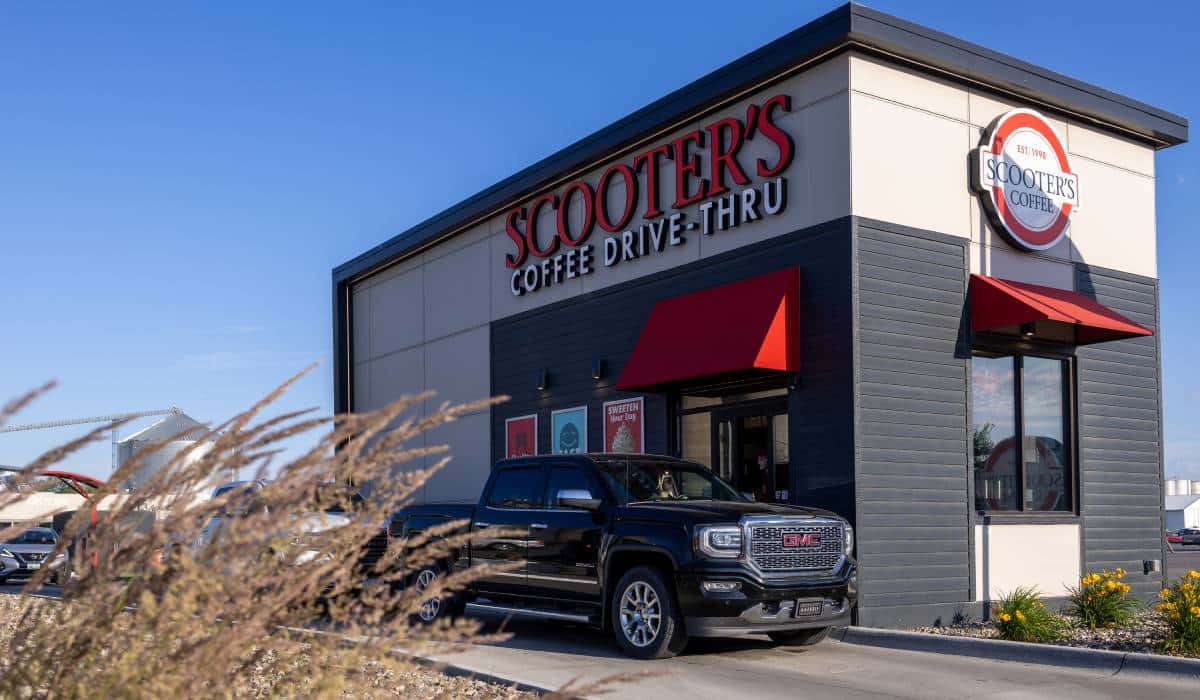
Scooter’s Coffee’s small stores, likewise, are a longstanding part of its business model rather than a response to the latest development cycle. Its roughly 1,000-square-foot end-cap format accommodates guests in the store, and the company also operates nontraditional units in airports, hospitals, and sports venues. But its traditional drive-thru kiosk, between 650 and 700 square feet, is the core prototype.
“The way this space is designed is intentionally around the business we want to operate,” says Aaron Hoffman, Scooter’s vice president of franchise sales. “We’re not trying to squeeze a traditional coffee house into a smaller box.”
That model can support expansion in secondary and tertiary markets, where a large café may not pencil out. “You don’t need a massive population base or large-format building to have a successful coffee business,” Hoffman says. “Those customers still want great brands and experiences, but the economics have to fit the community.”
Checkers & Rally’s sees the inverse opportunity. A smaller box can help franchisees enter large metropolitan markets, where space is limited and expensive, Himber says. It can work on a smaller parcel or let an operator use a larger site for co-branding. On a conventional site, it can make room for a longer drive-thru stack.
The operational work is where the model either delivers on its promise or breaks down. In a compact kitchen, equipment placement, inventory, and employee movement are intertwined.
Smalls works from the kitchen outward, examining the movements required for each role. Crumley says the brand’s model enables it to run with fewer employees and adjust staffing more readily during peak and off-peak dayparts.
“You’re not paying people to run across the restaurant,” he says.
But tighter quarters can magnify seemingly minor design mistakes. Smalls once tested a tall piece of equipment to move food from its cook line to its expo line, only to learn that it obstructed sightlines and reduced nonverbal communication between employees.
“The only way we’re ever able to do that is having a great feedback loop from our franchisees,” Crumley says.
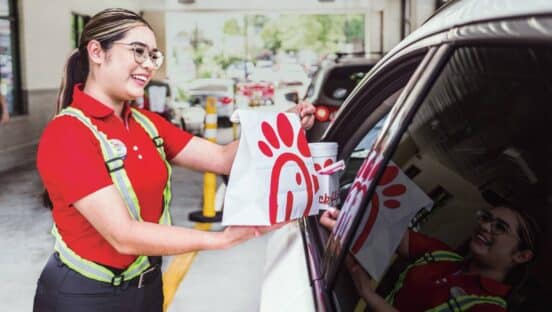
At Checkers & Rally’s, eliminating a second drive-thru lane in the 570-square-foot prototype hindered flow, Himber says. The lane also serves digital-order and third-party delivery pickup customers, so the brand brought it back. The company also scrutinized redundant equipment.
“We found that there were redundancies that we could eliminate,” she says. “Not only does it make the kitchen more efficient, but it is also less costly to build.”
Menu discipline is another guardrail. Smalls has focused on building a highly focused menu centered around cheeseburger sliders, fries, shakes, and drinks. Scooter’s similarly prioritizes a core menu and seasonal offerings rather than a stream of additions that complicate inventory and the work area.
The same logic applies to customer choice, since a consistent menu can keep drivers from lingering in the queue while deciding what to order.
For Hoffman, that is more than a menu-management issue. In a compact drive-thru, “unnecessary complexity shows up really, really quick,” whether it comes from additional inventory, a poorly placed piece of equipment, or a process that adds steps for the team.
The payoff from a smaller box comes not from reducing square footage alone, he says, but from making every square foot advance throughput and guest experience. That’s why a compact format can’t be treated as a shortcut.
“The mistake is assuming smaller automatically means simpler,” Hoffman says. “The entire system—development, operations, supply chain, menu, and so on—has to be designed to support that footprint.”