
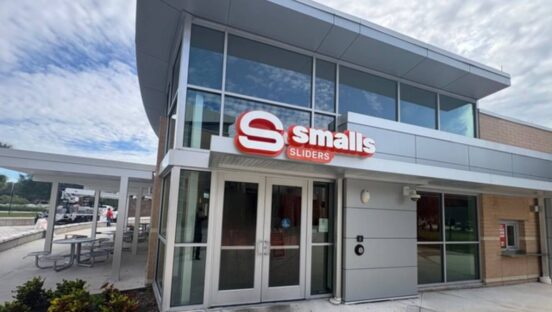
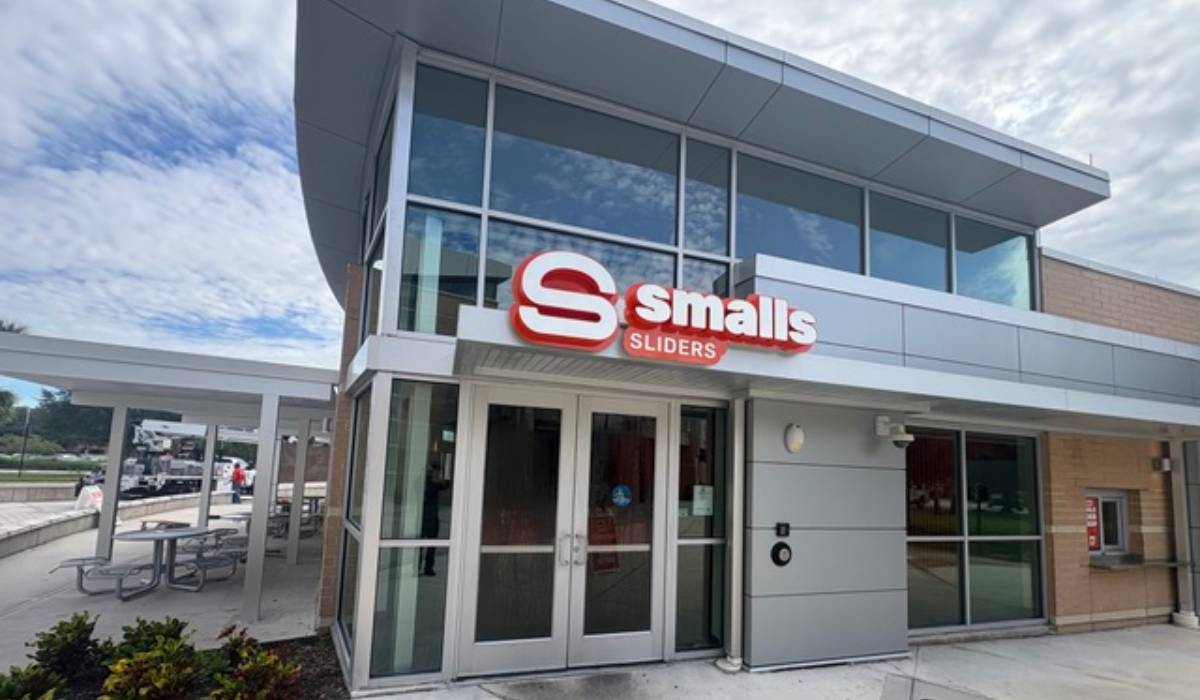
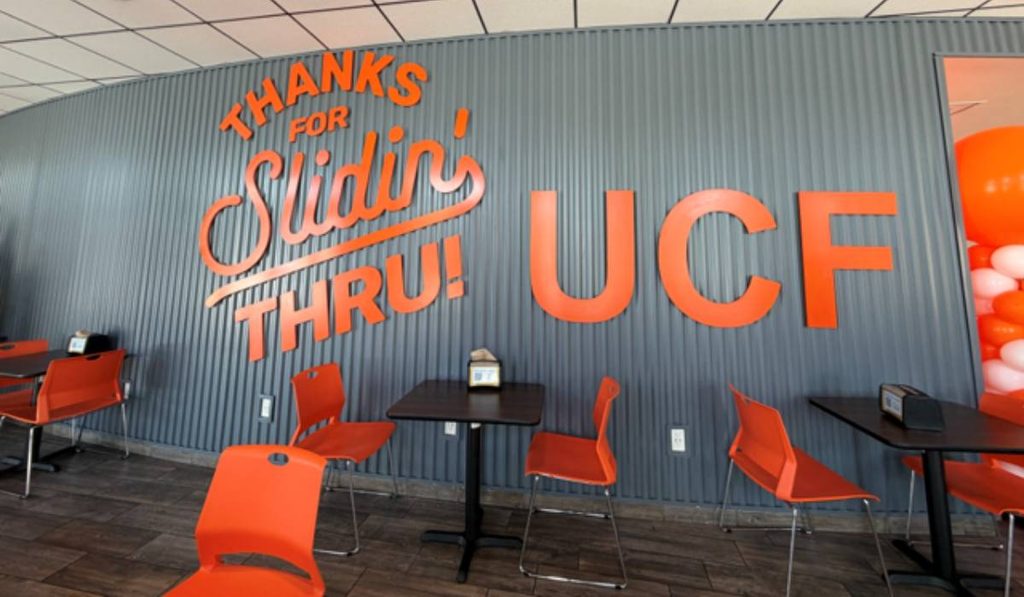
Smalls Sliders is taking its compact restaurant model onto college campuses, starting with a University of Central Florida location that introduces something new for the brand—a dining room.
The opening gives the slider chain an opportunity to study how guests use an indoor space and how its service translates to a campus setting. A second location at the University of Mississippi is expected to follow, giving Smalls two different environments in which to test a new avenue for franchise growth.
According to chief development officer Ryan Crumley, the move connects with the brand’s roots. Smalls started in Baton Rouge, the home of LSU, and college students already make up an important part of its customer base. The company has approximately 60 restaurants. The emerging chain, founded in 2019, opened a net of 39 locations from 2023 to 2025.
Campus development puts Smalls closer to customers who need a meal between classes or on their way to another activity. Crumley sees an opportunity to serve those occasions with a product and atmosphere that already resonate with students at traditional locations.
The UCF dining room also builds on work the company has done with its patios. Some locations have enclosed patio doors to accommodate colder climates. Others have roll-up doors that allow the space to open. Indoor seating gives Smalls another way to observe guest behavior without starting from scratch.
The campus openings add options to a growth strategy still rooted in traditional franchise development. Smalls’ standard store occupies 750 square feet, a small operating footprint that franchisees have used to deliver efficient service. Their work gives the company a foundation for testing locations with different physical requirements and customer routines.
Crumley views UCF and Ole Miss as separate experiments. The company wants to understand performance, learn what operators need in each setting, and determine how to support franchisees before pursuing additional campus opportunities.
Interest in additional locations is already reaching the brand. Smalls will assess those opportunities individually, using the first openings to inform its decisions.
“We’re now at a place where those opportunities are coming to us and so as those opportunities present themselves, we’ll evaluate them, and see if it’s a right fit for the brand,” Crumley says.
That evaluation extends to the people running the restaurants. Crumley puts operator fit first. The company seeks partners who understand multi-unit operations and have the capital to support development.
Geographic expansion is continuing alongside the campus work. Smalls recently opened its first Indiana restaurant and its first Ohio location. Crumley expects additional states to join the system next year, with growth extending into markets near its existing footprint.
The ideal franchisee brings three qualities to that work. Crumley looks for genuine enthusiasm for Smalls, experience operating multiple locations, and connections to the local community. Restaurant experience is preferred, particularly because running a sizable portfolio requires capabilities different from those needed to operate a single neighborhood business.
Local relationships are harder to measure, but Crumley sees their value firsthand through stories from the field. One colleague visited a franchisee’s market to check on a unit under construction. When they stopped for lunch at another restaurant, it took roughly 10 minutes to reach their table because people kept stopping the franchisee to say hello.
“So how do you measure and quantify that? I don’t really know, but that passion for connectivity to the local environment or local community is so important,” Crumley says.
On campus, connecting with guests can require a different kind of interaction. Crumley got a preview during a visit to the Ole Miss space roughly a year before it became an opportunity for Smalls. He stood in line at another quick-service restaurant, then noticed a large group of students waiting nearby. A digital board revealed they had placed orders through their apps, putting them ahead of him.
The experience offered a lesson in how students use restaurants. Mobile ordering can change the sequence of service, making pickup a more important point of contact than the initial transaction.
“This population of the customer, they use you very differently, and you can learn a lot from that,” Crumley says.
That creates a practical question for Smalls as it expands into places where guests may spend much of the transaction behind a screen. Hospitality has to reach the customer during whatever interaction is available, even if the exchange lasts only long enough to hand over a meal.
Crumley points to small actions that can make that moment count. Music can help create an enjoyable workplace. Asking for a guest’s name and greeting them with a smile can make pickup feel personal. Order accuracy gives the interaction substance, ensuring a friendly handoff delivers what the customer expected.
“If you can foster a really fun environment for your employees, your squad members, you’ve got a much better opportunity to give a good hospitality experience even if it’s just simply interacting with them to call their name and hand them their order,” Crumley says.