In 2024, Trader Joe’s raised the price of a banana from 19 cents to 23 cents. Normally, a four-cent price increase wouldn’t attract much attention. This one made national news.
There was a reason. Trader Joe’s had sold bananas for 19 cents for more than two decades. The price had become familiar enough that changing it meant more than charging four additional cents for a piece of fruit. Nineteen cents had become part of what customers associated with Trader Joe’s value proposition.
That raises an important question for quick-service restaurants. At a time when digital menu boards, apps, sophisticated analytics and AI make it increasingly easy to change prices, how do restaurants decide which prices should actually move?
Pricing researcher Utpal Dholakia recently explored the idea that every price has a “life.” In “What Decides the Life of a Price?,” he argues that some prices survive for years or decades while others disappear within hours, and that their appropriate lifespan depends on more than the technology or economics of changing them. It also depends on what those prices mean to customers.
For QSRs, that distinction matters because not all menu prices play the same role.
Some Prices Are More Memorable Than Others
Consider the difference between the price of a Big Mac, a new limited-time product and a temporary offer in an app. All three are prices, but they occupy very different places in the customer’s mind. Someone who has bought Big Macs for years may not know the exact price at the restaurant down the street, but has had many opportunities to develop a sense of what a Big Mac should cost. A new product has no such history, while a temporary offer may be evaluated once and quickly forgotten.
That suggests a continuum. Some prices are essentially forgettable. Others become reference prices, where customers may not remember the exact amount but develop expectations about what the product should cost. And a small number become iconic prices, where the price itself becomes part of what the brand represents. Costco’s $1.50 hot dog and soda combination, unchanged since 1985, is perhaps the ultimate example.
The further a price moves along that continuum, the more complicated changing it becomes.
QSR Customers Have Long Memories
Customer memory is especially important in QSR because of purchase frequency. A leisure traveler might stay at a particular hotel once or twice a year, encountering different dates, room types and market conditions each time. Hotel customers have also been trained for decades to expect prices to vary, so there may be no obvious answer to what a particular hotel room “should” cost.
Now consider a customer who buys the same lunch from the same QSR two or three times a week. That customer has dozens of opportunities each year to observe the price of the same product. Over time, that familiar price becomes a reference point.
A price increase can communicate more than the additional amount the customer has to pay. It can signal that the customer’s understanding of the brand’s value is no longer accurate. And when the price changes, the old price doesn’t simply disappear. Customers remember it, consciously or not, and compare the new price against it.
The Value Wars Were Really About Reference Prices
McDonald’s experienced this very publicly in 2024. After social media posts about an $18 Big Mac meal attracted widespread attention, McDonald’s USA President Joe Erlinger published an open letter addressing perceptions about the company’s prices. He reported that average menu prices had increased about 40 percent since 2019, while the average Big Mac had risen 21 percent, from $4.39 to $5.29.
Why publicly defend the average price of a Big Mac against a story originating with one unusually expensive restaurant? Because the issue had become larger than that particular price. The controversy had become a broader question about whether McDonald’s still represented the value customers associated with the brand.”
A month later, McDonald’s introduced its $5 Meal Deal nationally. By October, the company said the offer was continuing to draw customers back into its restaurants. McDonald’s wasn’t simply running another promotion. It was trying to repair a reference point.
In February 2024, the Wendy’s dynamic-pricing controversy provided another reminder. Consumers reacted strongly to the suggestion that familiar QSR prices might begin behaving like Uber prices, even though Wendy’s clarified that it did not intend to raise prices during peak periods. Customers have expectations not only about what restaurant products should cost, but also about how those prices are supposed to behave.
Technology Changes What’s Possible
Making prices easier to change doesn’t necessarily make changing them more desirable. Researchers from Northwestern University examined roughly 400 million transactions at 114 U.S. grocery stores before and after the introduction of electronic shelf labels. Despite dramatically reducing the operational effort involved in changing prices, the technology produced essentially no change in pricing behavior and virtually no short-lived surge pricing.
Technology removed a barrier to changing prices. It didn’t create a reason to change them.
QSRs face the same fundamental choice as digital menus and AI dramatically increase the number of prices that can be optimized. The question isn’t simply whether a price can move. It is: How much freedom should this particular price have?
A Pricing-Freedom Continuum
Rather than classifying menu prices as simply static or dynamic, restaurants can think about how much freedom each price should be given.
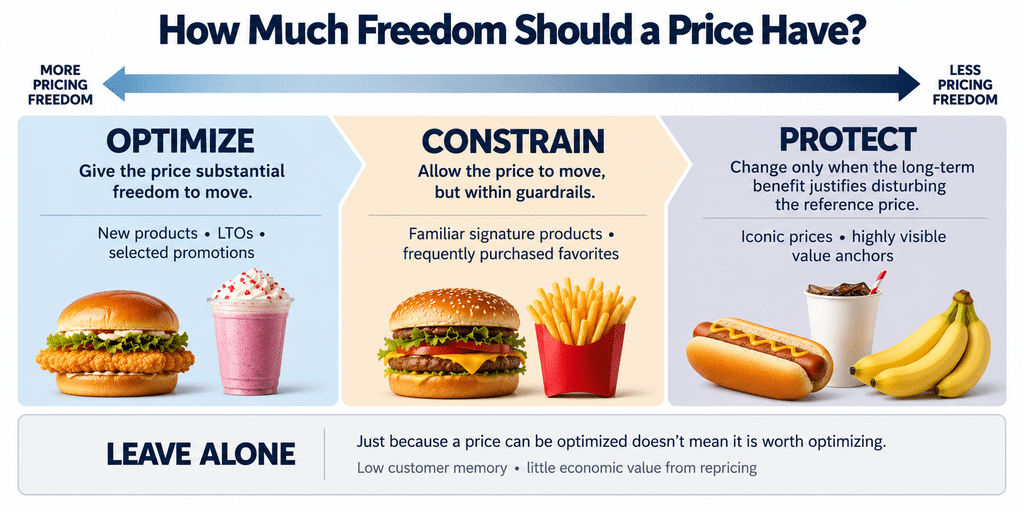
Forgettable prices generally belong in Optimize or Leave Alone, reference prices generally belong in Constrain, and iconic prices belong in Protect. Where a price belongs will differ by brand and market. But before optimizing it, restaurants need to understand what kind of price they’re dealing with. A familiar signature item deserves very different treatment from a new LTO or an offer that most customers will see only once.
The Protect category is particularly important. A short-run model may show an attractive gain from increasing an iconic or highly visible price. That doesn’t mean the model is wrong. The incremental revenue or contribution may be real, while the value destroyed by changing a powerful reference price simply doesn’t appear in the model.
Then There’s AI
AI makes this distinction more important because an AI pricing system can become extremely good at answering a narrowly defined question: What price will maximize expected revenue or contribution for this product, at this restaurant, under these conditions? The answer could be mathematically excellent and strategically wrong.
If a model repeatedly changes a familiar price in response to variations in demand, costs or competitive conditions, it can capture short-run gains while changing customers’ perceptions of value, fairness or trust. The algorithm hasn’t necessarily made a bad decision. The value of price stability simply wasn’t included in its objective function.
Management therefore needs to decide which prices AI is free to optimize, which operate within guardrails, which should be protected, and which aren’t worth continuously optimizing in the first place.
In franchise systems, this also becomes a governance issue. McDonald’s, for example, has emphasized that its franchisees set prices at their individual restaurants. How much pricing freedom should an individual franchisee have? Which prices should the brand protect? And when should human judgment override the recommendation coming from the pricing system?
A Different Pricing Question
For years, restaurant pricing discussions have centered on a familiar question: What should we charge?
For years, restaurant pricing discussions have centered on a familiar question: What should we charge?
But perhaps the first question should be: What kind of price is this?
Is it forgettable? Is it a reference price? Has the price itself become part of the brand? Should the system optimize it freely, move it within limits, or protect it?
Which leads back to Dholakia’s original idea and one final question: How long should this price live?
For some menu items, the answer will be days or weeks. For others, months or years. And occasionally, the best pricing decision will be to leave a highly optimizable price exactly where it is.
Sherri Kimes is an Emeritus Professor at Hotel School at Cornell and specializes in pricing and revenue management. She is passionate about helping restaurants increase profitability. She can be reached at [email protected].