During my years as a multi-unit Cold Stone Creamery franchisee, I learned that some of the most important leadership lessons do not arrive in classrooms, conference rooms, or carefully planned training sessions. Sometimes, they explode in a parking lot.
My wife and I were operating multiple Cold Stone Creamery locations, and the demands of restaurant ownership followed us everywhere. Operations, payroll, employee training, customer complaints, inventory, staffing, and the countless unexpected problems of running restaurants all competed for our attention.
After an especially busy Friday night, I arrived at the store Saturday morning already tired and overwhelmed. The crew was moving quickly to prepare for the day—making ice cream, filling the mix-ins, baking waffle cones, and getting ready for customers.
My wife arrived in our SUV with supplies for the store. Several employees and I went out to help unload. When the rear hatch opened, a gallon of milk fell from the vehicle. It hit the pavement, burst open, and splashed milk across the asphalt, our shoes, and everyone’s legs.
I lost my composure. Instead of accepting the accident and helping address it, I kicked what remained of the first gallon across the asphalt. I then reached into the SUV, grabbed the second gallon of milk, and threw it across the parking lot.
Then everything became quiet. No one said a word. My employees stared at me in disbelief. Their expressions communicated what they did not need to say: What just happened? Is this really our leader? In that silence, I saw myself through the eyes of the people I was supposed to be leading. The first gallon was an accident. I could not stop it from falling. But I could have prevented the second.
That distinction has stayed with me because it captures one of the most important challenges in restaurant leadership. We cannot prevent every disruption. We cannot control every callout, late delivery, equipment failure, guest complaint, employee mistake, or gallon of milk that falls from a vehicle. However, we are responsible for what we add to the moment. The first gallon created a mess in the parking lot. My reaction created a second mess in the culture.
The Human Moments Behind Restaurant Performance
Restaurant managers deal with staffing shortages, narrow margins, variable demand, guest expectations, technology disruptions, and time constraints. They make decisions rapidly, repeatedly, and visibly.
Most restaurant organizations prepare managers to execute procedures. They teach food safety, labor management, inventory control, guest recovery, cash handling, and operating standards.
Those systems are essential. But procedures cannot anticipate every human moment. A procedure cannot determine the tone a manager uses when an employee makes a mistake. It cannot prevent frustration from becoming intimidation. It cannot decide whether a manager responds to a callout with curiosity or condemnation. It cannot repair trust after a leader’s reaction damages it.
Those moments require something beyond operational competence. They require leadership alignment. I knew how I wanted to lead. I understood the importance of treating employees with respect, maintaining composure, and setting the emotional tone for the operation.
My problem was not a lack of knowledge. It was a lack of alignment. What I believed, how I wanted to relate to my employees, and how I actually behaved had pulled apart. The leader I intended to be and the leader my employees experienced were not the same person. That is fragmentation, which is the gap between intention and behavior. Pressure did not create that fragmentation. It exposed it.
Leaders Transmit More Than Instructions
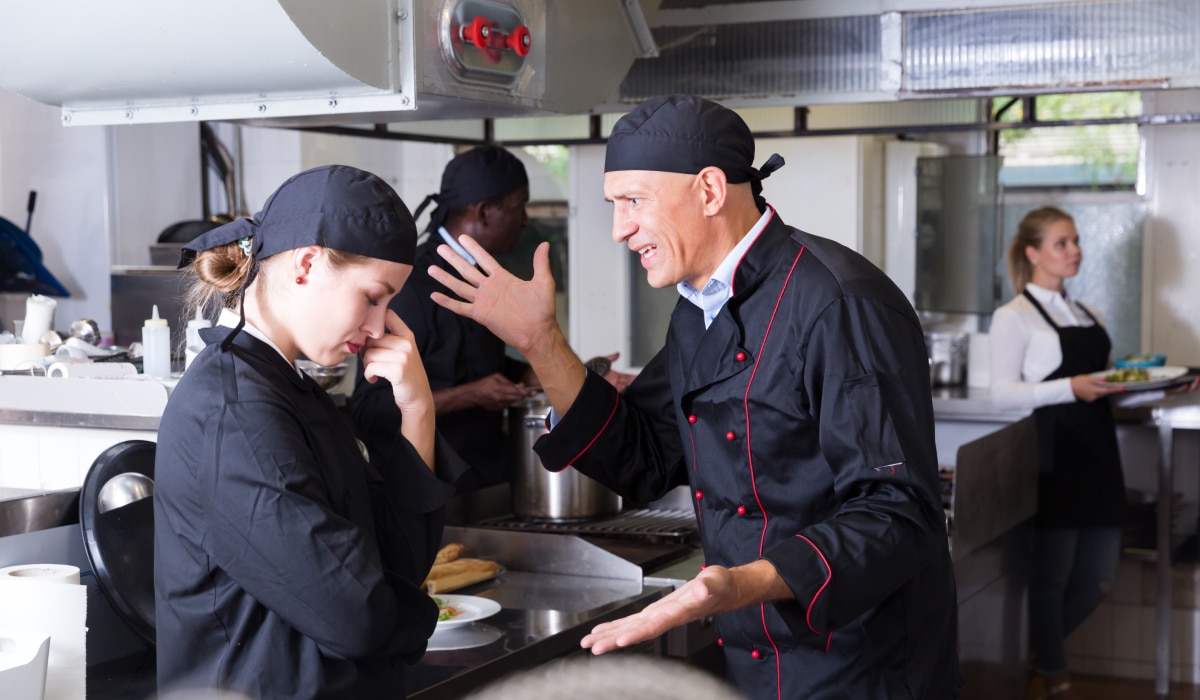
A manager’s emotional state rarely remains contained within the manager. Leaders transmit frustration or focus, blame or ownership, anxiety or confidence. Employees read facial expressions, tone, body language, and behavior, particularly when something goes wrong.
When I kicked that second gallon, my employees learned more than how I felt about spilled milk. My behavior signaled what might happen when someone made a mistake. It changed the atmosphere and redirected their attention from preparing the restaurant to evaluating the emotional condition of their leader.
That is how one reactive moment spreads through a shift. What begins inside the leader can quickly become the experience of the team.
A Three-Part Alignment Check
Restaurant leaders need a practical way to close the gap between their intentions and their actions. I call that capacity Leadership Poise™. Leadership Poise is not merely remaining calm. It is maintaining alignment among how a leader thinks, relates, and behaves—especially when pressure rises. That alignment involves three dimensions:
Head: Think clearly to create stability.
What is actually happening? What assumptions am I making? What matters most right now? When the milk fell, the fact was simple: an accident occurred. My frustration transformed an inconvenience into something larger. Clear thinking creates the space to distinguish facts from emotion before emotion takes control.
Heart: Relate intentionally to build connection.
What does this employee, or this team, need to experience from me right now? Connection does not eliminate accountability. It makes accountability more effective. Employees can be corrected without being diminished. Standards can be protected without sacrificing dignity. Leaders can be direct and decisive while still demonstrating respect.
Habits: Act consistently to produce impact.
What response reinforces our standards, values, and culture? Culture is not determined by the values printed on a wall. It is shaped by what leaders repeatedly model, permit, correct, and reinforce. Employees learn what an organization truly values by watching what its leaders do when circumstances become difficult. Under pressure, head, heart, and habits can pull in different directions. Leadership Poise brings them back into alignment.
Before reacting to the next disruption, ask one question: Am I responding constructive to the first gallon, or am I creating the second?
Reactive Leadership Has a Cost
Restaurant operators constantly monitor food cost and labor cost. We understand that small losses, repeated across shifts and locations, can become significant. Reactive leadership also carries a cost.
Its expense may not appear as a separate line on a profit-and-loss statement, but it surfaces throughout the operation, turnover, disengagement, inconsistent execution, avoidable mistakes, and diminished guest experiences. One leader’s uncontrolled reaction can produce costs long after the immediate problem has been resolved.
Consistency creates confidence. Confidence supports communication. Communication protects execution.
This is particularly important as restaurants promote strong individual performers into management. An employee can excel at production, service, or shift execution without knowing how to regulate emotion, build trust, communicate expectations, or lead through conflict.
Technical competence may earn the promotion, but poised leadership determines what happens next.
The Second Gallon Is the Leadership Decision
The milk was eventually gone from the parking lot. The effect of my response was not as easily removed. Leaders will have bad moments. Restaurant operations almost guarantee them. The standard is not perfection. The standard is responsibility.
Poised leaders recognize when they have become fragmented. They acknowledge the effect of their behavior. They repair what they damaged. Then they develop better responses before the next high-pressure moment arrives.
I could not prevent the first gallon from falling but I could have prevented the second. That is the leadership lesson. We cannot always control what happens around us, but we remain responsible for what happens within us—and for what our response releases into the people and culture around us. Employees do not experience our intentions. They experience our behavior.
Every shift communicates something and each response reinforces something. Every moment under pressure teaches employees what leadership means in that restaurant. The first gallon may be unavoidable. The second is a leadership decision.
Patrick Dickerson is a former multi-unit Cold Stone Creamery franchisee who served on the brand’s National Advisory Board and as a cooperative president. He holds a master’s degree in organizational leadership and brings 20 years of leadership experience across the quick-service restaurant industry, real estate, and leadership consulting. Patrick is the creator of Leadership Poise™, a research-grounded approach that helps leaders align how they think, relate, and behave under pressure. He is also a Maxwell Leadership Certified Speaker and Trainer, a certified TCI Team Performance Coach, and an NLP Practitioner.