
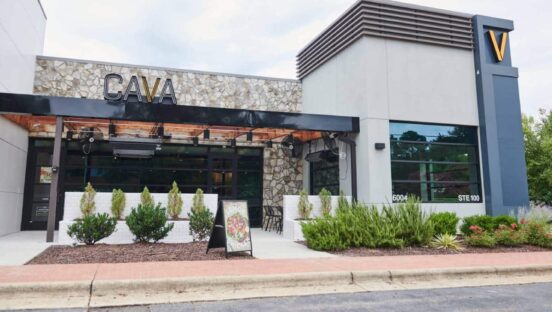

CAVA wasn’t immune to 2025’s trials. But it was a relative point. The brand in Q2 posted same-store sales growth of 2.1 percent, which marked its lowest result since going public more than two years ago and only the second time it generated single-digit performance. That after growing 10.8 percent in Q1.
Q3 mirrored Q2 at 1.9 percent, with flat traffic. However, CAVA’s figures were an internal reaction as much as a macro one. This past fiscal year lapped a 2024 when same-store sales rose 14 percent (traffic 9.5 percent) in Q2 and 18.1 percent (12.9 percent traffic) in Q3. And CAVA will soon post against a 21.2 percent Q4 (traffic 15.6 percent). So, growing on top of 2024, while tepid in comparison, wasn’t immaterial.
CAVA’s same-store sales are still running more than 34 percent on a three-year view.
Speaking to the larger landscape, though, CEO Brett Schulman in Q3 noted, since 2019, overall restaurant sales industry-wide have expanded. Total transactions have not. Spun differently, the larger category bumped top-line results but did so through price and not guest counts.
That’s been an ongoing dynamic as visits shrink and consumers trim frequency and become more selective with their income.
CAVA saw this begin to emerge out of COVID and decided to play a longer game. It kept its menu accessible, took roughly half the price increases of peers, and maintained figures nearly 10 percent below the broader consumer price index.
READ MORE:
CAVA’s Rapid Growth Moderates Amid Industrywide Slowdown
CAVA’s Growth Slows, But Still Outpaces QSR Segment in Tough Quarter
CAVA Defies Industry Trends with Soaring Sales and Traffic
William Blair analyst Sharon Zackfia recently hosted meetings with Schulman and CFO Tricia Tolivar to take stock of 2025 and examine what’s next. She said the conversations underscored a “massive growth” opportunity owing, in large part, to CAVA’s ability to hold fort on discounting of late and still expand. What’s happened during that unit count spurt opens possibilities, too.
CAVA’s 2025 class of restaurants—it opened 17 net stores in Q3 to reach 415 overall—are trending above $3 million in average-unit volumes, ahead of CAVA’s fleet average of $2.9 million and first-year targets of $2.3 million.
William Blair estimated CAVA’s 2025 openings will achieve a roughly 50 percent cash-on-cash return in Year 1 as unit-level margins approach the mid-20 percent range.
“The robust performance of new units in both new and existing markets speaks to the ultimate opportunity for CAVA to become a much larger brand relative to its 400-plus units today,” Zackfia wrote in a note.
William Blair’s saturation analysis suggests eventual potential of 2,000 domestic locations based on CAVA’s per-capital density in Washington, D.C. The brand said in the past it plans near-term expansion of 18.5–19 percent in 2025 followed by growth of at least 16 percent in 2026.
And returning to underlying realities, Zackfia called 2025 “perhaps the most aggressive promotional environment in restaurants since the Great Recession.” (Schulman echoed that sentiment in Q3 as well). Yet, CAVA has resisted the discounting lure to focus instead on driving everyday value.
Zackfia said it was a successful strategy given accelerating two-year comp and traffic trends for CAVA even with a relative slowdown. That, she said, occurred in spite of softer industry trends that began this summer across fast casual’s key 25- to 35-year-old demographic.
She anticipates stronger sequential two-year comps trends to continue into Q4, however, which Zackfia suspects will yield same-store sales toward the higher end of CAVA’s full-year guidance of 3–4 percent, with a clear path to mid-single digit performance in 2026.
“We view CAVA’s success despite its lack of discounting as illustrative of its compelling value proposition,” she said, pointing out CAVA has taken less than 17 percent of price since 2019. That lags a 27 percent CPI jump and an average 30 percent-plus hike across restaurants.
CAVA guided a price benefit of less than 2 percent in 2026—similar to 2025—factoring in expectations for, hopefully, a relief in commodity inflation.
Company management told William Blair there’s been no discernible competitive impact on its business and CAVA plans to keep developing scale in a Mediterranean category that isn’t loaded with competitors like some others, such as chicken and beverage. Zackfia said doing so should create insultation over time for CAVA as she’s seen with other “category killers,” such as Chipotle.

CAVA’S $300 million acquisition of Zoës Kitchen in 2018—a deal financed through an equity investment led by Act III Holdings, the investment vehicle created by Ron Shaich, founder and former CEO of Panera Bread—was geared toward this point from the outset. At 261 units, Zoës was significantly larger than CAVA (roughly 70 units). But, even with struggling sales and closures (Schulman called the brand a “melting ice cube”), Zoës touted high-quality sites that could rapidly accelerate CAVA’s expansion under a conversion framework.
Schulman, back then, said he felt scale was going to matter more than ever going forward and technology would serve as a large driver of bifurcation for the “haves and have-nots,” or those chains loaded with the resources to invest in differentiated guest experiences and the business insights needed to compete. Also, brands that could withstand COGs and labor inflationary pressures.
Converting, though, was hardly an easy process and Zoës’ comps rapidly slid post deal from low-single-digits during negotiation to a nearly 12 percent plunge. Zoës had 276 ingredients in its pantry, a third of which weren’t cross utilized, and CAVA spent the better part of a year stripping complexity and trying to stabilize the business before executing conversions.
Early on, however, CAVA saw benefits. It spent $600,000 to repurpose a Zoës to a CAVA (compared to the $1.2 million it cost for new builds) and witnessed weekly sales double from $25,000 to $50,000. That alluring prospect pushed CAVA to accelerate pace, pandemic or not, and flipped eight stores in 2020. Another 117 turned over the next two years and CAVA completed the process in fall 2023.
With a single-banner achieved for CAVA, Schulman told investors it was time to define “the next major cultural cuisine category.” It was a deliberate journey from 2010, when he joined founders Ike Grigoropoulos, Chef Dimitri Moshovitis, and Ted Xenohristos and morphed a 1,700-square-foot full-service concept in Rockville, Maryland, into a fast casual, assembly-line model.
CAVA followed the Zoës deal with a $40 million funding round in December 2019 and a $190 million investment in April 2021, which rocketed the company’s value to nearly $1.3 billion. That would reach as high as $2.45 billion in June when CAVA went public and sold 14.4 million shares.
Zackfia said converting Zoës enabled it to reach “brand escape velocity.” And its strong suburban presence (more than 85 percent of stores) in A-plus centers creates a moat against other restaurants given lease provisions that bar other Mediterranean concepts in the same centers.
CAVA’s heavy investment in the centralization of the production of its dips and spreads across two facilities also yields structural cost advantages while providing high-quality product. Additionally, Zackfia said, the company’s bespoke digital ordering platform provides greater agility than third-party options.
CAVA invested ahead of the torrent here as well. The brand introduced a mobile payment and loyalty app in 2013 and dedicated digital order makelines two years later. In 2017, CAVA established an in-house digital platform and laid the groundwork for pickup lanes in certain locations. By 2021, it implemented digital menuboards and, a year after, revamped its digital order platform with scalable microservices architecture. Over the course of 10 years, CAVA nurtured a 34 percent channel revenue lever.
“It’s incumbent upon restaurants to deliver exceptional experiences and differentiated value to guests,” Schulman said.
One of CAVA’s strengths throughout this spurt was to layer technology aside hospitality. It’s rolled TurboChef ovens to locations and deployed a kitchen display system (200 units as of Q3) while continuing to refine its digital ordering and rewards program. The latter increased membership about 36 percent since relaunching last year and now includes “Sea, Sand, and Sun” tiered status levels with distinct perks and experiences. CAVA added a status-matching initiative to attract new members as well and now features an expanded catalog of seasonal offers and engagement opportunities.
But it’s done so without swapping convenience for service. “Project Soul,” for instance, focuses on a design build with softer lighting, warmer tones, and more comfortable seating. It debuted in Miami and Chicago and will define openings going forward. Then, there’s a more recent “Flavor Your Future” initiative, which is a broad team development program focused on clarifying career ladders. An early example being a new assistant GM role aimed at providing restaurants with stronger leadership culture and positioning team members for future promotions. Schulman said in Q3 about 20 percent were ready to take the next step today. Another 50 percent were getting there through additional training.
The assistant GM program, geared toward high-volume stores out of the gate, showed a relatively quick payback in pilot over just a few periods, Zackfia said. The assistant GM is not a full headcount addition, she explained, as it essentially replaces GMs in training.
“This role provides more experienced leadership in our restaurants on more shifts throughout the week, ensuring a clear No. 2 leader is always in place,” Schulman said.
CAVA also touts a “Academy GM” network serving as a farm system for future leaders. These Academy GMs are certified to develop and train GMs and lead training restaurants. CAVA previously said it hoped to have at least one in each of its “gardens,” or groups of eight restaurants. In addition to stuffing the talent pool from the inside out, it minimizes pre-opening costs by creating training hubs in growth markets.
CAVA, in August, made a $10 million investment in Hyphen, the company behind Chipotle’s automated make line prototype. That was CAVA’s first major investment in automation. To note, CAVA does not plan to automate its front-of-house make line. It’s exploring the technology only for its secondary back-of-house make line, which handles digital orders. Schulman also highlighted the potential for automation to improve the brand’s multichannel operations. One area in particular—digital order accuracy—presents a major opportunity.
On the topic of menu innovation, Zackfia said CAVA boasts a multi-year roadmap of product rollouts, including an upcoming introduction of salmon next spring that drove incremental frequency in tests. Salmon will be priced somewhat higher than steak and in a manner to preserve penny profit per item, Zackfia said, rather than percentage profit. Salmon will leverage CAVA’s aforementioned TurboChef ovens.
Beverage remains an opportunity, too, with interest in caffeinated and energy platforms. Pita chip flavor updates (like cinnamon and sugar recently) proved effective at driving news without adding complexity. CAVA is testing shrimp as well, and white sweet potatoes are slated for a January return.

CAVA last quarter implemented its latest protein, chicken shawarma, which met expectations with strong engagement and healthy adoption across the system, Schulman said.
These kind of updates remain critical to gaining share when there’s less trips to compete for, as noted earlier. Gen Z unemployment is twice the national average and there are pressures from student loan repayment to inflation weighing on year-over-year frequency, especially among younger guests who flock to fast casuals like CAVA. “And that’s why it’s incumbent upon us to continue to double down on our experience and our value proposition and make sure we’re communicating that effectively,” Schulman said in Q3.
So it will guard prices, work on digital engagement, store ambiance, and cycle new menu news with on-demand protein options in particular.
Zackfia added, as has been shared in prior earnings calls, marketing represents less than 1 percent of revenue at CAVA. It holds potential to become a significant driver of the business over time, she said, with the brand testing media mix to determine what is effective from an upper funnel standpoint.
CAVA is also roughly two years into a catering test, including assemble-your-own bowl bars and already developed curated bowls and pitas. A market pilot in Houston featured three different types of catering production—a hybrid kitchen (a traditional CAVA with 300 extra square feet for centralized catering production); a digital kitchen (centralized hubs that support digital orders and catering from other restaurants); and the general CAVA format. The brand has been talking about this extension for years, and it, too, unlocked to a degree with the Zoës purchase. Zoës had the assets to do so, while CAVA was weary to scale the channel and detract from another. These new formats, however, supplement production.
On broader themes, CAVA this spring started to experience a modest comp penalty, Zackfia said, as it lapped strong new unit volumes, reflecting “mushrooming brand awareness” that translated into an average honeymoon period of about six months.
Often compounded by cannibalization from infill in newer markets, with the draw radius shrinking as new units open closer to customers, the class of 2024 comped slightly negatively versus the traditional 10 percent anticipated in Year 2, Zackfia said. That reflects a drag in the first six months after entering the 13-month comp base CAVA reports.
A similar pull on comps is likely to persist into 2026 given the strong performance of 2025 restaurants.
Still, Zackfia said, she sees the potential for CAVA to generate more than $2.5 billion in revenue and roughly $400 million of adjusted EBIDA by 2032 at about 1,000 locations.
And CAVA will get there without rewriting the playbook.
“It’s incumbent upon restaurants to deliver exceptional experiences and differentiated value to guests,” Schulman said in Q3. “That’s why the foundation my co-founders and I built 15 years ago is more important than ever.”