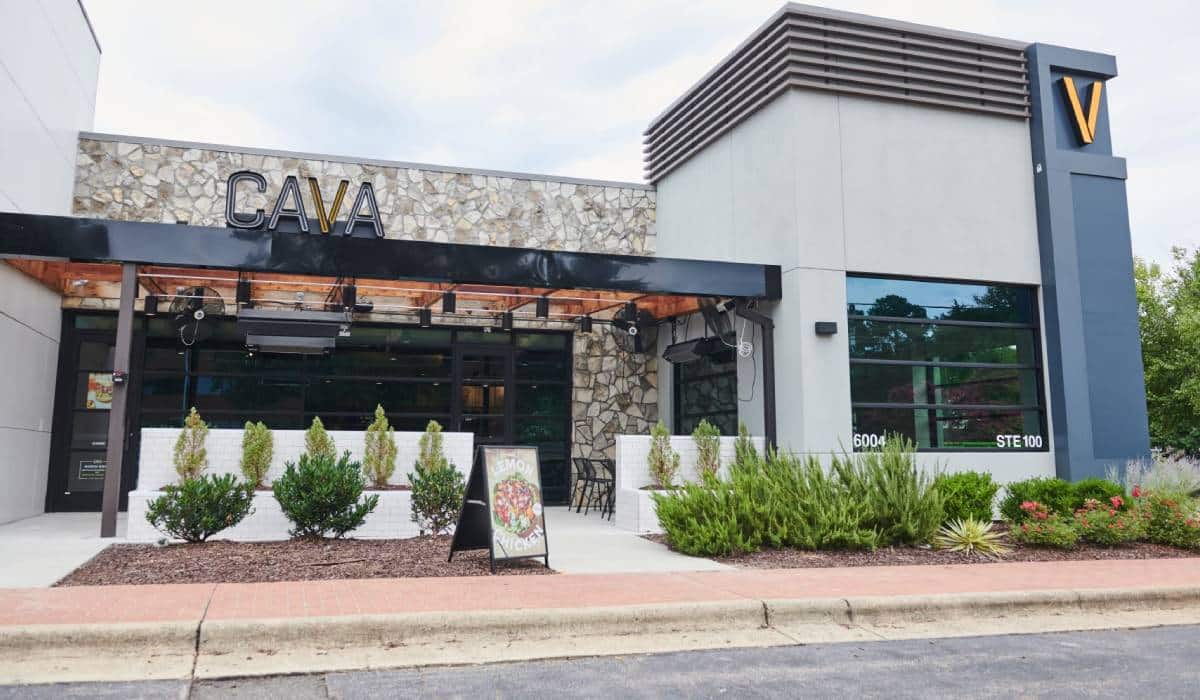
The typical CAVA restaurant is now doing more than $3 million in annual sales, a figure that would have seemed ambitious just a few years ago. And as the Mediterranean fast casual pushes deeper into the country, it is finding that customers in smaller markets and lower-income communities are just as receptive to the brand as those in its established territories.
That consistency is helping CAVA maintain its expansion trajectory despite an unpredictable consumer environment that disrupted traffic during the third quarter.
The chain reached 500 restaurants during the period, achieving the milestone ahead of schedule on its journey toward at least 1,000 locations by 2032. It opened 24 net new restaurants, bringing its footprint to 30 states and Washington, D.C., and increasing its restaurant count 20.5 percent year over year.
Revenue climbed 22.1 percent to $353.7 million, and same-restaurant sales increased 3.1 percent, driven primarily by menu pricing and product mix. Guest traffic was slightly positive.
READ MORE:
The People Plan Fueling CAVA’s Expansion
CAVA Sees More Room to Run as Restaurant Volumes Climb
CAVA Sees Massive Runway as Mediterranean Cuisine Goes Mainstream
CFO Tricia Tolivar says the results demonstrated CAVA’s ability to maintain momentum despite pressures affecting the industry.
The quarter began with consumer concerns surrounding Cyclospora and fresh produce consumption, which reduced CAVA’s same-restaurant sales by an estimated 150 basis points. The food safety issues were not directly connected to the chain, but they temporarily affected customer behavior across the category.
Higher gasoline prices created another obstacle following Labor Day, contributing to uneven traffic patterns before conditions improved toward the end of September.
CAVA did not introduce additional promotions or make significant changes to its operations in response to the produce concerns. Tolivar says customers gradually returned as the initial uncertainty faded.
“Food safety is always a very high priority for us, and we continue to to focus on that as we always have,” Tolivar says. “There wasn’t anything specifically that we did or shifted to address the concerns.”
The recovery continued into October, giving CAVA confidence to increase its full-year same-restaurant sales guidance to 6–7 percent. The company also expects 76–78 net new restaurants in 2026.
One of the more notable developments is where CAVA is finding its strongest sales growth.
Restaurants in markets with lower median household incomes continue to outperform the rest of the system on comparable sales, driven by transaction growth and customer demand for premium proteins. The results challenge assumptions that consumers facing greater financial pressure would gravitate exclusively toward the least expensive menu items.
CAVA offers an entry-level meal priced around $10.65 at many locations, allowing customers to choose chicken, falafel, or roasted vegetables, along with unlimited toppings, three dips and spreads, and two dressings. Customers can also upgrade to higher-priced proteins.
Tolivar says that flexibility has helped CAVA reach a diverse customer base without resorting to aggressive discounts.
“Since 2020, we had significantly underpriced CPI inflation, as well as food away from home and food at home, to create an increasingly strong value proposition for our guests, so that they can access our food and enjoy it, and really have that experience of great flavors and great tastes that make you feel good while you’re eating it, and after,” she says.
The company is also seeing little evidence of customers systematically trading down across its menu. Tolivar noted a modest increase in kids’ meal purchases, although CAVA could not determine whether that was connected to financial pressure or the growing use of GLP-1 medications.
Average unit volumes have increased to $3.1 million from $2.9 million last year and approximately $2.4 million several years ago.
The company is finding similar success across established and developing markets. Its 500th restaurant opened in Minneapolis, and CAVA is preparing to debut in Las Vegas later this year.
Tolivar attributes the consistency to growing brand awareness following CAVA’s 2023 IPO and its ability to deliver a familiar experience across different communities.
New restaurant productivity continues to run near 100 percent, meaning recent openings are performing in line with the company’s established productivity benchmark.
CAVA expects at least 16 percent unit growth in 2027, supported by a development pipeline that extends into markets where the chain has limited or no existing presence.
New restaurants are also producing attractive financial returns. The company reported first-year cash-on-cash returns exceeding 40 percent, making development its preferred use of capital.
However, CAVA is spending more money to prepare restaurants for opening and ensure employees can handle the higher volumes.
Preopening expenses increased to $8.4 million from $4.9 million a year earlier. The company is investing an additional $50,000–$60,000 per restaurant in employee training, earlier onboarding, and support during the initial weeks of operation.
The investments are producing measurable improvements in retention. GMs receiving expanded preopening training have experienced turnover in the low-single-digit range, compared with substantially higher rates previously.
CAVA has also expanded its assistant GM program to approximately 75 percent of restaurants and introduced annual equity grants for general managers.
Its 110 Academy-certified GMs receive additional compensation, and the company offers incentives for developing employees who advance into higher positions.
Restaurant-level profit increased 16.2 percent to $82.7 million during the quarter, although the margin declined to 23.4 percent from 24.6 percent a year earlier. Higher labor expenses, third-party delivery mix, and investments in repairs and maintenance contributed to the decrease.
CAVA is also simplifying kitchen operations through premarinated chicken, produce slicers, and new technology that gives restaurant operators greater control over digital orders and inventory.
The chain has temporarily disabled third-party delivery and catering at certain new locations to help employees concentrate on in-person service during busy opening periods.
Menu innovation presents another opportunity to drive customer frequency.
CAVA’s pomegranate-glazed salmon has performed in line with expectations and will stay on the menu through spring 2027, extending its original planned run through the end of 2026.
The company has completed market and operational testing for roasted garlic shrimp, with more details on a national rollout expected next quarter.
During the chain’s Q3 earnings call on Wednesday, CEO Brett Schulman said shrimp has experienced stronger adoption during testing because customers can combine it with another protein in a half-and-half order, an option unavailable with the four-ounce salmon fillet.
CAVA also plans to bring back its popular white sweet potato in January. Recent additions include Greek Goddess dressing and a pomegranate apple beverage.
Tolivar says attachment rates for chips and drinks have remained stable or increased, indicating that customers continue purchasing additional items despite economic uncertainty.
CAVA is simultaneously investing in the physical restaurant experience through Project Soul, which incorporates warmer interiors, natural light, and inviting dining areas. A related initiative, Project Sun-Kissed, will bring similar upgrades to existing restaurants.
An early remodeled urban location experienced an 18 percent increase in dinner sales, according to Schulman, supporting the company’s belief that customers still value opportunities to dine inside restaurants.
The company is also developing its catering business and preparing additional loyalty personalization capabilities for 2027.
Despite the spending required to support these initiatives, CAVA finished the quarter with $427.9 million in cash and investments and no outstanding debt. Adjusted EBITDA increased 5.7 percent to $42.3 million, and net income totaled $13.2 million.
Tolivar says CAVA is focused on preserving its growth trajectory without sacrificing the experience that attracts customers in the first place.
“[We] want to make sure that we’re resisting the temptation to throw out a lot of limited-time offers into our restaurants because that can often put a lot of burden on the team members. So, trying to create a great environment for them because, in our view, a happy team member equals a happy guest, and ultimately a happy P&L, and that’s what we’re striving to do,” Tolivar says.