Among the chains in this year’s QSR Contenders list, which will be fully unveiled in August alongside the QSR 50, and sorts 50 brands by systemwide sales outside the top group, there was one that flashed from a growth perspective: Cinnabon.
The 1984-founded treat concept, part of GoTo Foods’ seven-brand lineup (the company bought it for $30.3 million in cash in 2004 from AFC Enterprises, the group directing Popeyes at the time, which sold Seattle’s Best Coffee to Starbucks a year earlier, too), lifted in the U.S. by a net of 308 stores. Among the Contenders, the closest chain was Playa Bowls, which added a net of 81 restaurants. Buffalo Wild Wings’ counter-service offshoot, BWW GO, followed at 79.
Even considering the Top 50 chains, as explored here, Cinnabon’s number trailed only Wingstop’s 382 net domestic expansion in 2025. Cinnabon lifted by more units that Chipotle (294), 7 Brew (281), Jersey Mike’s (238), and Dunkin’ (231).
This pace marked a major year-over-year acceleration. Cinnabon expanded by 18 stores in 2023 and 56 in 2024 before nearly 6Xing that speed. It came all on the franchised side, where Cinnabon exited 2025 at 1,310 stores alongside 28 corporate.
Its franchised footprint has climbed from 929 at the outset of 2023 (23 and 50 in the past two years, respectively). Company-run, or affiliate owned, declined by five in 2023 before growing by six in 2024. As noted, it was flat at 28 in 2025.
Overall, Cinnabon opened 348 locations, terminated 36, had a non-renewal, didn’t reacquire any restaurants, and ceased three for other reasons. The openings compared to 91 and 53 the prior two calendars and terminations to 31 and 26. Cinnabon ceased three stores in 2024 as well (none in 2023).
The three that ceased in 2025 were in California, Delaware, and Michigan, and were food trucks. One relocated to Florida and two to New York (they were listed as openings in those states).
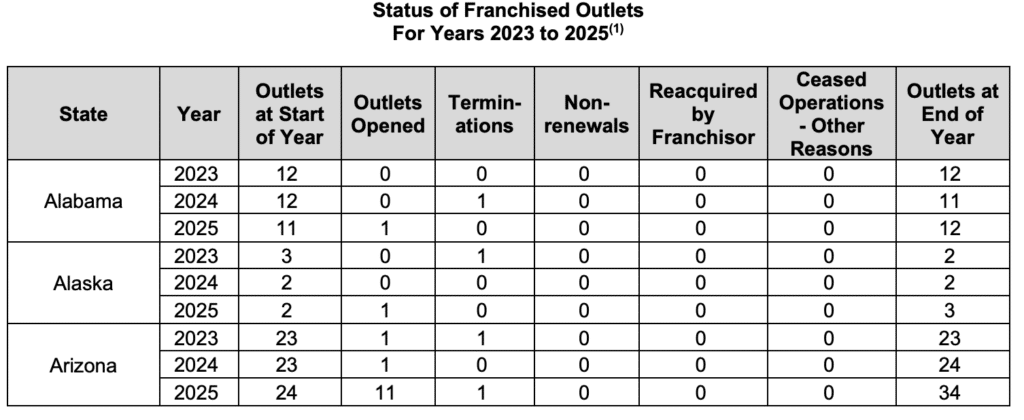


Cinnabon projects 95 new franchised bakeries in 2026 with a deep pipeline of 359 franchise agreements signed without a store opened yet. Texas has 14 units on deck to lead the 2026 field. The Lone Star State (50), New York (46), and California (42) are currently the top three for signed franchisee agreements.
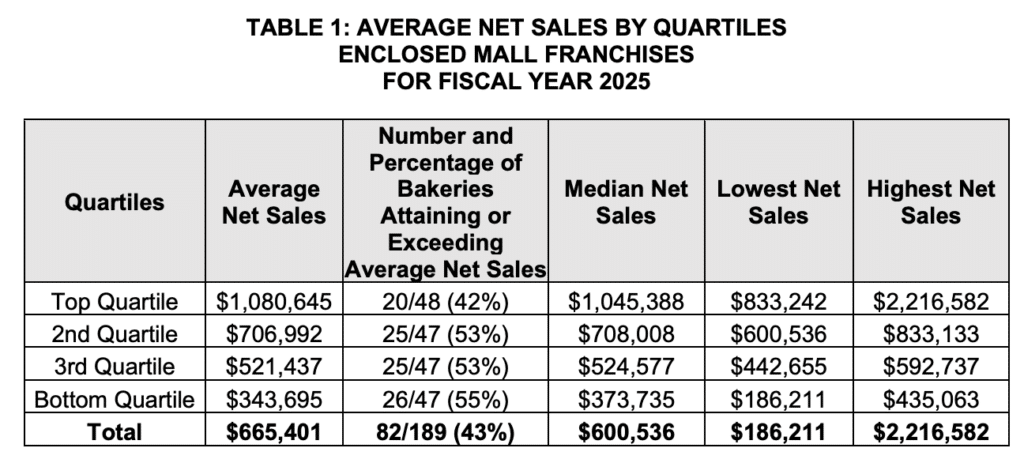
Cinnabon is a brand, naturally, that shows up as a few iterations. It disclosed financial performance for enclosed mall franchises, convenience franchises (located in travel plazas, centers, or C-stores), and Auntie Anne’s co-branded franchisees. The company does not share information for franchised bakeries in traditional locations or non-traditional ones outside those buckets. Things like express models, co-branded Cinnabons that aren’t with Auntie Anne’s, company restaurants, and concessions (food trucks fall in here).
Up first are mall venues. As of December 28, 2025, there were 267. Of the pool, 189 were included in Cinnabon’s table. Six permanently closed in 2025. Cinnabon also excluded 62 mall locations that were co-branded, 16 single-branded that did not report sales all 52 weeks of fiscal 2025, and eight openings. Cinnabon did not reacquire any stores in 2025.
Here’s a look at convenience franchises. Cinnabon had 219 of these by year’s end. It featured 187. That left out four co-branded venues and 28 single-branded that didn’t report sales all year, including seven openings and eight closures. Again, no company purchases here, either.

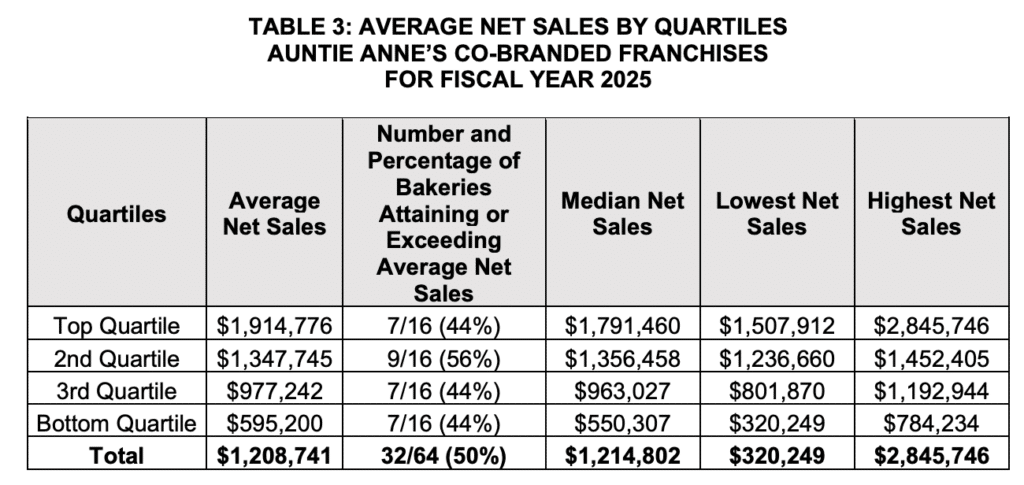
On the same date, there were 69 co-branded Auntie Anne’s franchises. The company brought the pretzel chain onboard in 2010, marking its sixth concept at the time, joining Cinnabon, Carvel, Schlotzsky’s, and Moe’s Southwest Grill.
Sixty-four locations were featured in the chart. Five that opened last year were left out, as were two that closed. Net sales for Auntie Anne’s co-branded franchises include revenue generated from the sale of both Auntie Anne’s and Cinnabon products.
The total investment to open a full bakery franchise ranges from $256,950–$703,500 ($35,659–$60,367 paid to the company). For an express model, its $29,250–$66,900 in a new Schlotzsky’s restaurant and from $70,850–$191,950 in any other location ($8,159–$31,267 paid to the company).
Concession bakeries run $125,465–$325,875 ($5,659–$28,767 upfront). An Auntie Anne’s co-branded venue is $410,675–$1.205 million ($71,159–$120,467 to the company).
A Carvel co-branded bakery or a Swirl bakery ranges $463,250–$1.136 million ($71,159–$121,467 upfront).
Swirl refers to the Cinnabon Swirl mark that offers a unique menu and traditional Carvel and Cinnabon items in addition to hybrid offerings. More on that here.
In-line full bakeries generally range about 1,300 square feet with 12 seats and three to six tables. A kiosk for a full bakery is 250–400 square feet and does not include seating.
The co-branded Auntie Anne’s show 1,270 square feet on average, and a Carvel co-branded or Swirl restaurant generally occupies about 1,325–1,590 square feet.
Express bakeries emerge at 80–100 square feet and most likely get developed as a co-brand within the space of a host facility. In limited circumstances, they’re located in another facility GoTo Foods approves.
So, rental costs fall concurrent with locating and leasing the site for a Schlotzsky’s or host facility. Express bakery seating varies depending on the location. There’s no counter seating.
Cinnabon posted total U.S. systemwide sales of $292 million in 2025. Fellow GoTo Foods brands Moe’s ($658 million), Jamba ($462 million) and Schlotzsky’s ($341 million) made the Contenders list as well. Auntie Anne’s ($813 million) and McAlister’s ($1.029 billion) were in the Top 50.
GoTo Foods also owns the Seattle’s Best Coffee brand on certain military bases and international markets.
Globally, as of March 29, Cinnabon boasted a footprint north of 2,400 locations through 48 states and 65 countries and territories. The brand is a global licensor for grocery stores, universities, and more.
Speaking of Seattle’s Best, Cinnabon in May announced it was upgrading its beverage platform (more on this in an upcoming podcast) thanks to a nationwide rollout of the brand. The goal being to enhance offerings amid a surging category and show up across more everyday locations. The coffee complements Cinnabon’s menu and aims to improve mix and support unit-level economics for franchisees. Seattle’s Best uses Cinnabon’s existing drip coffee equipment.

Additionally, the brand recently rolled out Swirled Sodas to capitalize on the dirty soda trend.
Cinnabon has been led since January 2025 by chief brand officer Urvi Patel. Also SVP of Brands for GoTo Foods, she previously was SVP, customer experience and engagement for the company and before, VP, strategy and insights. Patel came to GoTo Foods after 10 years with InterContinental Hotels.
GoTo Foods, backed by Roark Capital, closed 2025 by naming former Albertsons chief merchandising and digital officer Omar Gajial CEO. He replaced Jim Holthouser, who had joined the company in February 2020. GoTo Foods was rebranded, from FOCUS Brands, in February 2024— signaling an ongoing transformation toward an interconnected restaurant platform.
FOCUS was created in 2004 when Roark purchased Cinnabon and Seattle’s Best. It combined with Carvel—acquired three years prior—to form the early iteration of FOCUS. There were about 1,200 stores. It would add Schlotzsky’s in 2006, Moe’s Southwest Grill a year later, Auntie Anne’s in 2010, McAlister’s in 2013, and Jamba in 2018.
Presently, the company oversees 7,400-plus restaurants, cafes, ice cream shoppes, and bakeries in all 50 states and in 71 countries and territories