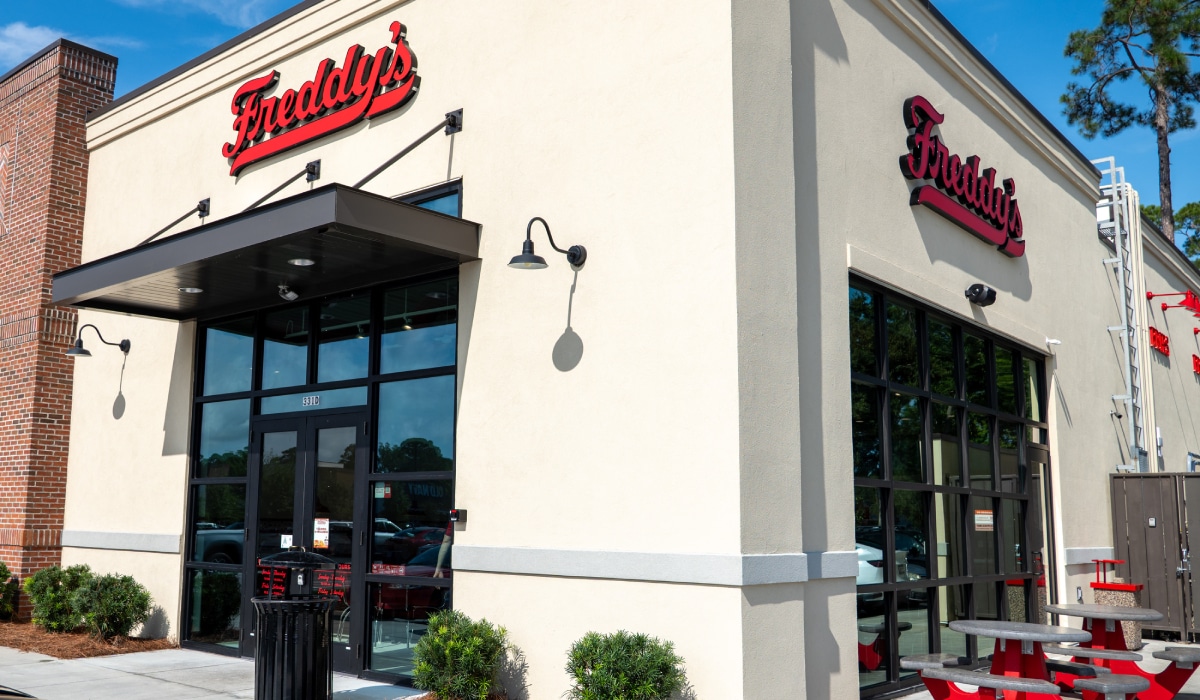
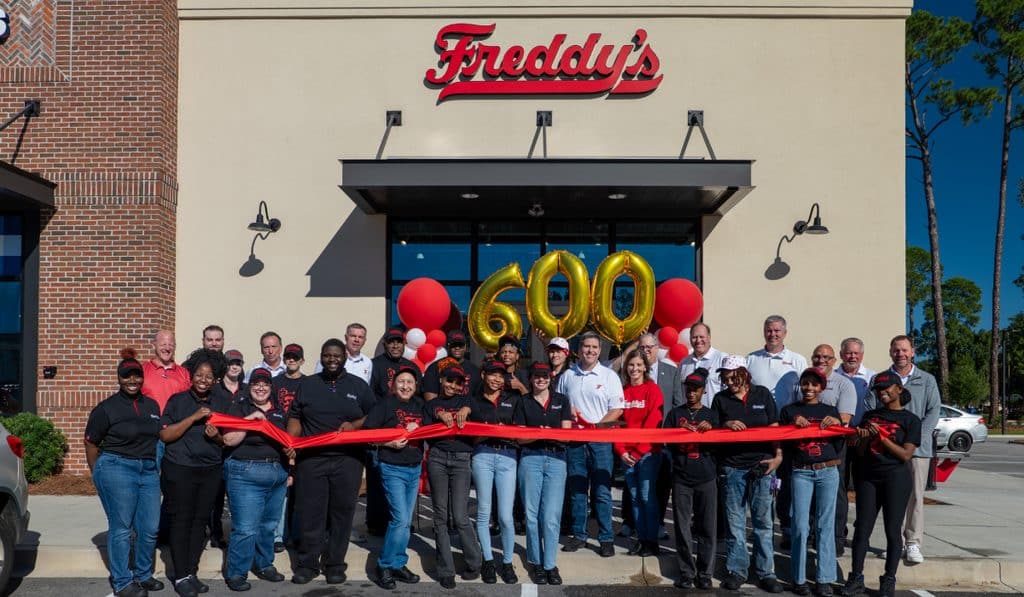
On a warm fall morning in October, Freddy’s leadership whipped out big red scissors and a long piece of ribbon to mark the opening of the brand’s first location in Beaufort, South Carolina.
But in the background of this moment, with staff members and C-suite executives gathered together, there were three golden balloons shaped as numerals to showcase an important milestone—Freddy’s has reached 600 units systemwide. It marks a significant achievement for a brand that began in Wichita, Kansas, in 2002.
But the new restaurant represents more than another addition to the chain’s national footprint. It offers a glimpse into how Freddy’s plans to accelerate expansion as development becomes more expensive and operators face continued pressure on profitability.
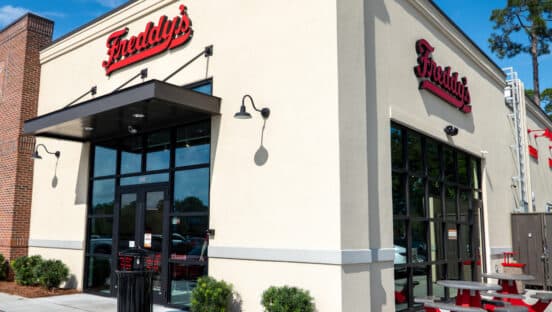
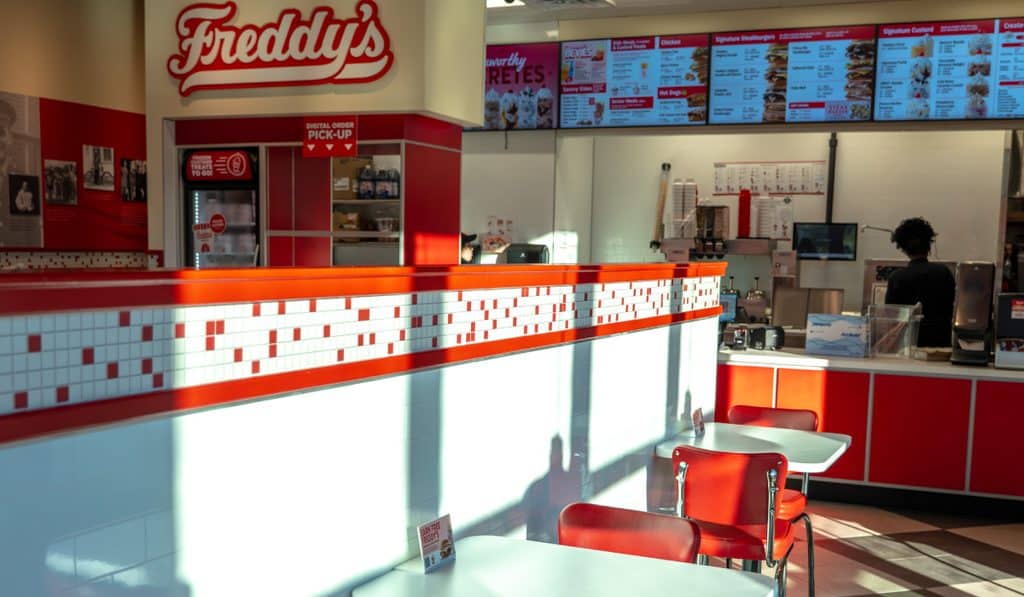
The unit introduces a 2,300-square-foot endcap format without a drive-thru. Operated by longtime franchisee Charleston Custard, the location seats 65 guests and includes an outdoor patio.
The format is part of a change in Freddy’s real estate strategy. Historically, opening a restaurant typically required purchasing land and constructing a freestanding building. The company is now giving franchisees more opportunities to lease existing spaces, reducing upfront costs and opening markets that previously would have been difficult to develop.
“Six years ago, Freddy’s was a franchise opportunity for folks who could afford to buy an acre of land and build a building, and that’s a very meaningful investment,” CEO Chris Dull says. “Whereas, today, with a format like this restaurant, you don’t have to buy an acre of land, you don’t have to build a building. You have to finish out an interior, bringing that investment level meaningfully down.”
The strategy is already changing Freddy’s development pipeline.
Chief development officer Andrew Thengvall says approximately half of the company’s current pipeline consists of endcap, inline, or second-generation restaurant spaces. Just a year ago, those formats represented approximately 10–15 percent.
The company has also identified savings through changes to restaurant construction and equipment procurement. Thengvall says recent projects have eliminated $200,000–$300,000 in building costs without materially changing the customer experience.
“It’s quicker to open. It’s a lower investment, and frankly, it’s easier to operate,” Thengvall says.
Freddy’s has been testing smaller formats for several years. Of the approximately 40 corporate restaurants it operates, the six most recently developed locations have used non-ground-up formats. The company also has more than 50 franchised restaurants in non-freestanding buildings.
The smaller restaurants also create opportunities in denser trade areas. Freddy’s historically developed many locations on the outskirts of growing communities, where land was more affordable. Leasing existing retail space allows the brand to pursue established urban and suburban locations without purchasing expensive parcels.
“The landscape of opportunities for us is 10x what it was just a few years ago,” Dull says.
Big Development Pipeline
Freddy’s is the 14th-largest burger chain in America, earning $1.04 billion in U.S. systemwide sales last year. It opened a net of 124 restaurants across 2023, 2024, and 2025.
The chain expects to open approximately 60 restaurants in 2026, continuing a steady pace of annual expansion. The company has more than 450 restaurant commitments in its development backlog and approximately 80 franchise operating groups.
Its pipeline spans the country, with activity in Washington, California, Florida, South Carolina, and the Philadelphia area, among other markets.
Thengvall says development commitments are generally split evenly between existing and new franchisees, giving the company a combination of experienced operators and new investment.
The company is also selective in approving sites, evaluating construction expenses, projected sales, rent, and potential franchisee returns before moving forward.
“There’s nothing that hinders your growth more than an unprofitable franchisee or an unprofitable location, so we try to avoid those,” Thengvall says.
Dull believes the more accessible investment requirements could eventually push Freddy’s annual openings closer to 100 restaurants.
“The amount of new interest that we’re seeing in the brand and new groups looking at Freddy’s to come and bring into their portfolio of other concepts that they operate is quite high,” the CEO says.
Keeping the Freddy’s Experience Intact
The Beaufort restaurant is smaller than Freddy’s traditional locations, but the company has preserved its dining room experience.
Dull says dine-in transactions are approaching 40 percent of sales, recovering from the shift toward off-premises ordering during the pandemic. The new restaurant includes movable seating to accommodate families, teams, and larger groups.
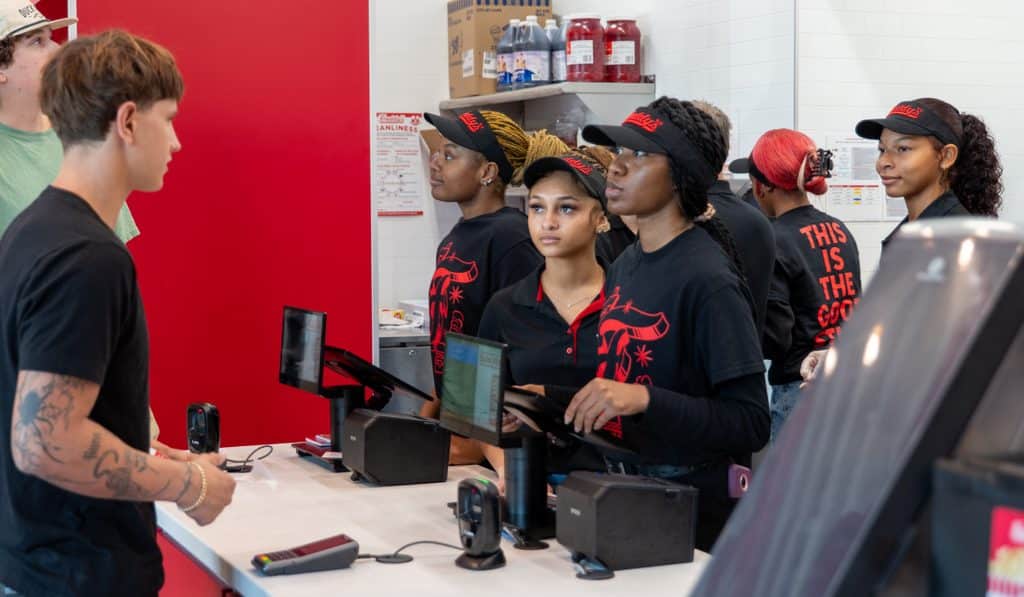
The company has also adjusted its operations to accommodate restaurants without drive-thrus. Executive chef and vice president of training and innovation Rick Petralia says the Beaufort location has additional space dedicated to digital order pickup and places greater importance on staffing its front counter.
Kitchen training materials are customized to account for different equipment configurations and employee workflows.
Petralia says the company brings experienced trainers into new restaurants to prepare employees for opening day. The process includes simulated high-volume shifts, cross-training, and hands-on instruction.
“All they care about is getting the great food and great hospitality they came for,” says Petralia, regarding customer feedback.
The company is also investing in technology to simplify operations across its expanding footprint.
Chief information officer Todd Paladini says Freddy’s uses visual kitchen display systems that help employees follow product preparation instructions and reduce training time. The company is exploring AI applications for sales forecasting, employee scheduling, and proactive equipment support.
Freddy’s is also preparing to test its first self-service ordering kiosks at a corporate restaurant in University City, Missouri, with the pilot scheduled to begin the week after the Beaufort opening.
Paladini sees opportunities to eventually incorporate AI-powered voice ordering into digital platforms and kiosks, although the company is prioritizing practical applications that support restaurant operations.
“We try to make it predictable in terms of IT. It’s repeatable, it’s scalable, and at the end of the day, it’s secure,” Paladini says.
Building Sales without Discounts
Restaurant expansion is only one piece of Freddy’s strategy as the brand approaches its 25th anniversary in 2027.
Dull says traffic is positive year-over-year, although sales have been approximately flat. Consumer spending pressures have prompted the chain to explore more affordable menu options without relying on traditional discounting.
Earlier this year, Freddy’s introduced its Steakburger Taco, priced from approximately $2.99 to $4.49 depending on the market. The product became part of a four-item Everyday Value menu currently being tested in nearly 100 restaurants.
The company expects to introduce the menu systemwide during Q1 2027.
The value products are attracting customers purchasing them as individual meals and as additions to larger orders, according to Dull.
Freddy’s is also continuing beverage innovation, with Petralia identifying the category as an important growth opportunity.
The company is testing new drinks that could include energy beverages, additional soda flavors, and fruit or boba inclusions. One recently opened Kalamazoo, Michigan, restaurant has been selling approximately 100 Freddy’s refreshment beverages per day, according to Petralia.
Menu development will also include a review of existing products in 2027, with the culinary team evaluating opportunities to simplify the menu and improve execution.
Petralia says innovation must fit existing restaurant workflows and deliver profitability without slowing service.
“We need to do things that don’t mess with the overall flow. It can’t hinder the experience of 95 percent of guests,” Petralia says.
As Freddy’s moves toward its next restaurant milestone, the company is seeking to expand its franchise network without changing the core products that built its customer following.
Dull says the brand has preserved its original ingredient specifications, including its beef, buns, and produce, even as it invests in new formats, technology, and menu categories.
“We haven’t changed a single spec of anything that we sell to our guests, from our buns to our beef to our produce,” Dull says. “We’ve kept everything exactly the same because I think you would be foolish to start monkeying with something that had built 20 years of fan base.”