Back to normal.
It’s a state of being restaurants have been scratching and clawing for in the years since the pandemic sent shockwaves through the industry. For Pancheros founder and CEO Rodney Anderson, 2026 has proven to be the year that the phrase has actually become real.
“We’ve been working really hard and trying to make the unit level economics exactly what they were before the pandemic, and I think we’ve done a great job with that,” Anderson says.
The roughly 75-unit Pancheros worked with suppliers to mitigate protein costs and leveraged AI tools to better calculate the right yield amounts and reduce waste. As a result, according to Anderson, Pancheros is back to the lowest food cost it’s ever had, even with continued cost increases related to taxes, digital services, and other expenses.
Franchisees appear to be on board with the brand’s direction, especially because of better operations. Pancheros has focused on remodeling older locations with digital make lines, a feature that’s led to increases in overall sales—not just digital. That’s in addition to better customer satisfaction, more efficient throughput, and lower employee turnover. More digital make lines are being added to restaurants each week.
“First you say, ‘Well, digital sales should go up, but you don’t realize that the in-restaurant guest really likes being treated properly, and those digital sales and the old design with the single make line were interfering with the in-restaurant experience. So that pain went away,” Anderson says. “…It is great for business. It really helps with those peak periods. And not just in handling the third party and the digital stuff, but handling the overall restaurant and the entire package—the entire experience that the customer has.”
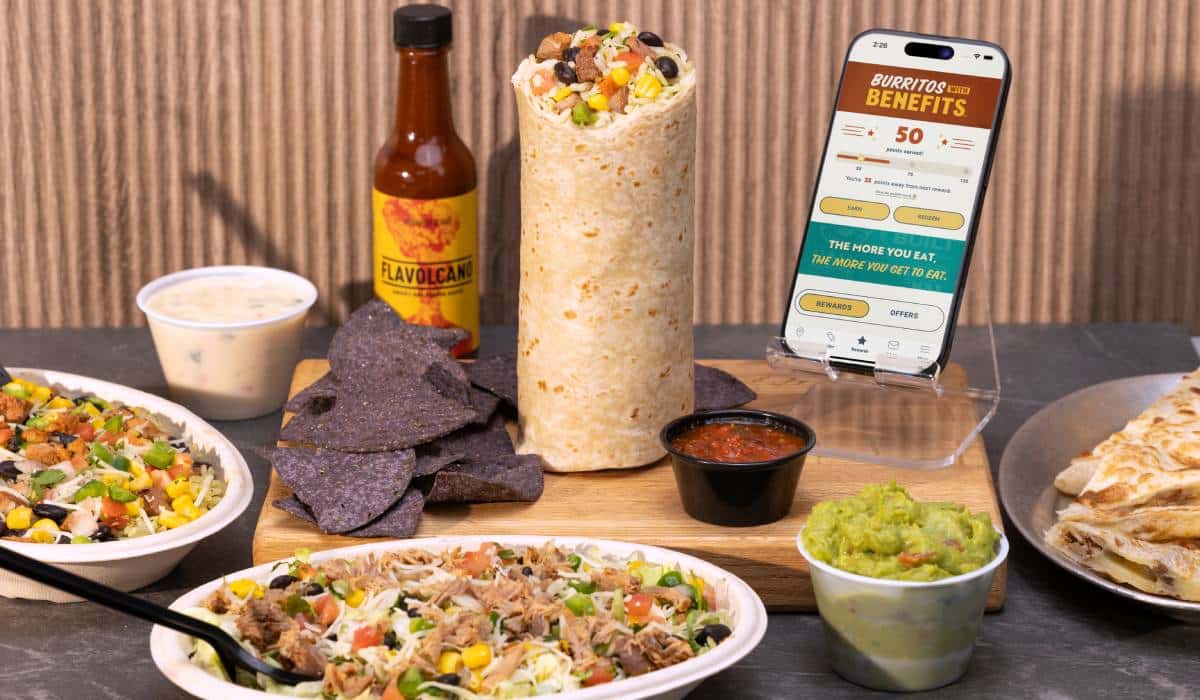
The rise in digital sales, which account for about 33 percent of sales, has coincided with increased loyalty membership. This year, Pancheros reached 1 million members, or about 13,500 per location. About 26.17 percent of members actively participate. These guests have access to promotions around National Burrito Day, Cinco de Mayo, Teacher Appreciation, and more. Pancheros plans to offer a Halloween BOGO deal for its loyalty members next week.
“During the pandemic, we had a real strategy to push digital. Only a couple weeks into it, we realized that we had to have that pickup and delivery work, and we took our entire budget and canceled a lot of projects, canceled a lot of creative, and we really pushed it into developing digital, and our digital grew like crazy, and it’s really given us an advantage over other restaurant chains,” Anderson says.
Anderson describes these promotions as rewarding loyal customers as opposed to discounting. The executive says Pancheros is in an advantageous position because it limited price increases a few years after the pandemic. The chain raised prices no more than 4 percent, he says.
So for those brands that may have implemented double-digit price increases, guests are pushing back, according to Anderson. The same isn’t happening for Pancheros because of its willingness to accept lower margins in the short term.
“We have kept our prices low. We will probably see a price increase this spring again, probably no more than a few percent. And we just want to treat the customers right, and be concerned with long-run sales and value with them, and not go out and start doing these bundled meals and discounts and things like that,” Anderson says. “But we do have a good loyalty program where we do reward them for eating there, and we do some promotions to bring them in. But we’re just very stable in how we approach the consumer, and we try to respect that long term.”
Growth is coming as well. Pancheros has several leases signed, mostly in the Midwest. For instance, Mex Midwest, an operator of Scooter’s Coffee, Wingstop, Jersey Mike’s, Smalls Sliders, and Billy Sim’s BBQ, signed a three-unit deal, including two locations in Northern Illinois.
Pancheros operator Davis Fresh-Mex—named franchisee of the year for the second time in three years—opened two Missouri locations in 2026. The chain debuted another unit in Waukee, Iowa.
However, Anderson acknowledges that construction costs have been a hurdle.
“It’s not quite as easy to build the restaurants, depending on where you are, cost wise. And I think multi-unit operators are looking at that and saying, ‘Well, what should I do?’ And unfortunately, interest rates really haven’t come down. So I think that’s a challenge. But our goal is to be very selective in who we franchise with. We really want to be contiguous to our markets—not too far away, so that we have some branding. But we’re doing a good job at growing in that contiguous fashion,” Anderson says.
Pancheros eyes endcap locations that are typically 2,000 to 2,400 square feet. The chain has slightly reduced the number of tables in its dining rooms but retained enough seating to accommodate dine-in guests.
While digital has been significant for the brand, Anderson hasn’t lost sight of in-restaurant sales.
“In these restaurants that do very well, you would have trouble taking care of the guest if you didn’t have at least 19 tables. I think the industry has overreacted to the digital and taken away a little too much of restaurant dining, and we find that as a competitive advantage versus others that are doing these 12 full table restaurants, and the customers don’t have anywhere to sit and they’re sitting with somebody they don’t know,” Anderson says.
The industry veteran is hopeful that Pancheros is putting forth a product that more operators will want to be a part of in the future.
“Development-wise, I really would love to see these a couple of these franchisees that are open in the slightly smaller markets do well and continue to build stores, and I’d like to find a few franchisees in contiguous markets that would open and build on what we’ve started in the Midwest and the Northeast,” Anderson says.