

While concrete data on the subject is difficult to uncover, likely because it’s so minuscule, the number of U.S. companies that make it to 100 years is theorized to be somewhere around half a percent. So maybe 1,000–2,000 nationwide, or somewhere in that range. What we do know from Bureau of Labor Statistics figures, though, is just 36 percent last a decade and a shade over 20 percent survive 20 years. It then tumbles, per the Census Bureau, to roughly 12 percent after 26 years.
Chick-fil-A CEO Andrew Cathy did his best to investigate the point as 2026—the brand’s 80th anniversary—approached. Again, there was no definitive feedback, but that fact didn’t change Cathy’s sentiment. “We take that very seriously,” he says of Chick-fil-A’s longevity, “in the sense of just being grateful of the way customers care for us.”
Roughly a year before turning 80, Chick-fil-A, with help from company historians (naturally, it has those), archives, family members, and long-tenured employees, began crafting a “Newstalgia” campaign to celebrate. This includes rolling touchpoints like retro-inspired cups, 3,000 of the now-viral Gold Fan versions, where customers can win Chick-fil-A for a year, frosted sodas and floats to trigger memories, and a host of packaging, marketing, digital, and culinary experiences to come.
To understand “Newstalgia” as it pertains to the brand, Cathy says, Chick-fil-A kept returning to perspective. His grandfather, S. Truett Cathy, started the Dwarf Grill (later renamed The Dwarf House) in 1946 with his brother, Ben, in Hapeville, Georgia. That’s where Truett invented a chicken sandwich that ultimately inspired the creation of Chick-fil-A in 1967 in Atlanta’s Greenbriar Mall.
But in those early days, Cathy says, Truett and Ben placed everything on the line to be successful. The restaurant industry, even more so than those larger business realities, is unpredictable. Any consumer-facing enterprise is a battle of trying to control the controllables while fate laughs. Everything from the weather to elections can decide if Year 2 arrives.
Considering the hazard and delicacy of this dream, Truett and Ben focused on diners coming through the door. “It started with the food and hospitality,” Cathy says. “… And, of course, over the years, that’s how he built the business.”
Closing on Sundays. That was hardly uncommon in the 1940s. Truett, to his core, Cathy explains, felt if he was open 24 hours per day, six days a week, he needed a rest. He liked to go to church and wanted employees to know they had a day off every week. They could sleep. Spend time with family. It was about assurance.
“That’s one of those things that’s timeless,” Cathy says. “The real and innate focus on the food and excellent service is another thing.”
The capital “A” in Chick-fil-A stands for “top-grade-A quality.”

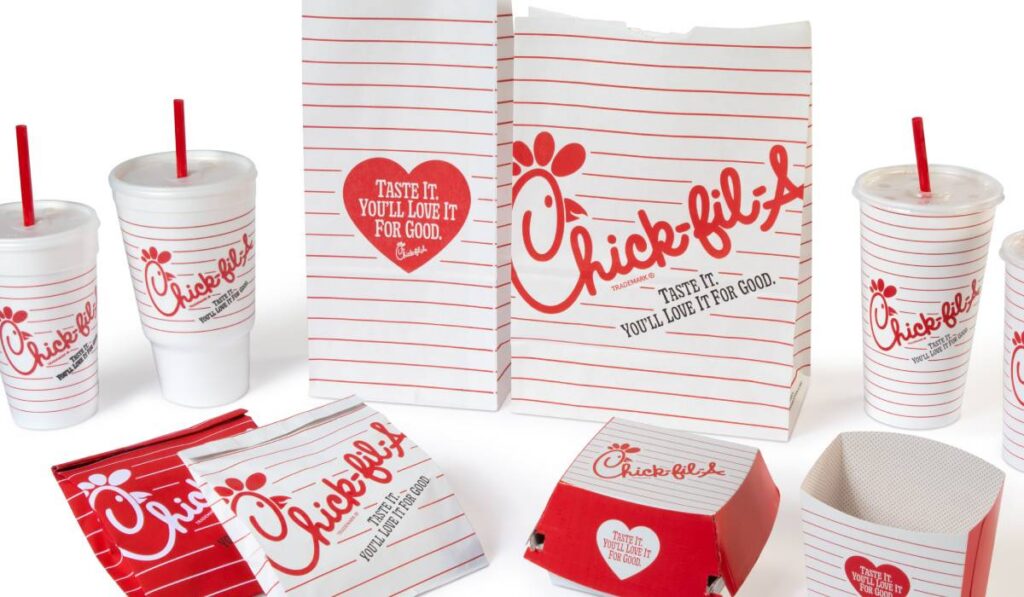
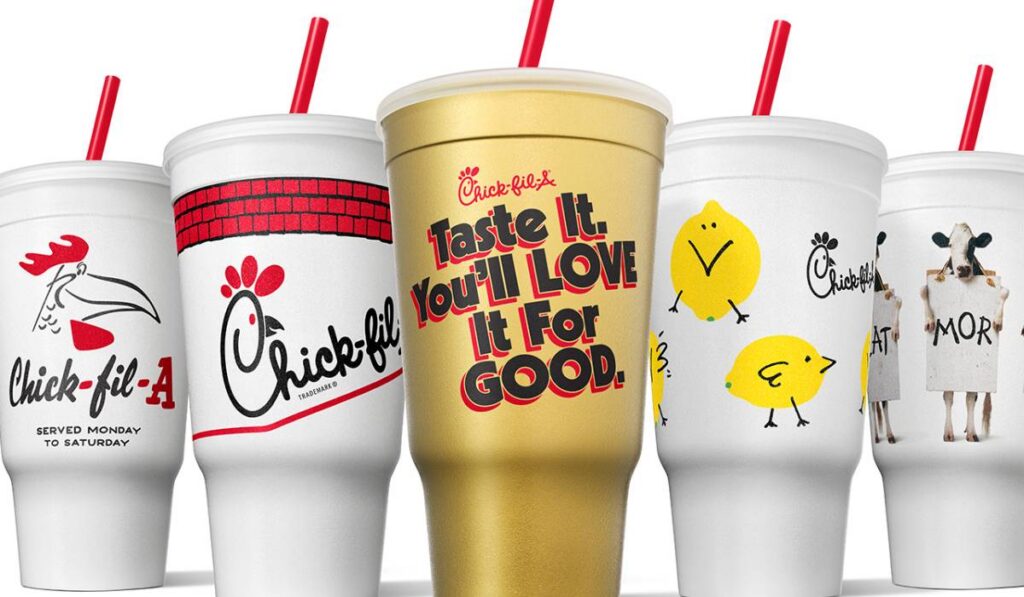
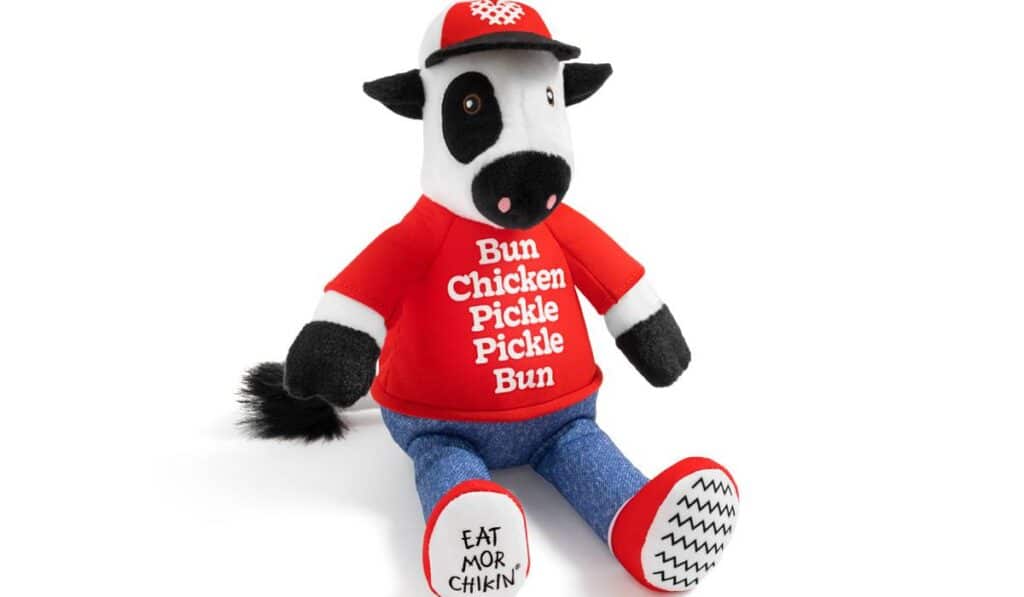
And now, Cathy says, Chick-fil-A had a twofold goal on its mind for 2026. Firstly, it’s going to celebrate loyal customers who have helped the brand get where it is and honor those ideals. That means tapping the nostalgic well with launches like specialty plush cows, bringing back “Cow Appreciation Day,” and even reintroducing the “Cow Calendar” retired in 2018 after 20 years. As Cathy puts it, the brand will “create memories and flashbacks for those who have been with us over the years.”
Chick-fil-A’s iconic “Eat Mor Chikin” phrase began on an Atlanta billboard in 1995. The cows were inducted into the Madison Avenue Advertising Walk of Fame in 2007.
As for the cups, which have garnered ample social media buzz, when Cathy saw the initial versions, he recalls, red shingles transported him to the early 1980s, when he was traveling with his father, Dan Cathy (second CEO in brand history), to openings and sampling food from mall locations. The cups with the stripes resurfaced high school and the 1990s working in restaurants.
Cathy became an operator at a store in St. Petersburg, Florida, in 2005. A couple of years later, he joined Chick-fil-A’s support center staff as a franchisee selection consultant and, after leading the process—famously more difficult to secure a Chick-fil-A store than it is to get into Harvard—he joined the company’s executive committee in 2015 as chief people officer before becoming head of operations. Cathy helmed international strategy in 2016 and was named VP of operations in 2019. He was appointed CEO in 2021.
“It just sparks those memories,” Cathy says. “For those customers, we hope that it creates fond memories as we think about experiences with Chick-fil-A. And as we continue to move into new markets and build new customers, we hope it’s a way for them to have fun with Chick-fil-A and experience it in a unique way.”
The second-fold part is what Cathy referenced there at the end. When he became CEO, Chick-fil-A was experiencing compelling growth. Dan became president and COO in 2001 and CEO in 2013. He added chairman to his title following Truett’s passing at the age of 93 in September 2014. When he was first appointed president and COO, Chick-fil-A earned $1.24 billion in sales and had just more than 1,000 restaurants. By the time he became CEO, the company collected sales of $5.78 billion across 1,881 restaurants.
As Cathy assumed the reins, Chick-fil-A had closed 2020 with north of 2,600 restaurants. This past December, there were about 3,100 domestic units open and operating.
Its systemwide sales lifted from roughly $12.2 billion in 2019 to $23.9 billion in 2025. Total revenue was $6.3 billion in 2022 and $10.3 billion in 2025. Average-unit volumes for freestanding drive-thrus climbed from $7.096 million in 2020 to $9.1 million that latter year.
Needless to say, Chick-fil-A has plenty of new customers to reach with “Newstalgia” as well as longstanding ones.
How it will do so, in addition to the playbook devised by corporate, comes down, as it always does for Chick-fil-A, to its owner-operator model that’s been going on since Truett wondered how he might be able to replicate his own success with like-minded partners 59 years ago. Chick-fil-A started developing free-standing units in the 1980s as mall development slowed (the first debuted on Atlanta’s North Druid Hills Road in 1986). But wherever stores popped up, the premise was to install a local leader invested in their community who understood the value of “second-mile service.” They were on the ground, listening.
Chick-fil-A buys the land, builds the site, and provides equipment, with owner-operators paying a $10,000 initial fee and giving 15 percent of gross sales plus 50 percent of pretax profit remaining each month to corporate. In a sense, it shifts the model to where Chick-fil-A doesn’t make its living on upfront fees. It needs stores to succeed.
Truett felt transactions followed localized focus. He never lost sight of his father’s struggles during the Great Depression and often referenced his Sunday School teacher, Theo Abby, as a model for how he wanted to live his life. Truett himself taught students for years and had an ardor for giving back he wanted restaurants to embrace.
It’s why Chick-fil-A remains so selective. Franchisors can only exact so much control, from hiring to pricing. But the brand figured if it picked service-minded leaders and then taught them the business, they’d form a fleet of stores that cared about hospitality in a way that mirrored its founder. And that’s what’s happened over the decades, Cathy says. A premise of “cared-for people care for people.”
This is true of 2026’s Newstalgia campaign as well. Cathy says Chick-fil-A wanted operators to get excited and have latitude to interact with customers. You more generally see things like daddy-daughter date nights and other events that embed stores into markets.
“As we think about that balance of new customers and customers who have been loyal all these years, we hope this is that blended piece of making those memories of the past but also creating curiosity to come and try us for the first time,” Cathy says. Expect to see some flavor innovation, like the recent Jalapeno Ranch Club, as well.
Expectations across both aisles
January 5 ushered in, as noted, two new beverage platforms inspired by old soda fountain favorites. Both offered a twist on Chick-fil-A’s classic Icedream dessert.
Frosted Sodas are hand-spun with the product and served with a guests’ choice of fountain drink. Floats are layered with soda and Icedream to create a fizzy, foamy option. Core flavors extend from Coca-Cola to Dr Pepper to Sprite, Fanta, Hi-C, and more.
Here, too, the timeline stretches.
Truett’s customer-facing journey dates to selling six packs of Cokes for a quarter, or each for a nickel, in the summer of 1929. He saw a cross-street neighbor sipping a Coke each afternoon. But she wouldn’t buy from Truett until he could ice them down during a time when many homes didn’t even have refrigerators. He set up shop in the front yard and chipped ice from his mother’s icebox to lower the temperature. His neighbor became a regular and so did other residents.
That kind of “second-mile service” mindset—harkening to Truett’s famed commentary of being in the people, not chicken, business—has threaded operations throughout the years at Chick-fil-A. None more so than partner approval. The company last December announced it was shifting its licensed location strategy to transition “as many as possible” to the local ownership framework. So, college campus, hospital, and theme park locations will eventually benefit from the same zeroed-in approach.
“It’s about the future, but food is food and service is service. And people want to have both of those. If you don’t do that, then the other stuff doesn’t matter,” Cathy says.
In 2023, the brand shared it picked 94 owner-operators, which was less than a half of 1 percent of the applicant pool (Harvard’s acceptance rate is roughly 4 percent, per the U.S. Department of Education).
“Fortunately,” Cathy says, given the approach and regarding Newstalgia, “we don’t have to do a lot of arm twisting on this.”
“[The owner-operators] are entrepreneurial in the way they think about wanting to grow. They have a growth mindset. It’s fun to see the excitement from them as we roll this stuff out and show them what the place is and some opportunities they could use to leverage the business.”
This is the first time in 80 years Chick-fil-A has launched a year-long campaign. And as much as anything, one reality about “Newstalgia” is that it’s going to pulse across the calendar. That will give Chick-fil-A and its operators a chance to keep celebrating the company’s heritage while looking forward, and dropping experiences, merchandise, and products to generate news.
“New products and flavors and different things that reach people,” Cathy says. “There’s just genuine excitement about it. Across our business, and I spend a lot of time around the field, there’s so much optimism and excitement about some of the things coming and ways to connect with guests. That gets me really excited, too, to see their excitement for it.”
The enduring value proposition
Internally, Cathy can’t help but reflect as Newstalgia marches on. When you start looking at companies that do last through the decades, you tend to find ones that guard purpose. Chick-fil-A clarified its “Corporate Purpose” in 1982 as, “To glorify God by being a faithful steward of all that is entrusted to us. To have a positive influence on all who come in contact with Chick-fil-A.”
The brand’s DNA of generosity, Cathy says, remembers Truett’s history of being poor, but, if he had an extra dollar, also trying to find someone to give it to. “That’s really in the spirit of the way we want to operate our business and have the kind of impact where customers not only get great food and service but come away feeling really cared for. That’s what we hope to not only continue but also take into the future.”
These are value-frenzied times in quick service. The past couple of years have been defined by tepid traffic and a consumer shouldering the weight of inflation.
Cathy says Chick-fil-A has always approached the topic holistically, and that’s proven evergreen. The brand fosters “value” from food quality, extra levels of service, and a setting you feel good about coming to, either in-restaurant or via the drive-thru.
“If you can create an environment like that where it’s, I got a great experience, food was off the charts, really good quality, it makes you feel like you got more than what you paid for,” he explains. “That’s where we’d rather err on the side of as we think about it. We’re a premium experience, more than [thinking] about what you paid.”
It doesn’t matter what business you’re in, Cathy adds, if customers feel like they got more than they expected, they correlate it to “value.”
Evolution and fundamentals
All this isn’t to say the Chick-fil-A navigating 2026 looks like the one from the 60s. Cathy says the blueprint remains to reinforce mission and set core values. Those should be ironclad within an organization and lived out beyond a statement. “Everything else,” he says, “has to change and evolve.”
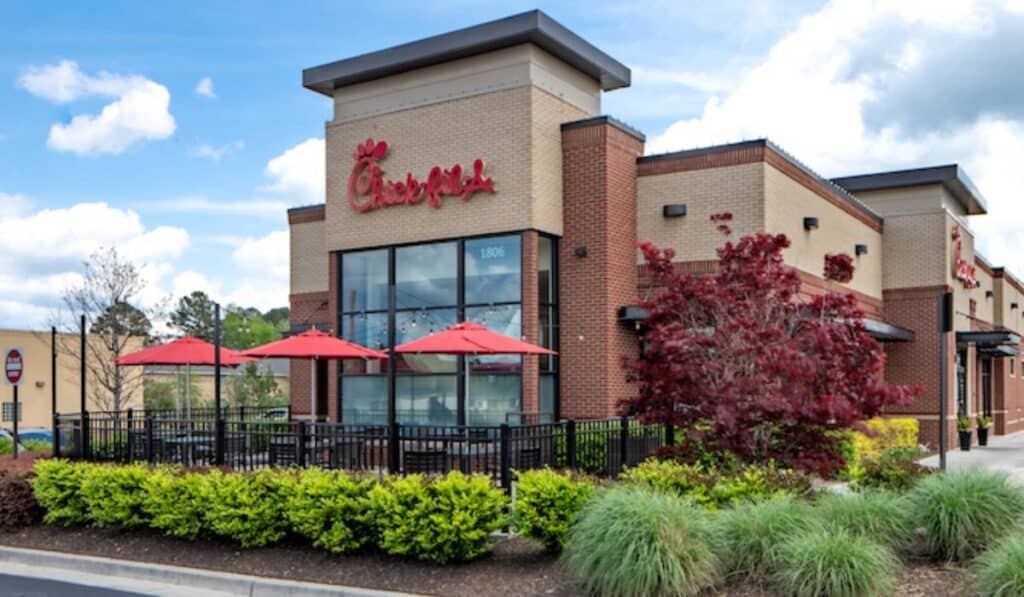
The first Chick-fil-A was a walk-up counter with a register. Today, you have multiple channels operating within one of the highest-volume retail operations in the country. There’s a two-story, four-lane unit in McDonough, Georgia, capable of hosting 75 cars at once. Chick-fil-A is testing drone delivery. It even brought a beverage-focused “Daybright” concept to life in Atlanta suburb Hiram with options like made-fresh daily donuts and specialty coffees.
Chick-fil-A subsidiary Red Wagon Ventures (a nod to Truett’s Coke tale) was established to create new concepts and services beyond staple restaurants, with a mission of exploring fresh ideas. It also operates Chick-fil-A’s “Little Blue Menu,” which is a single venue in College Park, Maryland.
Additionally, the company expanded scope beyond the four walls in November 2024 with an entertainment-focused Chick-fil-A Play App.
Cathy says the company constantly thinks about staying current, food or otherwise. There have been products over the years, like coleslaw, carrot and raisin salad, and lemon ice box pie, the brand discontinued despite years of success. Customer preferences changed and Chick-fil-A did so alongside them. Flavors emerge now, like jalapeno, unlikely to have made it 40 years ago.
And from mall counters to double lanes to drones, Cathy says, it’s vital to meet guests on their own terms.
He likes to think of business as driving a race car (perhaps because Cathy used to race motorcycles before he got older and wiser), where everything is changing quickly. And it’s best to spend more time looking through the windshield than the rear-view mirror.
“That’s why the windshield is so much bigger,” he says. “You’ve got to be aware of the surroundings—competitors, customers. But you have to continue spending more time thinking about the future so you can be relevant and meet customers where they are, whether it’s food, sales channels, or all of the other things.”
Yet “Newstalgia” would just be “new” if it wasn’t for the other side of the coin. Cathy says Chick-fil-A brainstorms often about how it can keep up without becoming unrecognizable. It must be fanatical about that, he says. Restaurants can introduce an app, features, products, campaigns, but if somebody leaves the drive-thru with the wrong order, or they didn’t get the service they expected, food was cold, etc., you’ve lost them. “And all the new app features are irrelevant,” Cathy says.
Chick-fil-A spent ample time in recent years, especially of late as consumers continue to pull back overall QSR spending, doubling, if not tripling down, he says, on the fundamentals of what guests want.
Service and running great restaurants is something Chick-fil-A stressed alongside 2026’s campaign. Cathy admits some pillars blurred a bit coming out of COVID when the task for restaurants turned to throughput and trying to satisfy drive-thru capacity when cafes closed. Most retailers were merely hoping to figure things out.
And Chick-fil-A, as shown earlier with revenue growth, welcomed a lot of customers, hastily. It lost sight at times, Cathy says, of some of those “second-mile service” elements.
In parallel with “Newstalgia” drops and unique products, the company retrenched the execution and hospitality parts of the business. Whatever it can do, Cathy says, to “create that extra wow experience for customers.”
“We’ve got to do both those things,” he says. “It’s about the future, but food is food and service is service. And people want to have both of those. If you don’t do that, then the other stuff doesn’t matter.”
The next 80 years
Given he’s just the third CEO in Chick-fil-A’s history, Cathy has a sharp sense of place. There are 12 people in his generation and 40 so far in “Generation 4.” Cathy has four children. What he hopes to instill going forward is a “spirit of stewardship.”
Cathy’s parents never pressured him to get into Chick-fil-A. He found his way to the business and grew up as his titles did. Whether it’s the family operation or not, however, Cathy wants to encourage this generation to find their callings and seek their passions.
“We’re here to try to improve, make it better, serve guests, serve our community, and use it in a way that really impacts people,” he says of Chick-fil-A.
And more broadly, Cathy hopes the restaurant industry can band together and fight hunger. There are 48 million people in the U.S. today who identify as food insecure. About 20 percent are kids.
“That’s an incredible need that we can work together on,” he says. “We can be competitors in the marketplace. But we can work together to make a difference. That’s my hope from an industry standpoint.”
He feels similarly about the type of food, packaging, and experience restaurants offer customers. There’s always room to get better.
Imagining the next 80 years, Cathy has a rough outline of what a 100-year-plan looks like for Chick-fil-A. It’s understandably impossible to envision the landscape then. But one thing he hopes customers still see from the brand in 2106 is a place they feel cared for.
“That they get great tasting food in a convenient way that meets their needs,” Cathy says. “But that we completely evolve in how that happens. I hope there are ways that people get food that would blow our minds today because we’ve continued to stay innovative and are thinking about the future. At the end of it, though, they still feel cared for, and we’re still known for making a difference in the communities that we serve.”