
“Would you like fries with that?” may be the most recognizable upsell in food service. For decades, suggestive selling has been standard crew training: make it a combo, add a dessert, try the new sandwich.
Crews are still trained on it today. In practice, most don’t do it consistently, and many senior leaders significantly overestimate how often their teams actually do. That gap between training and execution isn’t new. It has just gone largely unmeasured.
After analyzing thousands of real-world drive-thru orders, we found fewer than 10% contained any meaningful upsell or menu suggestion. When an offer was made, it was almost always the same generic pitch tacked on at the end of the order. That’s what I call a Hail Mary upsell. Those offers typically convert in the single digits.
The math changes dramatically when the offer is contextual. Premium toppings convert at 20 to 25 percent. Combo upsizes reach 25 to 30 percent. The difference is timing and relevance.
So why aren’t QSR brands executing this consistently? Training alone can’t solve the structural problem.
The three forces working against your crew
- The first is rejection aversion. Humans dislike being told no, and repeated rejection can wear on anyone over the course of a shift. It’s one thing to ask, “Would you like to make that a combo?” early in the day. It’s much harder to deliver that same suggestion with the same enthusiasm after hearing “no” over and over again.
- The second is competing incentives. Crew performance is measured primarily on order speed. Any behavior that lengthens the interaction is implicitly penalized, even if that behavior generates revenue. The system is optimized for throughput, not ticket size, and crew members respond to the incentive they’re actually measured on.
- The third is immeasurability. Until recently, there was no practical way to track upsell offer rates, conversion rates or incremental revenue at the drive-thru post. You couldn’t see what was happening, so you couldn’t fix it. Without that visibility, brand leaders can easily overestimate how consistently their upsell strategy is executed. The data often tells a different story.
The bottleneck isn’t where you think it is
The most common pushback on drive-thru upselling is that it slows the line. This is understandable intuition, but it misidentifies the bottleneck.
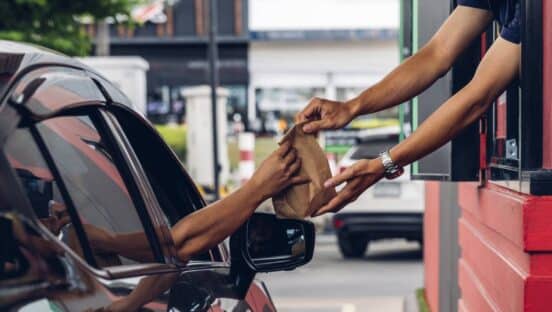
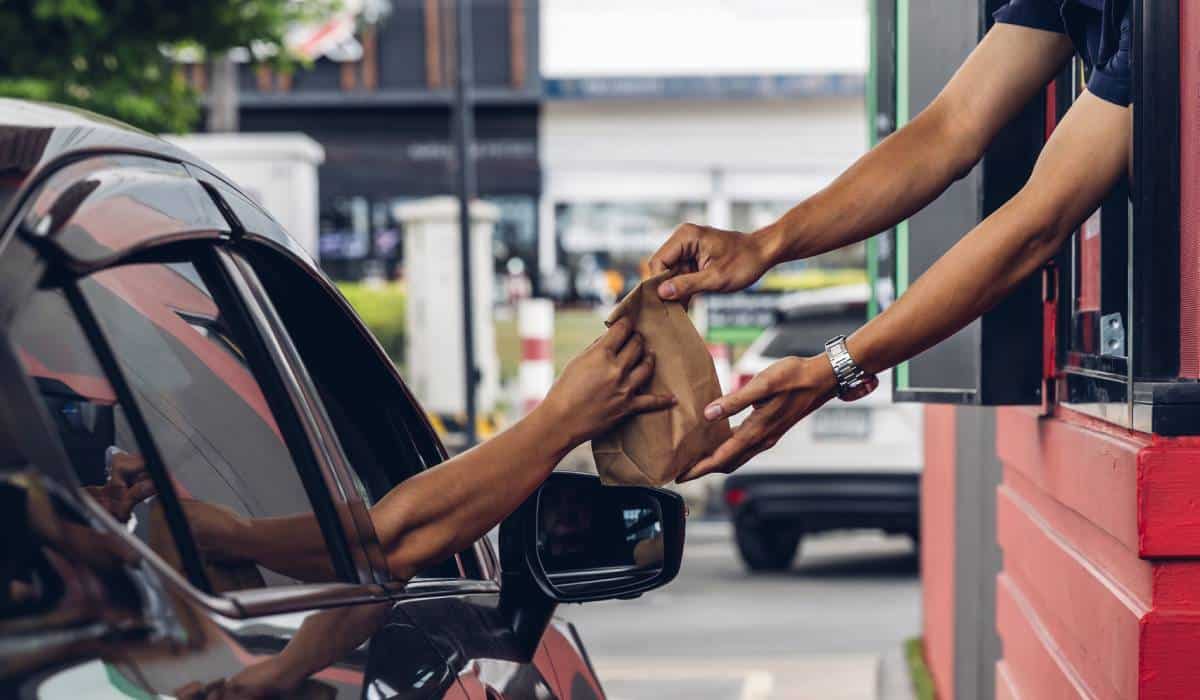
In a standard linear drive-thru, window time, which includes payment processing, handoff and food delivery, typically exceeds menu time by 10 to 15 seconds. That gap is free upsell airtime. A short, relevant suggestion at the ordering post can fill idle time that already exists without reducing throughput. Adding cheese to a burger takes two seconds. Filling a large fry container takes about the same time as a medium. These small additions generate incremental revenue with little or no additional service time. The line doesn’t slow down. The ticket goes up.
The psychology your crew is fighting
Another force at work that rarely gets discussed is the customer’s own psychology. Ordering can carry social friction. Guests may hesitate to supersize a meal, add dessert or request extras when another person is waiting on the other end.
Self-service kiosks offer a useful comparison. When QSRs introduced self-service ordering screens, average order sizes increased 15 to 20 percent. Kiosks also do something humans can struggle to execute consistently: They can ask, “Would you like to add bacon?” on every eligible order, every single time. The demand is already there. Consistency helps uncover it.
AI introduces a similar dynamic at the drive-thru. An automated system can make the same relevant suggestion consistently, without fatigue or concern about hearing “no.” The guest can simply accept or decline.
What operators can do right now
Here is what operators can act on immediately, with their current crew and current technology:
- Make an offer consistently. The highest-impact change may also be the simplest. Not when someone remembers. Not only when the line is short. Build suggestive selling into the ordering process consistently.
- Lead with contextual offers, not generic promotions. The best upsell is usually one step from where the customer already is. Someone ordering a sandwich is more likely to respond to “Would you like to add cheese or bacon?” than an unrelated promotion.
- Prioritize combo and size opportunities. A customer ordering a sandwich without a combo is a natural candidate for a combo offer. Someone ordering a medium combo may consider upgrading to a large. These offers are simple, relevant and among the highest-converting opportunities in our data.
Each of these tactics works when executed well. The challenge is consistent execution at scale, across every shift, every crew member and every daypart. Most restaurant leadership believes their crew is upselling far more than the data shows. That’s where the bulk of the opportunity lives.
The size of the prize
QSR operators may be leaving 10 to 20 percent of potential order value unrealized at the drive-thru post. For a location generating $2 million in annual drive-thru revenue, that’s $200,000 to $400,000 in potential sales. And it doesn’t require a new menu item, another marketing campaign or a major capital investment. The opportunity is already sitting in the drive-thru, one order at a time.
The fries question built the modern fast food empire. The question now is how many times a day your drive-thru is actually asking it.
Mike MacLennan is co-founder and co-CEO of Arc, a voice AI platform that helps restaurant operators manage their drive-thru like a modern, digital channel. Learn more about Arc’s approach to upsell optimization at tryarc.com.