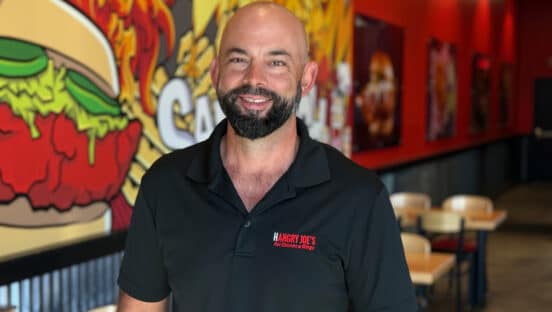
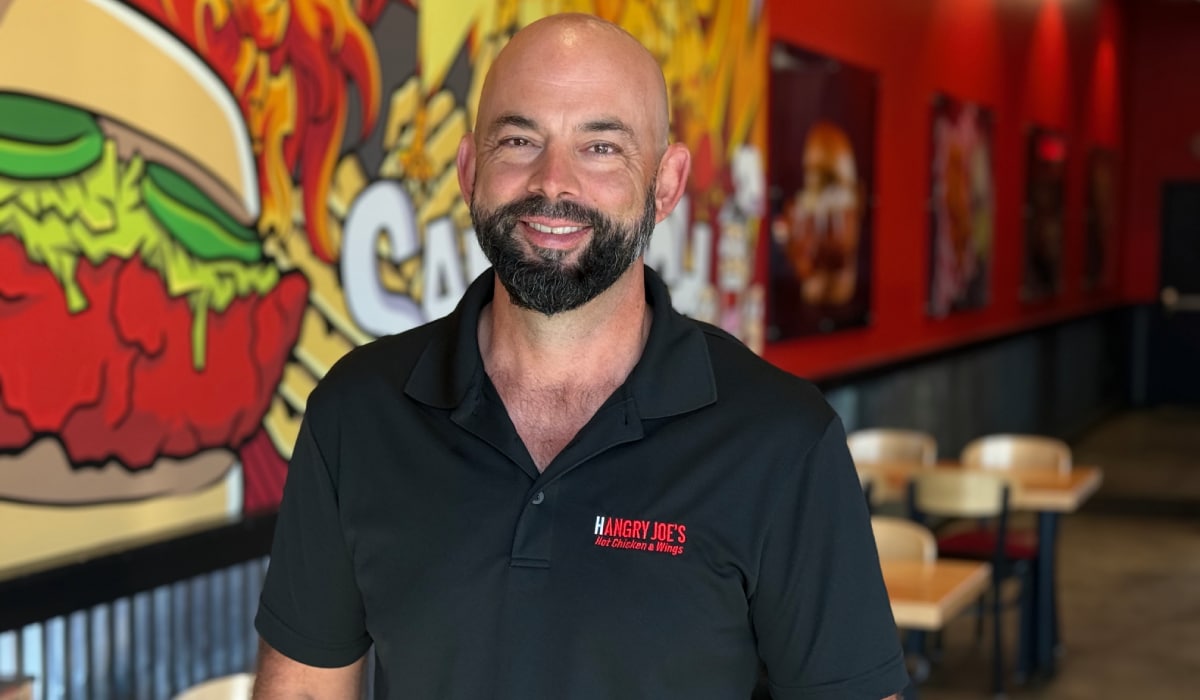
Brandon Wilhelm wasn’t necessarily looking to take on another major role in the restaurant industry. After spending nearly two decades developing Subway franchise territory across the Midwest, he was considering opportunities outside the business.
Then he discovered Hangry Joe’s.
Wilhelm traveled to Virginia to explore the emerging hot chicken concept, arriving a day early to secretly visit several restaurants before meeting with the corporate team. He came away impressed with the food, but also saw opportunities to improve the young franchise’s marketing, real estate strategy, and operational infrastructure.
That combination eventually led him to become a multi-unit franchisee, equity investor, board member, and, as of October 6, CEO of the growing fast-casual chain.
“I went out to Virginia and and tried the food and checked out the brand and it was the best chicken sandwich I ever had,” Wilhelm says.
Founded in 2021, Hangry Joe’s has expanded to more than 90 restaurants across over 20 states and international markets, including the United Arab Emirates. Another 20 locations are in the pipeline.
But Wilhelm isn’t measuring the company’s future success solely through restaurant count. His immediate priority is creating a more profitable, sustainable franchise system that can support expansion without repeating some of the mistakes that accompanied its early growth.
His experience includes overseeing operations strategy for more than 500 Subway restaurants and working with more than 140 franchisees. He also served as president of Hangry Development Texas and acting chief marketing officer of Hangry Joe’s.
Those experiences informed a series of proposals he presented to the company’s founders and board over the past year. The discussions eventually resulted in an invitation to implement the plans himself.
“I have no real desire to say, ‘OK, we’re going to grow this to a certain level and then we’re going to sell it to private equity.’ That’s never been my goal, and I’ve told those guys from the beginning,” Wilhelm says.
Wilhelm’s initial priorities include reducing food costs, improving purchasing efficiency, increasing consumer awareness, and establishing more rigorous development standards.
Supply chain improvements represent one of the most immediate opportunities.
Historically, individual franchisees have had considerable flexibility in sourcing certain products, creating inconsistencies that can limit the company’s purchasing power. Wilhelm wants greater compliance with approved distribution relationships to negotiate more favorable pricing across the system.
The company is also examining freight expenses, including proprietary ingredients that some operators currently purchase by the pallet and ship directly to individual restaurants.
Consolidating those purchases through distribution facilities could eliminate unnecessary expenses and make inventory replenishment more efficient.
Additional opportunities include renegotiating vendor agreements and examining third-party delivery commission rates.
The challenge is lowering expenses without changing the ingredients and preparation methods that distinguish Hangry Joe’s from competitors.
“Our product and our process and all that kind of stuff is not going to change,” Wilhelm says. “Our proprietary seasonings, our proprietary marinade, and the quality of chicken that we get in, none of that’s going to change.”
The same attention to unit economics is influencing Hangry Joe’s development strategy. The chain’s early expansion demonstrated considerable demand for its concept, particularly in markets where strong grand openings and local marketing helped establish enthusiastic customer followings.
However, not every development decision produced the desired results.
Wilhelm acknowledges that some restaurants opened in less-than-ideal locations, creating performance challenges that may require relocation or consolidation.
The company is introducing stricter site evaluation procedures and franchisee qualification standards to prevent similar issues.
Prospective operators must demonstrate adequate funding, restaurant operating experience, and the ability to execute local marketing strategies. Franchisees also need to understand that building a customer base requires continued community involvement after opening day.
Wilhelm believes selecting the right real estate is more important than accelerating the development calendar.
“I don’t want to have 300 stores with several of them B minus locations. I’d rather have 120, 150 stores to make sure that we get A locations,” Wilhelm says. “Even if it takes longer to get the right spot, speed of development is not necessarily as important as quality of development.”
The new standards also extend to training and ongoing franchisee support. Wilhelm believes Hangry Joe’s has established a solid foundation in these areas, but sees opportunities to provide operators with additional coaching and resources.
His objective is to preserve the close relationships associated with a smaller franchise organization, even as the company builds more sophisticated systems to support its expanding footprint.
That infrastructure includes a more substantial investment in marketing, another area Wilhelm identified as needing improvement during his initial evaluation of the brand.
Despite its growth, Hangry Joe’s continues to encounter a surprising number of first-time customers in established markets. Wilhelm estimates that 30–40 percent of guests at some of its highest-volume restaurants are visiting for the first time, even after those locations have operated for several years.
He sees that as evidence of considerable untapped demand.
Instead of pursuing expensive national advertising, Hangry Joe’s plans to direct more resources toward geographically targeted social media campaigns, local promotions, and its loyalty platform.
Wilhelm also wants to supplement the company’s advertising fund with royalty revenue over the coming years, keeping corporate expenses under control to free up additional marketing dollars.
“I’m going to try to run the company lean and mean so that we can actually take royalty revenue and put that back into the ad dollars as much as possible for the next couple of years to make that marketing budget more robust and drive the awareness,” Wilhelm says.
The chain’s current campaign, #IYKYJ, short for “If You Know, You Joe,” is built around the idea of creating an insider community of customers who recognize the brand’s food quality and participate in its rewards program.
The effort comes as Hangry Joe’s evaluates how to attract more budget-conscious consumers without compromising franchisee profitability.
Wilhelm sees particular opportunity during weekday lunch and afternoon hours, when customers may be less willing to spend on premium fast-casual meals.
The company is developing value-oriented offerings intended to increase visit frequency during those periods. Menu expansion, however, isn’t the immediate priority.
The goal is to make the existing menu more accessible and give customers additional reasons to return.
Inside restaurants, Wilhelm is also exploring how technology can improve efficiency without compromising the brand’s fresh-to-order preparation.
Hangry Joe’s can use point-of-sale and inventory systems to identify discrepancies between ingredients purchased and products sold, helping operators detect waste more quickly.
Artificial intelligence could also help restaurants anticipate order volumes and product mixes during peak periods, allowing employees to begin cooking certain quantities of chicken before individual orders arrive.
That capability could reduce ticket times without requiring restaurants to hold large quantities of prepared food under warming lamps.
The distinction is especially important given the company’s cooking process, which can create longer waits during busy periods.
Some restaurants have experimented with pressure fryers to shorten cooking times, although Wilhelm notes that the equipment introduces limitations of its own.
The operational changes are unfolding as competition intensifies across the hot chicken category, with emerging concepts seeking to distinguish themselves from established chicken chains.
Wilhelm sees similarities to his experience in the sandwich industry, where brands such as Jimmy John’s and Jersey Mike’s established distinct identities despite Subway’s enormous footprint.
Hangry Joe’s differentiators include multiple heat levels, bone-in wings, proprietary seasonings, and a scratch-made preparation process.
Its signature Sando features a whole chicken breast, and its chicken marinates for at least 48 hours. The company also prepares items such as coleslaw in-house.
Wilhelm believes those characteristics provide a foundation for developing a loyal customer following, particularly as the company expands its marketing reach.
The challenge is ensuring that customers experience that quality consistently across every restaurant, regardless of how large the franchise system eventually becomes.
“I got hooked on Hangry Joe’s because of the quality of the food and quality is above everything and we’ve got to do it right and execute in the restaurants the right way every single time,” Wilhelm says.