

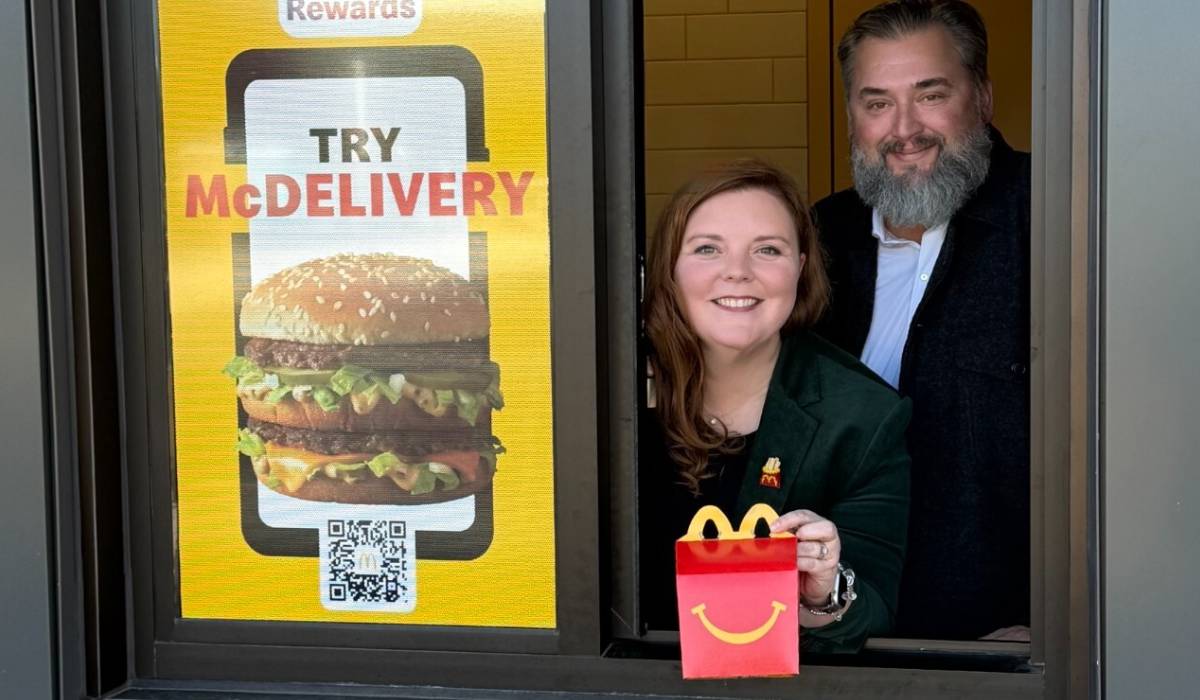
One of Leigh Chamness’ earliest memories came in kindergarten, when she stared through the bus window and saw a giant Ronald McDonald behind her house. Her mother was washing it down for a corporate event, and the bus erupted.
McDonald’s being a part of her childhood was hardly a one-off afternoon, though. Chamness’ mother was the admin to three brand presidents and her father led franchising across the Southeast, buying and selling stores.
Eventually, as tends to be the case at McDonald’s, the longtime corporate employees came up for international promotion. But Chamness’ grandmother was ill and they didn’t want to travel. So, her parents cashed out their 401Ks and bought a McDonald’s in 1994 in the Hamilton County, Ohio, suburb of Blue Ash—a location they still own.
As for Chamness, she studied engineering and found herself one day high up enough in the corporate ladder where she was spending more time discussing projects than applying them. And her thoughts kept returning to restaurants. She’d call and check in. “My parents were like, ‘what are you doing? This is clearly your passion. You should come home,’” she says.
Chamness listened and headed to the bottom. She worked opens, mids, closes, maintenance, and learned the operating system all over again.
After going through McDonald’s owner-operator approval process, Chamness acquired her first store 20 years ago. Today, as CEO of Ison Family Restaurants, she operates 11 with her husband. Chamness’ brother has another eight to cover 19 across the portfolio.
Naturally, much has evolved over those decades. Narrowing the timeline, Chamness says the economics of every U.S. business adjusted post-pandemic. Operators are trying to figure out how to lean out processes to guard margin as costs continue to soar. Can you automate? Become more efficient?
“We want to make it easier to get it right than it is to get it wrong,” she explains.
Namely, the split between a successful and struggling restaurant often comes down to how simple, or complicated, it is for managers to make decisions.
Chamness’ locations have a GM for each and 10 managers under those roles throughout. Some stores employ as many as 100 people and the company covers 1,400 or so overall.

She recently tapped an end-to-end solution to map an employee’s journey from application forward where they interact with one software (Harri, in this case). That includes talent acquisition, where Chamness started receiving 5X the number of applications. Application to hire into restaurants began averaging two days as well.
Being able to get employees through the process so quickly proved vital, Chamness says, when you consider how labor intensive restaurants are and how, generally speaking, high churn can be in a cyclical workforce like foodservice.
The onboarding and employee documents, I-9 process, etc., shifted electronic so managers could spend less time onboarding and more on showing new workers the ropes. “Not doing that paperwork but actually training and developing people,” Chamness says.
The system offered analytics around scheduling, too, and learns over time how to project staffing levels needed through different peak and shoulder stretches. It happens digitally to take some of the guesswork out of managing labor on the floor.
Speaking to larger labor realities, though, restaurants used to specialize in part-time employment, whether it was a teenager, retiree, or mothers who wanted to work while her children were in school, Chamness says. While she still employs a lot of those cohorts, McDonald’s has become more of a career.
“We always say things like, whether you’re here for a year, whether you’re here for your career, I think we’re seeing a lot more of those career path people,” she says. “And that puts a lot of pressure on the restaurants to train and develop and give people the skills they need.”

An upspin, however, is restaurants were always designed for this, even if they weren’t always tapped for it. Her father began at McDonald’s as a 15-year-old making fries before working up.
There are opportunities throughout each unit and corporate, Chamness says. What’s changed is how clear operators have to make the point.
And the benefits structure shifts when you’re not focused solely on teenagers. For her stores, it’s meant 401Ks and insurance. Younger employees, she jokes, are more concerned about merch.
“We’ve got to build those benefit packages around who you’re employing,” she says.
Chamness’ organization matches 4 percent on 401Ks as a nod, in some respects, to how her family liquidated to get that first McDonald’s. It “changed the trajectory of generations,” she says. In turn, her company offers it to every employee who signs on.
Currently, Chamness’ workforce essentially breaks out as a third teenagers, a third adults, and a third retirees. Rural communities tend to skew toward the former. That’s led to her offering tuition reimbursement, and not just for traditional universities, but for trades as well.
There have been an increasing number of employees in recent years who walk into McDonald’s hoping to eventually take on professions like electricians or plumbers.
But returning to technology, McDonald’s as a brand, Chamness says, has been focused on automating repetitive tasks employees don’t want to do, like order taking. Making a drink or creating a hamburger is a different story.
Because stores have automated so much of the order taking process, she adds, it’s placed added pressure on kitchens (more volume coming in). That’s forced Chamness to hire more staff to serve demand, “which is an amazing story and not the story we were expecting,” she says.

With managers, the emphasis remains on peer-to-peer conversations and decision making. GMs need to be freed up to oversee larger calls, such as optimizing the placement of people and ensuring restaurants are fast, friendly, and accurate, Chamness says. It’s now the expectation.
The pipeline under GMs became critical as well. Chamness says they do some outside recruiting, but by and large, her restaurants home grow management teams.
It’s a process in motion. Restaurants, like any field that jumpstarts careers, are not a resume business. Although it helps to have experience, inherent hospitality is difficult to measure with a PDF.
Chamness says her restaurants screen for outgoing, friendly employees who interact well with customers and each other, and look for people with “an eye for the future” who want to grow.
They structured management training programs to focus on soft skills. “Especially with this generation coming up and having less interaction personally with people, that is a gap we see in the market with employees—how do you talk to people?” she says. “So, we spend a lot of time training interaction with others and conflict resolution and dealing with the interpersonal part of being in a big group.”
Not everyone, she continues, is equipped to handle personalities in an orchestra like back-of-the-house management. “But we believe if you want it, we can train you how to that,” Chamness says.
As for how her McDonald’s restaurants identify proper fits, they’ll present questions like, “tell me a time when you disagreed with somebody and how you convinced them to go your way.”
When you talk to teenagers in particular, Chamness says, you need to cater to stuff they’ve lived.
“Everyone has had conflict in their life,” she says. “Everyone has had interpersonal issues. Just asking them questions that get to understanding their thought process, because you find out really quickly the people who are looking for solutions and people who are looking for conflict.”
One thing her stores do with managers specifically is something they call “OJE,” or “on the job evaluations.” The reality is, if somebody has never worked in a McDonald’s, they’re not going to understand the pace. It’s a job where you have to race while still getting orders correct and delivering customer service.
So, what Chamness does is have mangers spend a fully paid day on site. Call it a “get ready with me video,” but in real life, she says.
“The best thing we can do is be up front with what it feels like,” Chamness says. “Working in the restaurant, if you love a fast-paced environment, you’re going to thrive in our environment. If you’re more chill and you want a slower workday, that’s not going to work in a McDonald’s.”
The OJE gives both sides transparency into what a relationship might look like.
“It can be really expensive to hire the wrong person and spend all the time trying to manage them and then figure it out,” Chamness says. “It’s a great way for us to give a preview of what we do.”