

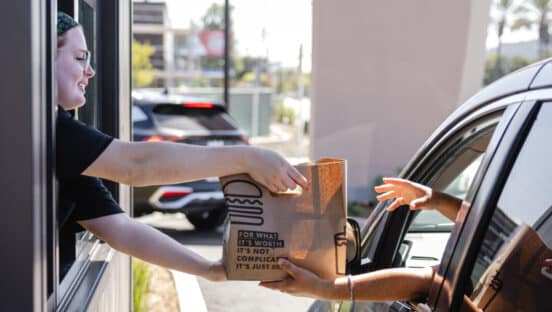

With off-premises on the rise, the drive-thru has become somewhat of a de facto dining room, according to PJ’s Coffee EVP of operations Chris Collins.
It requires a balance of speed, engagement, and hospitality, and a lot of times, it’s a brand’s only chance to make a first and last impression. So the employees on the front lines of the drive-thru window—the order takers—have a lasting impact.
“We can bring the quality of the products that we have, but the people on the front lines are really what’s defining the customer experience,” Collins says.
At PJ’s Coffee, that effort starts with understanding what the drive-thru now represents. For a brand that does up to 80 percent of its business through the lane, the first impression isn’t made by a barista behind the counter, but by a voice through the speaker. Collins, who spent nine years in the McDonald’s system before joining PJ’s, is quick to point out the distinction between staffing for speed and staffing for connection.
“Some people like working behind the lines and some people like being customer facing,” he says. “Personality, engagement, hospitality has a lot to do with it, and energy. Personally, as a customer when I’m going to place an order, if I can hear someone smiling through the speaker, that in itself is a good start.”


That focus on the speaker-box interaction isn’t unique to PJ’s. At Scooter’s Coffee, which operates mostly in compact, drive-thru-only kiosks, the company staffs up to six employees during peak times—sometimes as many as 10 in high-performing locations. Michelle Wickham, VP of national operations, says the best operators plan ahead rather than scramble to react.
“They don’t chase the chaos. They anticipate it with intentional placement and strong store leadership,” she says. “That proactive oversight can be the difference between a line that moves and one that stalls.”
Shake Shack COO Stephanie Sentell echoes that proactive approach, crediting operational systems for giving the brand tighter control of staffing. “We’ve successfully implemented new systems and processes, such as our new labor model, that have made us more agile and given us better control of our staffing,” she says. “Efforts like this have helped us reduce our average wait times by a full minute over the last year.”
For Portillo’s, organized staffing is essential. The company runs shifts of up to 45 employees during peak hours throughout the entire restaurant. Scheduling is approached with equal care. Portillo’s recruits heavily through referrals and school partnerships, targeting high school and college students looking for flexible hours.
“One of the things that our team members tell us is that they love having a best friend at work,” says Portillo’s chief people officer Jill Waite. “That’s a reason they want to stay.”
To meet those expectations, store leaders are encouraged to build schedules around real-life availability, not just business needs. “We try to create a very agile workforce between our crew chiefs and our hourly team members that allows them to slide and appropriately support the guest experience,” Waite says.
Shake Shack has adopted a similar model for scheduling flexibility, with new systems designed to better align labor with guest flow. “We’ve implemented improved hourly and manager scheduling with enhanced reporting that leverages real-time data and analytics, which has been instrumental in driving productivity,” Sentell says. “Our labor model accounts for many variables given our sales come in through multiple order channels and at varied frequency from shack to shack.”
Alongside scheduling flexibility, Portillo’s invests heavily in staff development. It takes a high-touch approach, launching a training program called Ignite that prepares future leaders before they assume new roles. This builds confidence and reduces failure rate—two things that are critical when pressure is high and labor availability is low.
“We want to make sure that our leaders are actually prepared for that role, not just put in it and then figure it out,” Waite says.
Portillo’s also leans on incentives that go beyond pay. Life insurance, mental health resources, and stock ownership options are all part of the employee package. Waite says these benefits, combined with flexible scheduling and a strong team culture, help retain staff even in competitive markets.
Slim Chickens typically uses two to four employees per shift specifically in the drive-thru lanes, depending on traffic and whether tablets are in use outside in the drive-thru lanes. While these roles are often dedicated during busy times, cross-training is the norm, especially to help cover slower periods or unexpected absences.
“We like to plan for the unexpected,” says Slim Chickens COO Christina Vaughan. “Cross-training is probably going to be the key approach. We have to make sure that, no matter which role calls out, we’ve got flexibility so that we can adjust on the fly.”
Rotating employees between positions not only prevents fatigue but allows them to understand the full rhythm of the restaurant, something that’s essential when speed and accuracy must be delivered simultaneously. That agility is mirrored at Portillo’s, where team members are trained across stations to support each other in real time. “If our beef station gets a little overrun, one of our team members can slide in,” Waite says.
Shake Shack follows the same logic. “We believe cross-training is a critical part of our overall operations for multiple roles and we have continued to invest here,” Sentell says. “This also gives our team members a better experience as they are qualified to work multiple positions and contribute to the business at a higher level and remain engaged as an overall team leading to higher retention.”
Scooter’s Coffee takes a similar approach to flexibility and team dynamics.
“Everyone in our store is cross-trained,” Wickham says. “The best shift leads don’t panic. They prioritize and move people where they need to be based on their strengths.”
She adds that engagement in high-pressure situations begins with a solid foundation: a great schedule, a competent store leader, and a culture where team members support each other.
Preparing team members for that dual burden—throughput and hospitality—requires training that goes well past orientation. At Slim Chickens, training starts with clarity and ends with empowerment. Employees are taught how to take orders and manage POS systems and how to make judgment calls under pressure.

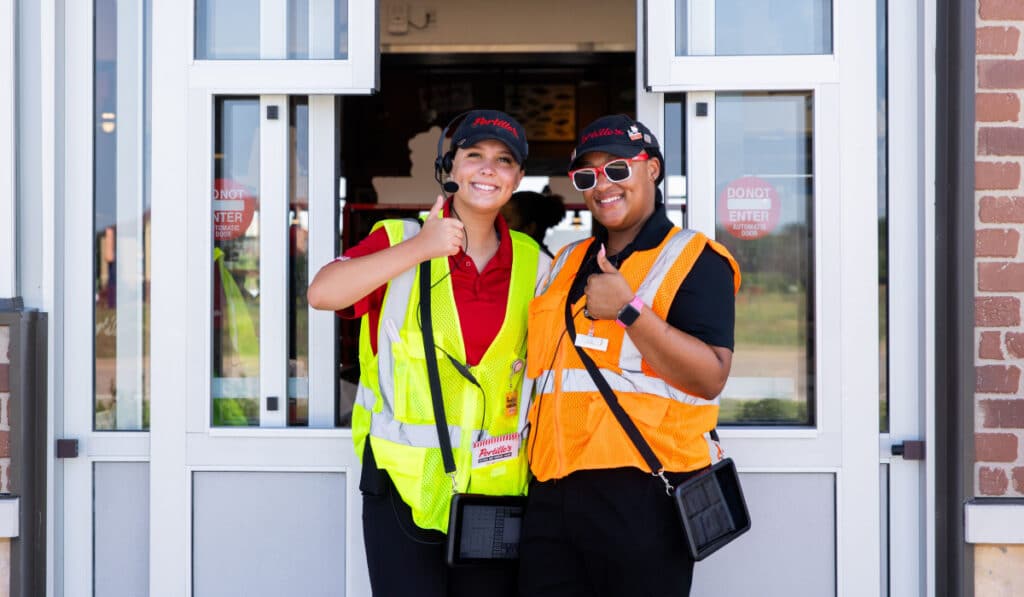
“They’re empowered so that when, whether it be guest interaction or issues of things not going so well, they know how to make those decisions and choices that are best for the guests,” Vaughan says.
The brand is also piloting stat boards—large digital displays inside the restaurant that show real-time sales, labor hours, and weather forecasts.
“We found that to be very helpful versus all of that information being only contained in a manager’s computer,” she says. “Our team feels empowered, acknowledged, and supported.”
Scooter’s Coffee focuses its training on what Wickham calls “training that sticks.” She says the company combines classroom elements with practical role playing, speed drills, and headset exercises, all supported by daily in-the-moment coaching.
“Great drive-thru execution in our opinion doesn’t just start in a classroom setting,” she says. “We bring out all the smiles in our baristas so that they transfer to our guests.”
Accuracy and order confirmation are key components, along with suggestive selling, and store managers reinforce those habits every shift, Wickham adds.
Shake Shack has also placed a sharper focus on targeted coaching, especially around service metrics. “We’ve implemented an operations performance scorecard that’s driving accountability and visibility for our shacks, which has in turn improved guest experience, wait time, and profitability,” Sentell says.
Portillo’s applies structure across training as well. Waite says consistency is prioritized across the system. “We have very defined training guides. We don’t do one-off training programs. We want every new hire to have a consistent experience.”
Whether it’s stat boards at Slim Chickens, hands-on coaching at Scooter’s Coffee, performance scorecards at Shake Shack, or standardized curriculum at Portillo’s, that real-time reinforcement also contributes to order accuracy.
At PJ’s Coffee, accuracy has taken on new significance as the company rolls out new products, cup sizes, and digital menu boards. The brand is now tightening standards around order validation, speed-of-service targets, and staff response time. Training includes not just headset and POS use, but situational judgment—how to de-escalate issues, recover errors, and maintain guest trust when something goes wrong.
“The coffee market … there’s millions of ways that consumers like to have their coffee,” Collins says. “Accuracy is an area of importance. Nobody wants to get their coffee messed up first thing in the morning.”
Technology can help with all of that, but only if it complements the people using it. At Slim Chickens, the deployment of tablets and AI ordering is designed to enhance, not replace, the employee.
“What we don’t want to come across is that we’re having machines or AI take the place of people, but really more of a complement,” Vaughan says.
In select company-owned restaurants, the brand is testing AI voice ordering, with team members standing by to intervene if needed. While the technology takes some adjustment, employees have responded positively.
Shake Shack is taking a measured approach to automation. “While we are watching and learning about AI ordering, it’s not something we’re using in our Shacks today given our focus on both our guest and team member experience,” Sentell says. “Our staffing needs are not changing as a growing brand. We see technology as a tool to redeploy labor to higher guest touch points and as a way to reduce repetitive tasks.”
This mixture of human and digital support also plays a role in how Slim Chickens approaches outdoor ordering. Employees using tablets rotate every 20 to 30 minutes to avoid fatigue. Vaughan says the company provides shade, cooling vests, and hydration—especially in summer—and avoids scheduling anyone outside in extreme weather.
“We want it to be a pleasant experience for our team members so that way they can be over pleasant and hospitality-focused with our guests,” she says.
Scooter’s Coffee also applies a clear filter when evaluating new technologies.
“AI goes—or any technology goes—through this filter of, ‘Does it make it easier for our teams and better for our customers?’” Wickham says. “If not, then it’s just noise.”
For Scooter’s Coffee, tech should enhance the warmth and connection baristas create, not interfere with it. Like the others, Portillo’s evaluates technology based on how it supports its teams, not replacing them—a view shared across all five brands.
That culture of retention and support is central to Scooter’s Coffee. Wickham says the brand’s philosophy is built around its mission: to create amazing experiences through every life it touches.
“We just don’t want to be the fastest. We want to be unforgettable and create moments that matter for our guests,” Wickham says. “We really believe the guest experience will never exceed that of our baristas.”