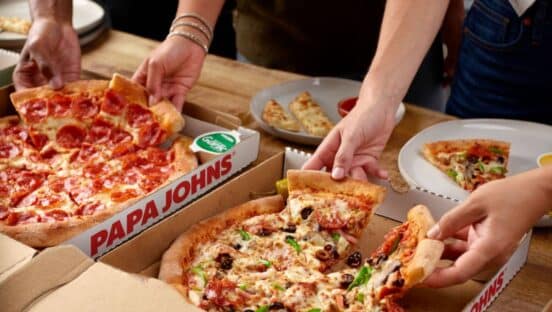

Papa Johns CEO Todd Penegor is more than two years into the job. What he often heard in the early days hasn’t tapered off. If anything, it’s only gotten clearer from franchisees in recent benchmark surveys.
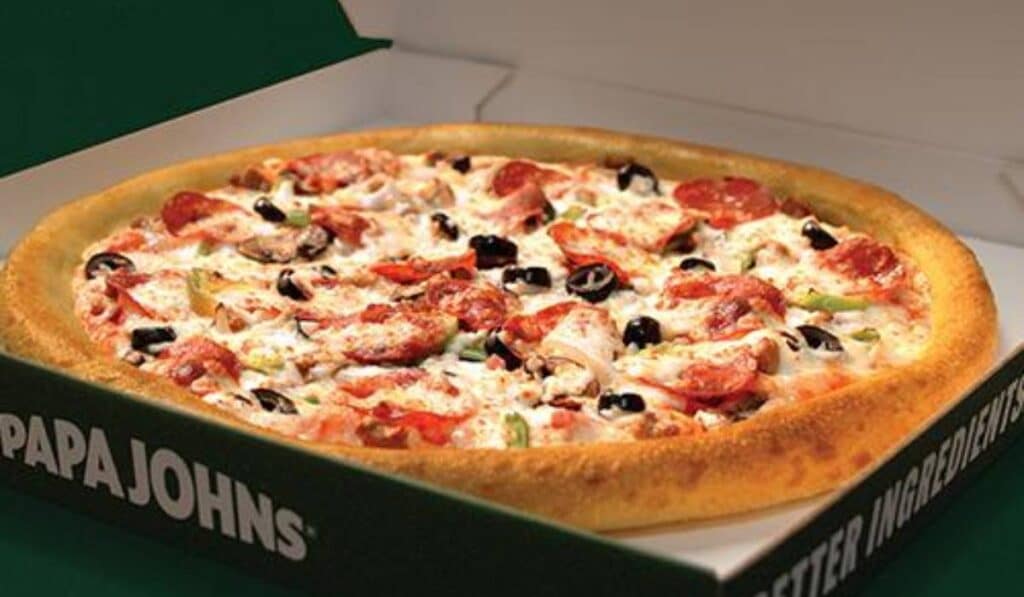
This is a brand known for its tagline, “Better Ingredients. Better Pizza.” But while the customer might associate Papa Johns with the phrase, coined in the mid-1990s, it’s become less obvious why the brand is better.
The realization, Penegor says, brought Papa Johns to a full-circle moment. “Why were we created in the first place?” he says. “And really tell our story of why we’re better.”
It led to the creation of a new company-wide strategy unveiled Thursday called “Unbox Better.” Penegor refers to it as a “moment of Back to the Future to really set our teams up for success.”
The brand, which posted North America same-store sales declines of 8.3 percent in Q3, with domestic company-owned comps down 7.5 precent and franchised 8.5 percent lower, is entering an important next phase of transformation, Penegor says.
For decades, he believes (and franchisees agree), customers picked Papa Johns because it stood for something distinctive; not because it was the cheapest option. They felt the brand offered an option worth choosing, Penegor says—quality ingredients, great pizza, and a brand promise that set it apart.
At its best, it was a framework that inspired trust and loyalty.
However, over the years, guest expectations climbed and competition flooded in. Delivery, for instance, is a universe today that swallows all of foodservice. What separates quality at convenience is an equation that’s moved alongside parity in the marketplace.
Has Papa Johns evolved in tandem?
Unbox Better isn’t going to be a short-term initiative or mere marketing platform, Penegor says. It encompasses a wide-scope re-strengthening of Papa Johns’ system.
The chain will start in a lot of places, Penegor explains, but will begin at the foundation. Employees will be retrained on how to make pizzas. Corporate will investigate what renovation needs to happen to make sure there’s a flavorful, easy melting cheese on top. What it will need to invest in so orders show up delivered at temperature.
And importantly, as the strategy unfolds, it will be supported by Papa Johns’ new marketing designed to create operational and financial alignment.
“With our franchisees and corporate teams moving forward together,” Penegor says, “we have a stronger foundation than we have had in years to execute a common vision and accelerate our transformation.”
He noted the framework was approved by 98 percent of cast votes.
As much as anything, the near universal buy-in showed Papa Johns was in need of some commonality.
And that’s built around the belief, Penegor says, “customers do not owe us their business.”
The path begins
There are two priorities at the root of Unbox Better.
The first is give customers reasons to choose Papa Johns, Penegor says. Second, bolster the system by delivering to expectation.
That opening notion has four imperatives. One, reignite food so it’s worth picking, Penegor says. That means improving Papa Johns’ core menu.
The company, as noted, needs to work on and retrain fundamentals across dough optimization, bake consistency, better toppings, and presentation, with improved ingredients and execution behind them.
It’s already recommitting to fundamentals, Penegor says, and pairing efforts with a offer that invites customers to come back, try Papa Johns again, and tell the company how it did.
That feedback will guide a steady set of product and quality improvements in the year ahead.
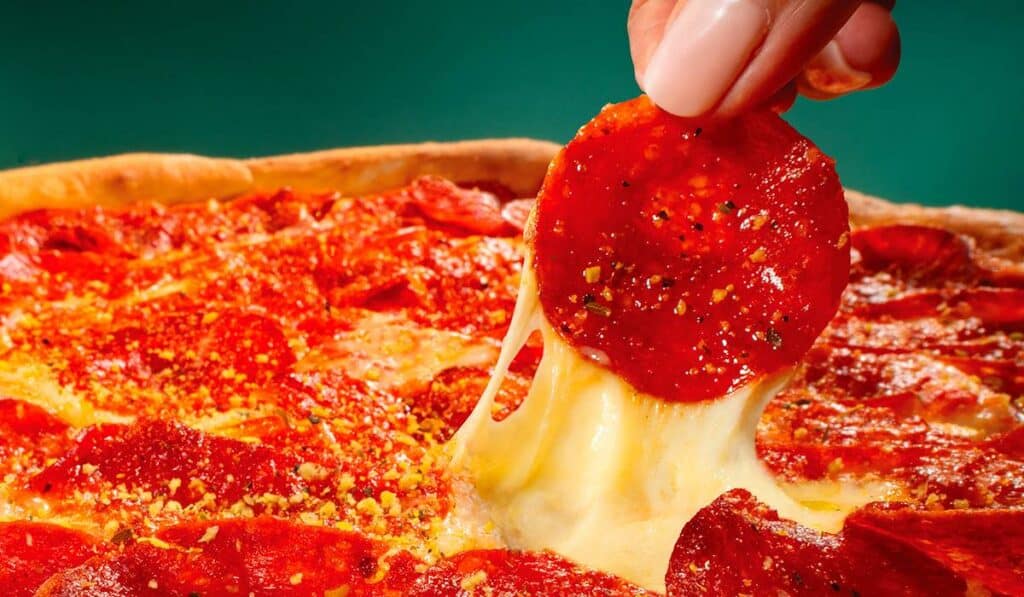
This bounce-back campaign, with a minimum purchase of $15, asks customers to take a picture of their pizza (they need to be logged into the app as a loyalty customer), take a picture, and send it forward. If they do, they’ll get a free pizza coupon with a $5 purchase.
Penegor says Papa Johns can leverage AI for the process. It’s training the algorithm to be able to know when a pizza is truly one of its own and also how to grade it. It’s kind of like a modern, virtual version of how Papa Johns used to have its founder approve builds back in the day, Penegor says.
The company has done some work with Google Cloud and camera technology in-restaurants already. This is an opportunity to use pictures to train the AI even further.
“We’re ready to pivot wherever they want to take us,” Penegor says of feedback.
Papa Johns has long touted a quality guarantee where it will make a mistake whole if asked. Here, it doubles down and gathers constructive feedback on how to improve broadly. And when responses flood in, the chain will be able to tell the story as it improves.
“We’re going to engage the consumer to help us become even better,” Penegor says. “Those pictures will be available for the restaurants, and we’ll use that feedback from the consumer to help our individual restaurant teams continue to elevate the experiences for our customers.”
Up next will be bringing Papa Johns brand promise back to life. Like he shared earlier, Penegor says it’s a matter of grounding in some company and product truths. Signature garlic sauce. Fresh vegetables. Ingredients out front.
Thirdly, the brand needs to reset value. Penegor says value is not “simply the lowest price.”
“It is what customers receive relative to what they spend, including quality, convenience, and trust,” he added. “In a very promotional category, we chose to protect margin over deep discounting. And transactions declined as a result.”
There is work ahead to improve Papa Johns’ barbell so signature products join traffic- and conversion-driving price points. Penegor admits it will take “several quarters of that consistency” before customers give the brand credit.
Fourth is customer connection. Loyalty members outperform non-users by 10 percentage points at Papa Johns. Their tickets are 4 percent higher per order and they order about twice as often.
Papa Johns continues to roll out an AI-powered personalization engine within its CRM so it can send more relevant offers and deliver value at the right moments.
The next tier
And this brings Penegor to the second strategic priority of Unbox Better: strengthen the system. Within, there are three imperatives.
No. 1 is deliver on “every promise, every pizza, every time.”
In Q3, restaurants in the top quintile of operations scores were 400 basis points ahead of Papa Johns’ bottom section concerning comps and restaurant margin. Penegor wants to narrow the gap and raise the floor. The first area of focus for training circles supporting these units.
It’s doing so through coaching, earned financial incentives, and a regional franchise business director model that places support closer to franchisees. Tech will support, too.
Papa Johns is testing a modern, AI-native point-of-sale platform in a “small number” of restaurants. The system, Penegor says, allows for more accurate forecasting, better labor scheduling, and increased speed and flexibility to deploy offers and promotions. The current POS is 35 years old and there’s a lot of menial tasks happening day in and day out the customer never sees.
The goal ahead is to allow restaurant teams to spend less time on non-guest-facing tasks and more on making food and driving positive interactions.
Papa Johns expects to have an initial wave of stores live by year-end, with the bulk of the U.S. system onboarding sometime in 2027.
For franchisees, it runs on the existing hardware and the cost, Penegor says, will be “essentially zero” because operators are going to be charged the same monthly fee for the new system they’re paying on the old one, with no upfront bill.
“We know we’re only as good as telling the story as we actually deliver on the promise at the restaurant level, and that’s been the Achilles’ heel,” Penegor says. “How do we deliver on it better at the restaurant level, with every visit, with every customer, every time? And we know we owe it to our general managers to put some technology in to automate, set them up in a position with some less complexity to deliver, and to really give them the tools through training to be able to deliver on that promise.”
More importantly, Penegor says, what the brand learns now will set the rollout up for success. “Lou AI,” the company’s AI ordering companion built with Google Cloud, aims to make ordering easier. Customers tapping it convert at a higher rate and finish orders faster.
The company is now improving driver routing for faster delivery and hotter pizzas while simultaneously making operations easier for employees.
No. 2, bring Papa Johns to more customers. The chain in September partnered with Walmart Express Delivery to become the first national restaurant brand on the platform. It enables orders to be fulfilled entirely from store locations outside of Walmarts.
Penegor says the partnership reaches guests who might not otherwise have Papa Johns in their consideration set. It’s in early pilots this fall.
A vital component of all of this involves a pizza adage that’s been repeated through the eras: “It’s a game played nationally but won locally.”
Up until the end of 2023, Papa Johns had co-ops in a shade more than 90 percent of the system. When the chain voted to go from 5 percent national marketing fund contribution to 6, and make local optional, it allowed the system to blow up the co-ops (this was the beginning of 2024).
Penegor says it’s been challenge since to compete as a unified message market-to-market. Papa Johns pushed a strong barbell approach with a high offer and a low one from the national calendar without it being complemented, accentuated, or offset at the local level.
It’s putting all that back. Basically, Papa Johns is returning to where it was for the first 40 years. So, 2 percent spending at local and national coming back down to 5 percent. Overall, 7 percent of marketing spend versus 6 percent.
Roughly half of the U.S. system today is supported by the reestablished co-ops, with funded markets meaningfully outperforming those without one. The rest of the system projects for 2027. There’s been a more than 200-basis-points delta on sales performance in the markets with them.
“I would say as we have established the co-ops, they’ve been working together to compete in the local community, but we haven’t fully coordinated how they work locally against the national calendar,” Penegor says. “As we reset the field marketing teams during the course of this year, I think we now have an opportunity to really get ahead of the 2027 national calendar and then partner with the co-ops that have been established or are being reestablished to make sure that the message at the local level truly complements and it’s optimized against the national calendar, which is an opportunity to be even more efficient and effective with the spend that comes both the national and the local level. That’s the opportunity ahead.”
It allows Papa Johns to spend dollars with best practices across the country.
No. 3 turns to building a system where operators thrive. To further support franchisees, Penegor says, Papa Johns is reducing its supply chain margin to 4 percent, providing 100 basis-point margin improvement for operators compared to previously targeted 2027 numbers.
The company plans to continue about $35 million of investment into next year.
Supply chain margin will then step up to 4.5 percent in 2028 and 5 percent in 2029.
Additionally, Papa Johns is rolling back its tech fee from 1.75 to 1.5 percent. “We view these actions as fuel for growth, strengthening the unit economics franchisees need to compete as a team in their local co-ops,” Penegor says.
Papa Johns is optimizing its store footprint as well. Year-to-date, it’s closed 239 restaurants systemwide, including 146 in North America. That’s about half of the 300 North American closures committed to through 2027.
Penegor says early results show strong sales transfer to neighboring locations as underperforming one exit. He mentioned briefly some of this was happening near Pizza Hut closures, too.
To reiterate, though, Papa Johns is aware Unbox Better won’t produce results overnight because improved execution needs time to be earn recognition. But Penegor says it’s a straightforward roadmap: “deliver consistently, earn customer trust, and convert that execution into stronger business performance over time,” he says.
“Unbox Better is our commitment to reclaim what has always made Papa John’s special while modernizing the business for the future,” Penegor continues. “We are strengthening our brand, so customers have compelling reasons to choose us. We are strengthening our system, so we consistently deliver on what we promise. Through our new agreement with our franchisees, we now have greater alignment to execute those priorities together.”