Brett Patterson made his first Portillo’s trip two-plus decades ago. Those were, naturally, different times for the 1963-founded Chicago staple. It’s since gone public (2021), spread into Texas, faced rocky development trends, and begun, more recently, to grapple with value gaps as the brand tries to stabilize experience amid growth.
For Patterson, who joined as CEO in February, coming over from the same post at Miller’s Ale House and, previously, president at Outback and Ruby Tuesday, as well as SVP of operations at Olive Garden, he admits he’s still learning.
Patterson spent his opening 60 days listening, talking to teams inside stores, and understanding the brand’s unique model from the ground up. That includes new markets as well as its Windy City backyard. The challenge for Portillo’s, as has been the case since filing an IPO, stretches from becoming more well known in places it’s not, and maintaining a lofty bar where the company stokes cult-like fandom.
Patterson says he’s been asked “a lot” about coming over from full service to fast casual and how that affects his directives. “What I would tell you,” he said on the brand’s Q1 earnings, “is I think there’s so many similarities.”
“And one was when you just step back and think about what a customer wants, it doesn’t really differ between the two channels,” Patterson continued. “They want great value created by food, service, atmosphere, divided by price. And that’s what we have to deliver.”
Portillo’s first report under Patterson offered its green shoots. Total revenue was $182.6 million, up 3.5 percent, year-over-year. The figure was fueled by non-comp restaurants ($7.7 million of the increase). Same-store sales declined 0.1 percent (two-year stack of 1.7 percent).

Registration is now open for our biggest restaurant event of the year! Secure your spot today.
But in Q1’s comp, traffic climbed 0.8 percent, which marked the first positive transactions turn for Portillo’s since 2023. Average check comprised negative 1 percent of mix and 0.1 percent price.
The brand’s Perks program drove traffic and lowered Portillo’s price benefit from sub-2 percent.
Much of Patterson’s first conversation with investors, however, centered on two themes: One, there’s a data gathering effort underway, personally and more broadly, for Portillo’s to further understand what’s going right and wrong, and where it can react.
Secondly, there aren’t going to be short-term solutions.
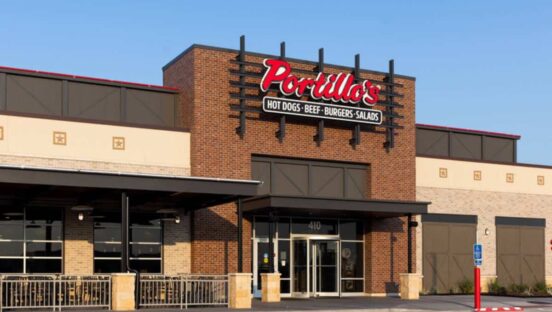
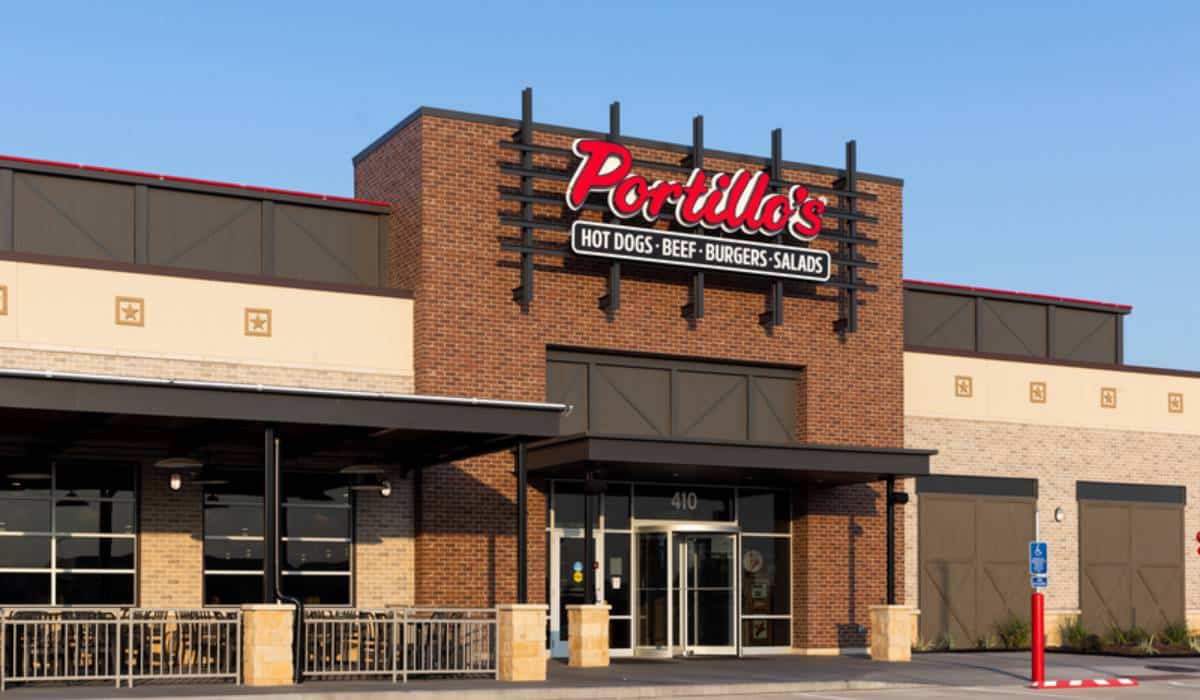
Portillo’s is not your average QSR. When it filed to go public, the fleet averaged 7,800-square-foot boxes that took 87 people to staff. AUVs were close to $8 million and drive-thru sales alone contributed nearly $5 million, with staff greeting guests throughout the line. Portillo’s sold more than $600,000 worth of salad that prior year and lunch and dinner were near even dayparts. The brand scatters visits throughout the week and attracts frequency from hot dogs to chocolate cake.
Portillo’s AUV, as of March 2026, was $8.3 million, lower than $8.7 million in the year-ago period—a downshift owing to honeymoon results of new locations, like a Kennesaw, Georgia, store that marked Portillo’s entry into the Atlanta market, tapering off after robust starts (more on this later).
Patterson said Portillo’s base model is a time-honored proposition. Create memorable experiences, develop a culture of hospitality, and cultivate a differentiated menu.
He began his career in restaurants at 17 and hit the front lines. Doing so provided a foundation, Patterson said, that’s shaped his leadership and taught him the value of well-trained and committed teams.
Now, he’ll look to bring those elements together into a clear, disciplined strategy Portillo’s can execute, keeping its core equities in mind.
Over the next several months, his priority will be to partner with leadership and lean on formal research and insights to develop a roadmap that aligns the organization.
And it won’t stray from what got Portillo’s here over the past 60 years.
At a high level, Patterson explains, expects to see three areas spotlighted: operational excellence as defined by a guest-centric mindset; well-trained team members (as noted); and high-quality food executed at standard, served accurately, and on time.
That will join an integrated and targeted marketing approach leveraging data and insights “while fully utilizing the right platforms to drive awareness, trial, acquisition, and frequency,” Patterson said.
Lastly, value that doesn’t need promotions to feel clear to guests.
If Portillo’s executes, Patterson said, he believes the brand will generate year-over-year same-store sales growth and improved store-level profitability. Portillo’s posted operating income of $4.5 million in Q1, down $5.9 million from the previous year, and swung a net loss of $500,000, a decrease of $4.5 million from net income of $4 million.

Restaurant-level adjusted EBITDA was $34.8 million, a slide of $1.8 million.
“Everything starts with operational excellence,” Patterson said. “It’s essential that we consistently deliver a great experience in all our restaurants no matter how guests choose to use us. The best insights come straight from the source—our restaurant teams and managers. That’s why I have, and will continue to, make it a priority to spend time with them listening to what they need to ensure the proper tools and resources are in place to deliver on this imperative.”
Regarding data, Portillo’s engaged with outside partners to execute “several” landmark studies for the brand, led by CMO Denise Lauer, who onboarded last September after leading marketing at Marco’s Pizza.
The research will focus on guest segmentation, brand positioning, and menu satisfaction. Results, Patterson said, will then give Portillo’s guidance on marketing strategies in core and growing markets.
Patterson added Portillo’s has “significant long-term growth opportunity” (this was once outlined as 600 potential stores; there are 106 today, up from 94, year-over-year). Portillo’s opened one restaurant, in Frisco, Texas, since Q1 ended and expects three more during 2026, including its first airport spot at DFW International and its second in-line unit, which will come to market in downtown Chicago.
But, largely, Portillo’s has slowed expansion considerably to retrench.
This past November, the brand said it was limiting openings in 2025 and 2026 to already signed leases. Other potential debuts were either pushed or dropped. Portillo’s lowered its store opening guidance from 12 to eight in 2025 and eight as well in 2026.
As management admitted, Portillo’s opened “too many locations too quickly and too close together” over the course of 24 months. That was particularly vivid in Texas, with a number of restaurants posting initial volumes insufficient to deliver healthy economics.
Michael Miles, serving as interim CEO last year, went as far to say if the brand could do it all over again, it wouldn’t open some Dallas and Houston stores slated for 2026.
The company blamed Texas struggles on marketing missteps. It invested heavily in promoting an initial restaurant at The Colony, which at one point was making $48,000 per day, but the location got overwhelmed. Portillo’s then backed off and other openings (Houston and Dallas) suffered from a lack of exposure.
Simply, Portillo’s was still trying to “crack the code” on how to communicate with customers who hadn’t visited the brand before or knew somebody from Chicago who had.
Texas negatively impacted restaurant-level margins by 1.8 percent in Q4 and 1.7 percent across 2025.
In March, Portillo’s brought on Jennifer Pecoraro-Striepling as CDO. She also worked at Miller’s (in the same role) and previously held leadership titles at Walk-On’s, Papa Johns, Bloomin’ Brands, and Kohl’s.
Patterson said she’ll home in on evolving Portillo’s new market playbook, “selecting sites that drive healthy returns, exploring prototype formats, and ensuring a more disciplined use of capital by safeguarding responsible building costs.”
Lauer is still working on a “very integrated” marketing plan for Texas as well while COO Tony Darden, a 2024 hire from Jack in the Box, addresses on-the-ground issues like labor productivity and success benchmarks.
Patterson said Portillo’s identified 2027 opportunities to back off sites. He didn’t break out where but said the chain “made some decisions to get out of a couple of them.” The brand next year, he projected, should open somewhere between four and six restaurants.
When asked if double-digit unit growth (something Portillo’s targeted previously) remained realistic, Patterson said he was “anxious to answer that question myself.”
The company also announced the departure of CFO Michelle Hook. She took the job at Shake Shack. Hook joined Portillo’s in 2020 and helped guide it through the pandemic as well as its 2021 IPO.
Patterson said Portillo’s is actively searching for her replacement.
And returning to value, Portillo’s came into Q1 with about 3 percent of incremental pricing from prior 2025 actions. It had 1.5 percent roll off in January, 1 percent drop in April, and the remaining 0.7 percent lapse in June. Portillo’s did not take additional pricing in the quarter.
However, Hook said, Portillo’s did layer on 2 percent in mid-April across “select menu categories.” And it expects surprise-and-delight offers within its Perks program to continue to have an impact on pricing. Portillo’s in May sat at just under 3 percent.
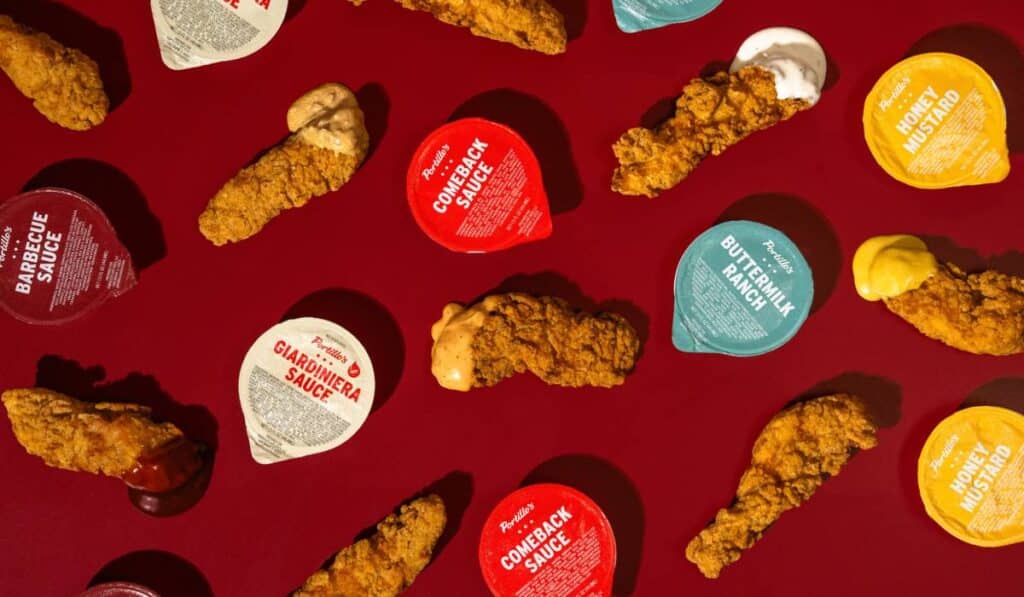
Traffic in Q1 benefitted from a limited-time Big Burger Bundle meal (burger, fries, and a drink for $9.99) and innovation, including Portillo’s birthday cake LTO, and the launch of new sauces. Additionally, it ran targeted offers through its loyalty arm.
During April, Portillo’s saw negative comp trends of roughly 1 point thanks to a challenging lap of last year’s breakfast pilot. Further headwinds are expected in May, Hook said, as Portillo’s measures against a 2025 BOGO Beef promotion.
Portillo’s, like much of the industry, slogged through January weather before improving. April ran negative thanks to the difficult lap as well as what Hook described as “more trade downs versus items on the ticket.”
From a consumer perspective, as guests go into offers, like the burger bundle or Perks deals, Portillo’s observed a lag in terms of value perception. It’s led to an ongoing shift.
The current Hot & Saucy Beef promotion, for instance, is more of an LTO than a discount.
Patterson said Portillo’s is looking “at the numerator of the value equation.”
“And if you think about our strategy when we’re starting with ops excellence, one of the things we need to do is make sure that we’re delivering or exceeding the expectations of the folks coming in that are paying full price,” he said. “I think the second lever that we’ll explore as part of the strategy is going to be the use of food innovation ot create value. So, not just locking in on a fully discounted value offer, but how do we use innovation to talk about value? How do we use marketing to talk more about value?”
“We certainly know it’s a driver for the business and where the customer is at today is important,” Patterson added, “but not locking ourselves into just going after this discounted promotional model.”
In Q1, Portillo’s witnessed 3 percent more penetration from Perks than Q4. But the unlock will be how to better understand customer cohorts and tailor messages based on visit frequency.
Patterson said there’s a lot of test-and-learn going on.
He was also asked about the earlier point of AUVs slopping dramatically after strong openings. Patterson said he’s still breaking that one apart.
There’s opportunity, he explained, to learn more about customers as Portillo’s enters fresh markets. It’s been a steeper drop than he’s used to.
“I don’t how much that has to do with our ability to drive quick awareness out of the gate,” he said, “and that kind of wanes off over time. So, I would tell you, I don’t have the answer now. But it is certainty something we need to continue to explore to better understand that and how do we prop it up during that kind of down cycle in the honeymoon.”
Patterson added net promoter scores remain high, even as traffic wanes. “So there’s nothing that jumps off that and says you don’t open it well and now you’ve disappointed a lot of guests. Again, that frequency is going to be something we really have to understand.”