
Yum! Brands turned in a solid Q1 beat, driven by another strong quarter at Taco Bell and continued momentum across KFC’s global business.
System sales rose 6 percent in the first quarter, with global same-store sales up 3 percent and digital mix reaching a new high of 63 percent. Core operating profit grew 10 percent excluding Pizza Hut—a qualifier that came up repeatedly throughout the company’s earnings call as the chain remains under formal strategic review.
Taco Bell continued its hot streak, with system sales up 10 percent. The quarter marked the brand’s eighth consecutive period of same-store sales growth ahead of the industry, with comps rising 8 percent year-over-year. CEO Chris Turner said the performance was driven in part by traffic gains, noting that comps included three percentage points of transaction growth, with value scores and value mix both increasing following the launch of the Luxe Value Menu.
Globally, Taco Bell’s international system sales increased 16 percent, while same-store sales grew 5 percent. The chain opened 30 gross new restaurants across eight countries, including 14 in the U.S. and 16 internationally. Looking ahead, CFO Ranjith Roy said the brand has a long-term opportunity to reach more than 10,000 U.S. locations, representing over a decade of development and expansion into new venues such as college campuses and airports.
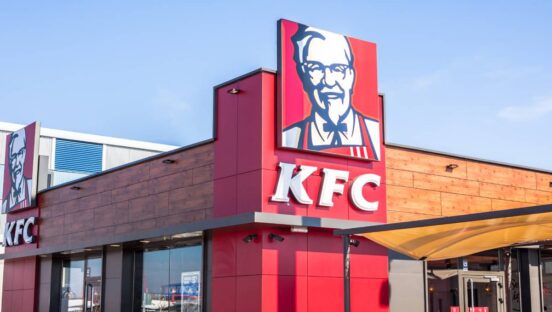
KFC, which accounts for 53 percent of Yum!’s divisional operating profit, delivered 6 percent system sales growth. The brand’s expansion reached a new milestone in Q1 with 648 new restaurant openings across 45 countries, marking a record for first-quarter gross builds.
That development momentum is being supported by a push toward more efficient construction. In Chile, for example, a franchisee recently opened a prefabricated restaurant that was assembled on-site in just 15 days. Yum! said the approach can reduce total construction time by as much as 17 weeks compared to traditional builds.
In the U.K., KFC posted 7 percent same-store sales growth, helped by the “Pickle Mania” menu. The offering came from the company’s “Global Innovation Pantry,” a system designed to replicate successful menu items across markets. That centralized approach also includes a globally deployable sauce platform launching in eight of KFC’s top 20 markets this year, built using insights from Saucy, the brand’s tenders-focused spinoff concept.
“Christophe Poirier, who developed the Saucy concept, is now the KFC global chief concept officer,” Turner said. “So, we are leveraging Saucy in a big way in terms of powering the broader KFC business.”
KFC’s domestic footprint is becoming a smaller piece of Yum!’s financial picture. The company has stopped disclosing KFC U.S. same-store sales since the segment now accounts for less than 5 percent of Yum!’s operating profit, excluding Pizza Hut.
Domestic system sales declined 2 percent in the quarter, and KFC’s home market now ranks as its third-largest region by system sales, behind China and Europe. Still, Turner said the U.S. business remains strategically important, even as leadership has been dissatisfied with its performance in recent years.
In response, KFC U.S. is leaning into a revamped value strategy, including $20 build-your-own buckets and a tiered $7, $9, and $11 value menu introduced in the second quarter. The brand is also working to boost relevance through a partnership with chef Matty Matheson and an expanded pipeline of menu innovation.
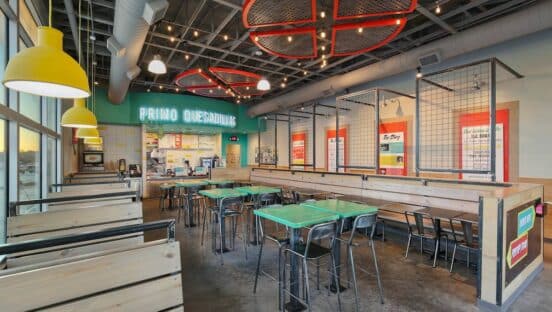
Beverages have emerged as another area of focus across Yum!’s portfolio. Taco Bell is piloting its Live Más Café concept in 38 restaurants, with 43 percent of specialty beverage sales coming from standalone orders without food. KFC is following a similar approach, scaling its KWENCH beverage platform to the U.K., Australia, and Canada.
Yum! is also expanding its proprietary technology platform, Byte by Yum!, to modernize operations and unify systems across markets. Digital ordering and “Smart Ops” bundles were recently rolled out to Taco Bell U.K., and the company is continuing to invest more heavily in artificial intelligence. In Q1, Taco Bell U.S. piloted AI-driven A/B testing in the drive-thru, with plans to expand the technology nationwide. The system can dynamically adjust menu layouts, content, and visuals in real time, allowing the brand to generate insights more quickly.
“First and foremost, we want to use AI to drive growth,” Turner said. “We’re also going to use AI to elevate our team members… to help make our jobs easier and allow people to be more productive.”
Turner pointed to KFC’s U.K. division as an example of how the company is already applying AI internally. The market currently uses 10 different AI agents across the organization, including a virtual learning and development team member that helps build training programs, as well as a development-focused agent that supports permitting by handling analysis and information gathering.
At Habit Burger & Grill, Yum! said it is seeing top-line momentum driven by value initiatives and menu innovation, including the Baja Crispy Fish Sandwich. The brand is also working to strengthen its positioning, particularly in Southern California, where it recently partnered with the Los Angeles Dodgers. At the same time, Habit continues to manage cost pressures, particularly from elevated beef prices.
Pizza Hut remains the outlier in Yum!’s portfolio. While the brand posted 11 percent system sales growth in the Middle East and 8 percent growth in China, its overall results were mixed. In the U.S., system sales declined 6 percent and same-store sales fell 4 percent.
Core operating profit for Pizza Hut was in line with expectations but continues to be impacted by spending tied to the Hut Forward initiative. The program includes a one-time investment this year focused on upgrading digital platforms and in-store technology to improve speed, conversion, and the overall customer experience. It also includes plans to close roughly 250 underperforming U.S. units in the first half of 2026 to strengthen franchisee health and improve profitability.
As part of that effort, Pizza Hut opened 346 gross new restaurants globally in Q1, resulting in 158 net new units after accounting for closures.
The brand’s long-term structure remains the biggest question. Yum! said in November that it would explore strategic options for Pizza Hut, which has lagged the rest of its portfolio in recent years. Several private equity firms, including Apollo Global Management and Sycamore Partners, have been reported as potential buyers.
Yum! did not provide an update on that process during the Q1 call but confirmed that the review is ongoing and on track to be completed in 2026.