


Fourteen years into building Cousins Maine Lobster into a national food truck powerhouse, Jim Tselikis and Sabin Lomac weren’t necessarily looking to start over. They have about 100 units, a proven operating model, and a brand synonymous with premium lobster rolls served out of brightly wrapped trucks across the country.
But about a year ago, what began as a casual experiment—a fried lobster item tossed around for the existing menu—started to stick. It lingered long enough to turn into something bigger.
“We were actually making a fried lobster item to put on the truck, and then we just were like, dude, fried seafood,” Tselikis says.
What followed wasn’t a pivot away from lobster, but an expansion of the world the founders had always come from. Growing up in Maine, lobster may have defined their business, but it wasn’t the only food on the table. Fried seafood—shrimp, scallops, haddock—was just as much a part of family gatherings and coastal culture. It simply hadn’t made its way into the Cousins Maine Lobster story yet.
Now it has, through a new concept called Cousins Fried Seafood, which launches its first truck in Louisville, Kentucky on Friday, as a corporate-owned unit before expanding into both franchise and company growth. The idea is familiar in structure—mobile, event-driven, and rooted in high-quality sourcing—but broader in reach. Where lobster carries a higher price and niche appeal, fried seafood opens the door to a wider audience in appetite and affordability.


That accessibility is key to the concept’s appeal, particularly for the franchisees who helped Cousins Maine Lobster scale in the first place. The founders quickly realized the limitations of even a successful niche. A single market can only support so many lobster trucks. Fried seafood, on the other hand, offers flexibility—not just in pricing, but in geographic density.
“You can’t put 10 lobster trucks in Raleigh [North Carolina], but you can put more fried trucks,” Tselikis says. The model allows operators to layer in a second concept alongside existing units, using the same booking systems, labor pools, and event relationships.
That operational overlap is what makes the idea feel less like a leap and more like a natural extension. Franchisees aren’t being asked to learn a new business from scratch. They’re adding a complementary product line to an ecosystem they already understand. The truck shows up in the same places, serves a different menu, and captures a different segment of consumers without cannibalizing the original brand.
“It’s literally saying, I have trucks in the market. I just need to park a new truck with different colors on it,” Tselikis says.
The founders insist Cousins Fried Seafood isn’t simply about volume or price-point expansion. If anything, it’s another attempt to do for fried seafood what they did for lobster—take a category often associated with inconsistency and elevate it through sourcing and execution.
Lomac points to the perception problem head-on.
“Fried food sometimes gets the rap of gluttonous and maybe not the highest quality, and in this instance, we’re really elevating the food,” he says.
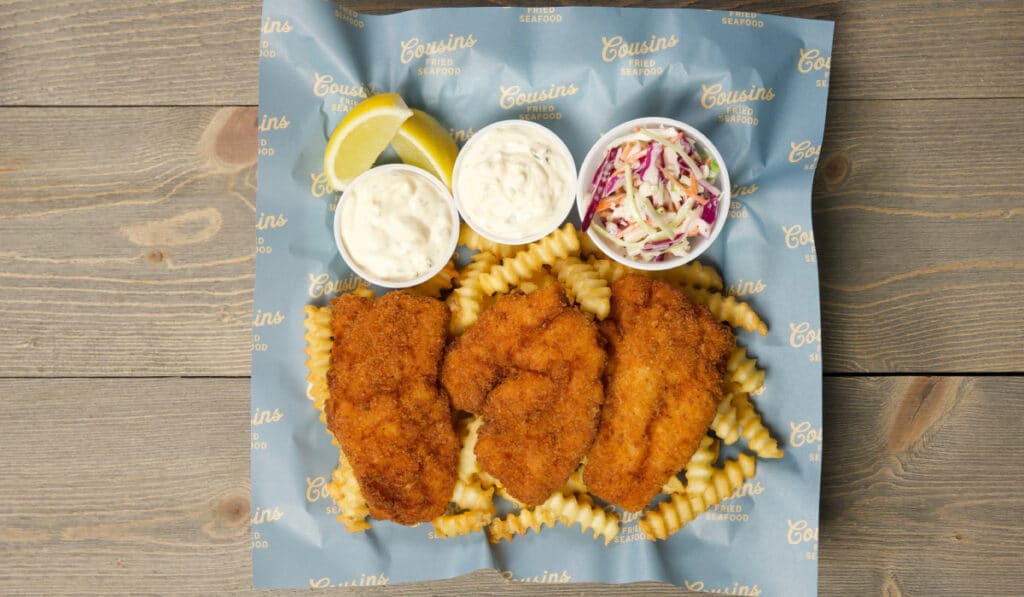
The menu features haddock, shrimp, scallops, and clams, but the emphasis is on the product beneath the breading. Tselikis describes a process that mirrors their original approach to lobster, starting with the protein and building outward.
“We want the protein as if there was no batter on it to be able to eat,” he says. The team opted for higher-grade scallops, resisted shortcuts like heavy batters that mask flavor, and spent months developing everything from proprietary breading blends to hand-made sauces.
Even seemingly minor elements received outsized attention. Lomac calls out wax paper testing, including evaluating how different materials handled oil saturation and visual presentation, as an example of how far the team pushed experimentation this time around.
It’s a stark contrast to their early days, when their first Cousins Maine Lobster truck cost $65,000 and was built with little more than instinct and urgency. Today, trucks approach $300,000, complete with advanced layouts and digital screens, reflecting years of iteration and a clearer understanding of throughput, guest flow, and operational efficiency.

This made launching Cousins Fried Seafood fundamentally different from starting Cousins Maine Lobster. The founders aren’t guessing anymore. They’re applying a decade-plus of lessons—what works, what doesn’t, and where small decisions compound into meaningful improvements.
“We have the luxury of going back and saying, OK, I don’t want to make that mistake again,” Lomac says.
The founders are well aware that Cousins Fried Seafood is opening in a category that has been relatively stagnant. Traditional seafood players have struggled to generate sustained momentum, like Red Lobster, which went bankrupt last year and shuttered hundreds of restaurants.
The founders don’t frame that as a warning sign as much as an opportunity. From their perspective, the desire for seafood hasn’t disappeared—it’s simply underserved when it comes to quality and experience. Lomac describes the category as one that remains deeply desired by consumers. The important part, he argues, is execution.
Part of it is emotional. Lobster, in particular, carries a sense of occasion, something Lomac likens to champagne. Fried seafood taps into a different but equally powerful dynamic—nostalgia. It’s the memory of coastal vacations, roadside shacks, and summer meals that feel indulgent and familiar. Cousins Fried Seafood aims to deliver that experience consistently, regardless of geography.
Mobility remains an advantage in doing so. Unlike brick-and-mortar restaurants, the food truck model allows the brand to meet guests wherever they are, such as large urban events, suburban neighborhoods, or small towns that couldn’t support a permanent location. Tselikis recognizes the ability for franchisees to “make your month” financially through targeted appearances, whether at a major festival or a rural community that draws hundreds of customers simply because the product is rare.
That flexibility has already shaped the rollout strategy. Louisville serves as a controlled launch market, but the real growth engine is expected to come from franchising, where demand is already building among existing operators. The founders estimate the model will skew heavily toward franchise expansion, supported by a smaller number of corporate units.
“They can go faster than we can because there’s more of them,” Tselikis says.
With fewer than 20 franchisees operating around 100 units, the company has prioritized depth of relationship over scale of ownership. Lomac says the group is intentionally tight-knit, built around operators who align with the brand’s values and approach.
That alignment has translated into trust, which in turn has shaped how Cousins Maine Lobster develops new ideas. Instead of building Cousins Fried Seafood in isolation, the founders brought franchisees into the process early—soliciting feedback, pressure-testing assumptions, and ensuring the concept resonated with those who would ultimately operate it. It’s a collaborative approach that contrasts with more top-down franchise systems, where new initiatives are often introduced fully formed.
For Tselikis, that dynamic is strategic and personal. Franchisees aren’t just operators. They’re partners whose success directly influences the health of the brand. Cousins Fried Seafood, in that sense, isn’t just about expanding the company’s footprint. It’s about creating a next step for operators who might otherwise hit a ceiling within the lobster concept.
There’s also a longer-term horizon in play. While the initial focus remains on food trucks, the founders acknowledge the potential for brick-and-mortar locations as the brand attracts a bigger pool of franchise candidates. The idea of small-format, possibly seasonal seafood shacks—or even co-branded concepts pairing lobster and fried seafood—has already entered internal discussions.
For now, though, the immediate test is simpler: a single truck, a new menu, and a familiar operating model in a new context. Early expectations are high, with the Louisville launch projected to draw hundreds of customers out of the gate. It’s a level of demand that mirrors Cousins Maine Lobster’s early growth, despite the absence of an established brand identity for the new concept.
In many ways, that’s the bet. Not that fried seafood needs to be reinvented, but that it can be reintroduced through better sourcing, tighter execution, and a model that brings it directly to consumers who may not otherwise have access to it.
“You can have our food and you love it and we check every box—that’s the expectation,” Tselikis says.