
Bon-Die Fortner, Yogurtland’s VP of franchise development, has been on the job less than a year but he already has a favorite quote from a franchisee, who once told him he would die with his locations.
In other words, franchisees have no interest in letting go of their Yogurtland stores; franchisee turnover is almost nonexistent.
“They renew. They keep doubling down. Their biggest frustration is if they’re in a market where there’s just no more room for them to grow,” Fortner says.
This eagerness is linked to the chain’s ongoing momentum.
Yogurtland’s AUV is approaching $1 million after two straight years of growth, and Fortner believes it’s a notable sign that consumers have renewed confidence in the brand and its products.
The executive says growth is coming from loyal customers and new guests. Some are discovering frozen yogurt as an alternative to sweeter or more indulgent desserts as they become more conscious of their diets, lifestyle goals, and overall gut health.
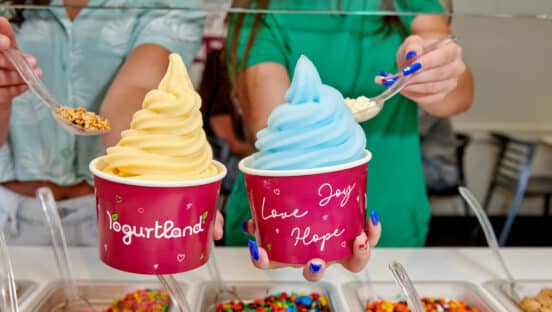
Fortner also notes shifts in social behavior. These include guests searching for “third spaces” outside of their homes and workplaces and those who are “sober curious” and not as interested in meeting at bars. He adds that after years of spending more time online, customers are seeking in-person activities that allow them to connect with others. Yogurtland’s shops—which feature over 200 flavors and let guests craft their own frozen yogurt desserts—serve as a natural destination for these desired shared experiences, according to Fortner.
“What I’m seeing whenever I’m in a shop are groups of people coming in together,” Fortner says. “You almost never see just one person coming in and getting frozen yogurt. What you see are people coming together. If I was just taking a vibe check of everything, I would say that so much of it is really friends, families, and acquaintances wanting to gather somewhere. And they’re trading coffee shops and they’re trading the bars for something that I think they all feel is fun and enjoyable.”
From Yogurtland’s perspective, Fortner has seen increased investment in marketing, product quality, and customer accessibility. The chain already operates over 200 locations in eight states—with a ninth one signed for development—making it one of the largest frozen yogurt concepts in the country. Smarter site selection has led to over 60 restaurants moving through various stages of development. The chain announced in early July that it aimed to open eight new locations by the end of the summer.
Economically, Yogurtland is set up well for a rougher macroeconomic environment. Thanks to a vertically integrated supply chain, low labor model (since guests serve themselves), and the absence of common pain points like ongoing beef inflation and tariffs, the brand has been able to avoid headwinds that other concepts can’t escape.
“If you’re selling a hamburger, now you got to worry about where your margins are going at this point. The labor complexity of increasing hourly wages and having to choose whether or not you have to raise prices or cut labor—those are things that, 20 years ago, whenever Yogurtland hit the scene, it was already built in. That consideration was already accounted for. It’s the actual natural architecture of the concept.”
“… A lot of our existing franchisees actually own other brands, and the investments that they are looking to expand upon are the Yogurtland brand because of those exact pain points that they can avoid through our brand,” he adds.
A majority of shops are based in California, so much so that Yogurtland has paused additional development in Southern California to protect against saturation and cannibalization. As a result, growth has spilled into nearby states like Arizona and Nevada.
Texas has become a major target as well because of multiple major markets, crossover between California and Texas residents, and consistent warm weather. Atlanta and Nashville have been cited as potential new markets as well. Fortner says whenever Yogurtland enters a new market, it does so with multi-store operators that have signed up for area development agreements that pair with a detailed schedule. It also works with its supply chain to ensure it’s aware of the new business coming in.
“The number one thing that we’re always focused on for franchisees is their ROI. And so when we go into a market, however we can improve upon it and build brand awareness, build traffic, build support, do all those things, it’s always part of the equation,” Fortner says. “We don’t want to just go into a market to plant a flag and then add to a unit count. We want to do it the way that’s conservative and it’s strategic and it’s meant to be successful for the franchisee, so it’s a little bit different. I think some brands can take that slippery slope where what they’re looking for is a unit count metric, and what we’re looking at is a success metric.”
Fortner says Yogurtland is careful in its evaluation of prospective franchise partners.
While the brand values those who come with multi-unit experience, it’s also looking for alignment on operating standards and achievement of ROI in a way that’s not detrimental to the brand, doesn’t sacrifice the guest experience, and is representative of the company’s core pillars—love, joy, and hope.
Fortner is well aware that those three words sound a little cheesy and campy. But once an operator joins the organization and works around CEO and founder Philip Chang, they immediately recognize those principles are the backbone of Yogurtland.
“It’s a big reason why the success has been what it has been over the past 20 years,” Fortner says. “Philip brought to the market the self-served frozen yogurt model. I don’t think there’s anyone who disputes that. They realize Yogurtland was the pioneer of the model. A lot of copycats came along, and other competitors have grown and ballooned to larger sizes, but every step of the way the decisions made by Yogurtland were conservative. They were meant to build an insulated and forward-looking model that always took great care of the health and well-being of the brand and the franchise partners that we had.”