
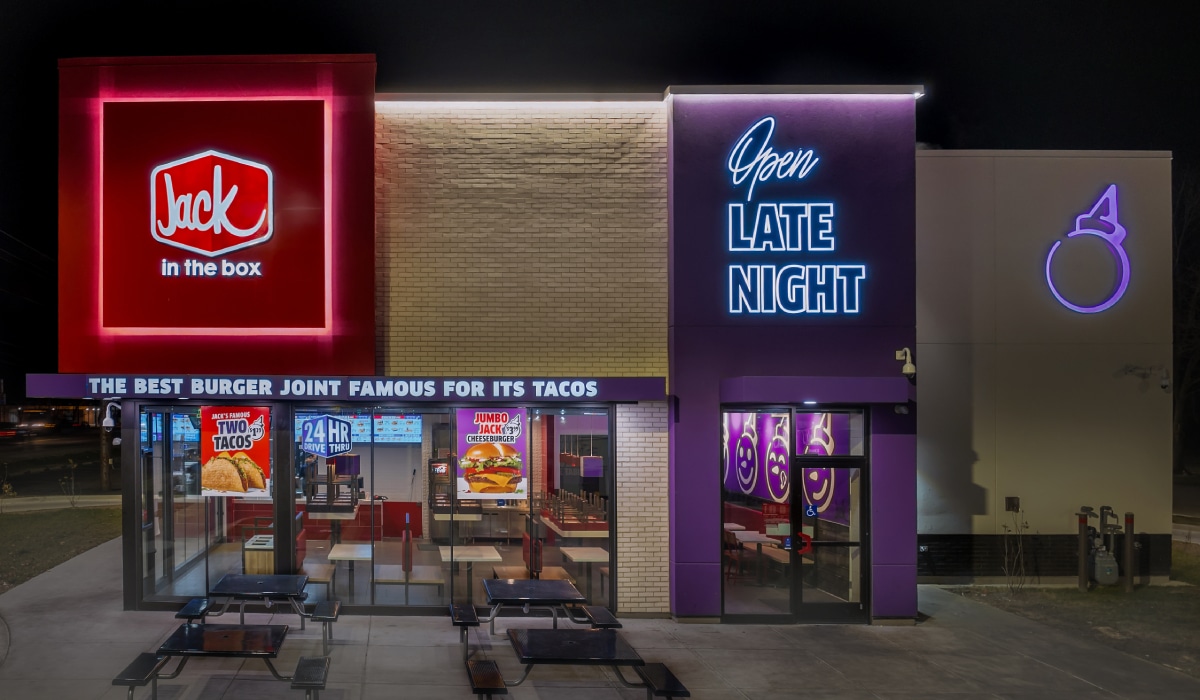
Jack in the Box has plans to shutter roughly 200 restaurants, but it wants to refresh a lot more of them.
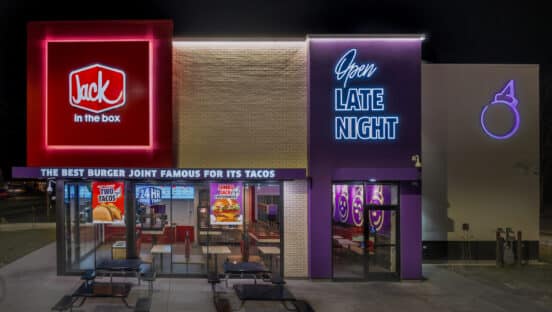
On Wednesday, the burger giant announced a new “Jack’s Way” operating plan, including a multi-year reimage initiative that will touch at least 1,000 locations. This is tacked onto the current program, which is scheduled to reach 300 to 400 restaurants, with a $50 million contribution from corporate. Jack will provide funds for the additional remodels as well, but CEO Lance Tucker didn’t provide an exact figure.
The CEO said the “guest experience has suffered over the years” because stores haven’t been properly refreshed.
“We are going to attempt to touch an additional 1,000, which honestly ought to get us to a spot where we’ve touched the vast majority of the system when we’re finished with it,” Tucker said during Jack’s Q3 earnings call. “And it will be a meaningful contribution from corporate. I’m not ready to give the exact numbers quite yet, and we’ll do that in November. But you can look and say, well, gosh, we did $50 million before and it touched 300 to 400.”
READ MORE:
Del Taco Draws Strong Buyer Interest Ahead of Official Sale Process
Jack in the Box Mulls Selling Del Taco, Plans Hundreds of Store Closures
What’s Next for Jack in the Box After CEO Darin Harris’ Departure?
The chain views Jack’s Way as a method to “get back to basics,” according to Tucker. That means better guest interactions, consistent quality across core menu items, more training and support for employees at the restaurant and field levels, and holding restaurants more accountable by reintroducing new recognition programs to motivate team members.
Another part is delivering value to the consumer, an area where Jack has “missed the mark,” Tucker said. In 2026, the brand’s 75th anniversary, guests will be greeted with more innovation, improved quality across core products, the return of classic products that customers have been asking for, and a “modern twist on iconic commercials from the brand’s past.”
“As I look longer term, the entire guest experience requires improvement in the coming months and years,” Tucker said. “The value equation has gotten a bit off track across the broader QSR industry and Jack in the Box is no different. So we need to work on the entire guest experience not just promotion or price.”
Tucker hinted that some of the tweaks may involve altering the size of the menu.
“I think we’ll look at it,” the CEO said. “A lot of our brand equity though at Jack in the Box does come from a variety and the fact that we have 24-hour breakfast, and we have a 24-hour menu generally, and you can get an egg roll … or tacos or things that you can’t traditionally get elsewhere. So I think we do need to look to make sure we’re being smart about our menu. But it’s a difficult task at Jack in the Box simply because so much of the equity relies on variety, so it’s making sure how do you keep as much variety out there on the menu for the guest, while maybe trying to make it a little simpler in the back of the house.”
The move comes as Jack’s same-store sales dropped 7.1 percent in Q3. This was comprised of a franchise comp decrease of 7.2 percent and a company-owned comp decline of 6.4 percent. Transactions and mix were negative in the quarter, offset by several price increases. Restaurant-level margin percentage in Q3 fell to 17.9 percent, down from 21 percent a year ago, primarily driven by sales deleverage. In one bright spot, digital sales mixed 18.5 percent, putting the brand well on pace to reach its goal of 20 percent.
Tucker attributed the negative results to lower-income consumers and Hispanic guests—which are a primary demographic in core markets—pulling back spending. Jack is also facing difficult compares due to a successful Smashed Jack promotion last year as well as significant price taken by many restaurants in 2024, especially in light of the new California law that hiked fast-food minimum wage to $20 per hour.
Moving forward, Jack hopes to resolve the declines with more demonstrable value. The brand responded by reintroducing its Bonus Jack combo at an introductory price point, launching Spicy Chicken Strips, bringing back its Sauced and Loaded Potato Wedges for a limited time, and propping up its Munchie Meal during the late-night daypart. Jack plans to invest $5.5 million in incremental marketing across the fourth quarter to support these menu efforts.
“As we look to Q4, what I’ll tell you is that the first few weeks started off a little bit rough,” Tucker said. “The last couple of weeks, while it is still early, the trends have looked much improved. So we definitely think we’re on the right track. And I think kind of the theme is going to be, we probably need to be looking at a little more price-pointed value, little more consistent value honestly, and making sure it’s visible by being on the menu board—which we’re also doing, which we don’t always do when we do an LTO.”
Jack’s shuttered 21 units in Q3. Thirteen of these were associated with the JACK on Track closure program, which calls for 150 to 200 shutdowns and is completely separate from the expected 1.5 percent to 2 percent system closures for fiscal 2025. Five of the 13 closures were company-owned restaurants; the rest of the shutdowns as part of this program will all be franchised.
The stores closing under the JACK on Track plan earn $1.2 million in AUV (the system average is above $2 million) and swing an average annual four-wall EBITDA of negative $70,000. Jack expects to feel a sales transfer benefit to nearby restaurants, many of which are owned by the same franchise operator. Under this plan, the chain is on pace to shutter 80 to 120 units by the end of 2025; most of these performed worse than the previously outlined financial figures, according to CFO Dawn Hooper.
The sale of Del Taco is another part of the JACK on Track plan. The Mexican chain’s same-store sales dropped 2.6 percent in Q3, comprised of a 2.7 percent decline at franchise stores and a 2.2 percent decrease at company-owned restaurants. Restaurant-level margin was 9.7 percent, down 370 basis points year-over-year due to lower sales and higher costs.
“We have good interest and are progressing through the process,” said Hooper, regarding the ongoing Del Taco sale.
Selling real estate is also part of the plan. Jack didn’t sell any in Q3, but it does expect to earn proceeds of at least $100 million within the next fiscal year.
Jack finished Q3 with 2,168 restaurants, 2,026 of which were franchised. Del Taco ended with 585 stores—453 franchised and 132 company-owned.