
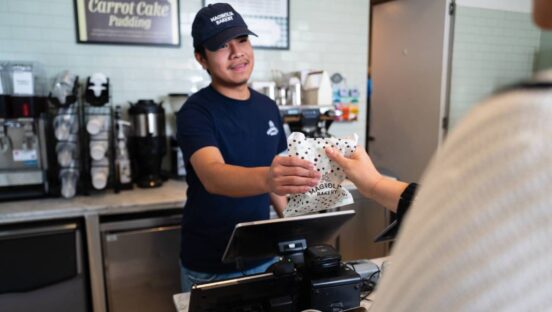

Magnolia Bakery is on the cusp of a record-breaking growth year.
The 30-year-old bakery is scheduled to open nine U.S. shops in 2026, on top of the 10 it operates across New York City, Chicago, and Los Angeles. All openings this year will be driven by franchising, a strategy the brand kickstarted in 2025. There are also 40 bakeries internationally, and that should bump to 50 by the end of the year.
But to new CEO Nathan Louer, the expansion simply feels business as usual.
“I’ve never thought about this year being a record-breaking year or unprecedented growth,” he says. “To me, it’s always just seemed like we’re doing what we need to do to grow the business.”
Louer comes in with plenty of franchising experience. He spent nearly 17 years at Jimmy John’s and over two years as Jamba’s brand president. And the executive appreciates the infrastructure Magnolia built before he arrived, including the necessary franchisee support around training rigor, real estate, and construction. The business model is sound as well. As Louer puts it, “We’re a bakery, not a one-trick pony.” Meaning, Magnolia has a diversified menu—the star product being banana pudding—that doesn’t take up just one daypart or consumer occasion.
“We have the people in place, we have the process in place, and we have the know-how from doing this over and over and over again, day in and day out,” Louer says.
That infrastructure Louer refers to has been spearheaded by Bobbie Lloyd, who joined Magnolia in 2006 when it was one shop in New York City’s West Village. When Lloyd first arrived, there was no C-suite; she had to “wear all the hats.” This was especially true during COVID when Magnolia scaled down to around 15 employees. However, by 2021, Lloyd officially became CEO and had the opportunity to fill key positions. Some of those hires include Eddie Revis, who joined as CMO in 2021 and was elevated to chief commercial officer in 2024, CFO Federico Reyes, who started in 2023, and COO Dominic Alessandrini, who came onboard in 2024.

Alongside store growth, the brand launched international franchising in 2010, e-commerce in 2011, and CPG in 2023. It also dived into other marketplaces, such as Dashmart, Gopuff, and Wonder, and relaunched its website and rebranded the company a few years ago.
Thanks to all of the sales levers, Magnolia’s revenue has doubled over the past five years.
“It’s through product innovation. It’s through literally remaining constant in the products that we make,” Lloyd says. “They have to be the same. They have to be delicious. We can’t do newfangled, crazy things—things that are outside of our brand. But it could be an innovation like our Banana Pudding Bar that was an innovation [last] year that brought a lot of money to the bottom line by creating a product that we know the consumer wants in a format that they want it. And that’s through data.”
To Lloyd, it felt like a natural progression to bring in a CEO who could run the domestic franchising business.
“I felt that what I could bring to the table over the last five years was building out each of these channels and get the foundation laid so that I could hire the right people to lead them,” Lloyd says.
But Lloyd isn’t going away. Since 2006, she’s served as chief baking officer, leading Magnolia through menu enhanacements. Now she’ll add the title of chief brand officer, which she views as culture-building and working for her employees, not the other way around.
She’ll have a part in franchise relations too.
The franchised locations will open in the back half of 2026 across Salt Lake City; Las Vegas; Detroit; Louisville; Fairfield County, Connecticut; Cleveland; and Staten Island.
Louer acknowledges the markets being so far apart seems like a “scattershot franchise strategy,” but he insists it’s not. The plan is informed by the strength of Magnolia’s CPG and wholesale businesses—the company knows where there’s demand around the country.
“When I asked the questions, and Bobbie would tell me the reasoning and data behind it, it’s like, ‘Oh this is a no-brainer,'” Louer says. “And now for us, it’s achieving critical mass in these markets that do have a semblance of brand awareness for the business. And frankly, being a New York brand and this being one of the biggest tourism places in the world, there’s a lot of people around the country who know Magnolia and use us frequently. And so for us it was, I don’t want to say easy, but it was pretty simple to identify the hotspots for Magnolia around the country.”
Although Louer and Lloyd are protective of Magnolia as a concept, the two aren’t so staunch in their beliefs that they think the brand couldn’t diversify its store base. The chain is known for its urban roots, but leadership has considered drive-thru; some franchisees are actually looking at endcap spaces.
The majority of real estate Magnolia has identified in franchise markets is “suburban, but with an urban feel,” explains Louer. He uses Detroit’s suburbs as an example. Birmingham, Michigan, is about 30 minutes north of the city, but still has an “urban-esque area and walkable downtown,” the CEO says. Magnolia isn’t afraid of diving into nontraditional spaces either. One of its NYC locations is based in La Guardia Airport. Louer also poses a situation where the brand could fit into roughly 200 square feet and just pump out banana pudding (the company already sells five cups of banana pudding every minute).
“This brand can flex,” Louer says. “We will flex. The economics will work differently, and we’re well prepared to take that on and figure out the best recipe for the franchisee and franchisor in that regard.”
Wherever Magnolia puts its next bakery, Lloyd emphasizes that it must foster culture and community.
“We know that at Magnolia Bakery, there’s an emotional connection that our customers have. And it’s generational now,” Lloyd says. “Sometimes it’s three generations because my grandma brought me, now my mom brings me, now I can come by myself. And that has to mean that our goal is to maintain that to every community that we go into—to be part of the communities, to make sure that we’re also giving back in those communities just like we do here in New York. Every one of our stores is its own little community.”