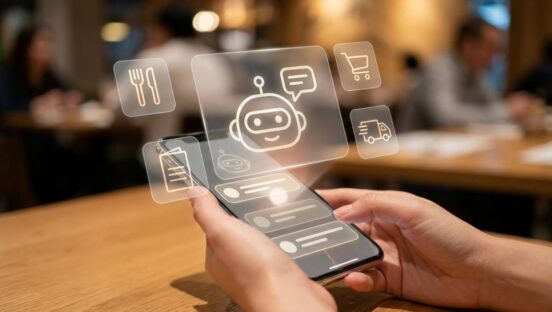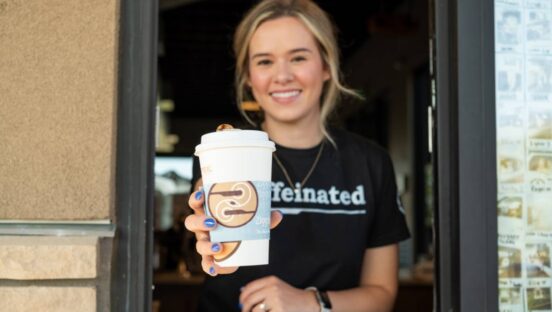

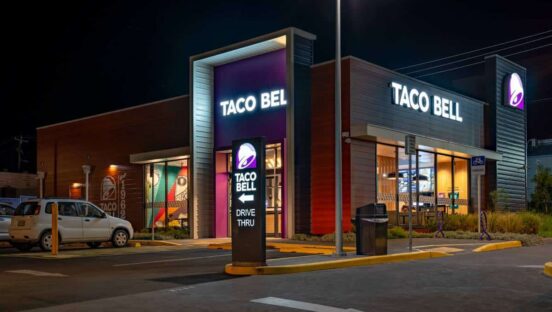

Taco Bell clearly believes in the future of automated voice ordering at the drive-thru.
The technology is now active in over 890 U.S. restaurants in 38 states. The chain’s voice AI provider, Omilia, announced Tuesday that the two sides will extend the partnership even further.
The expanded deployment builds on a relationship that began in 2023. It marks one of the largest AI-powered drive-thru rollouts in the quick-service industry.
“Omilia’s Voice AI gives us the ability to ease team members’ workloads and provides them the flexibility to engage with customers in a more meaningful way,” Dane Mathews, Taco Bell’s global chief digital and technology officer, said in a statement. “Omilia’s platform has proven itself at scale in select U.S. restaurants, and continuing this strategic partnership supports our long-term digital and tech strategy.”
Drive-thrus account for the majority of Taco Bell’s sales, and the brand has consistently ranked among the industry’s fastest operators. The chain has led QSR’s annual Drive-Thru Report for five consecutive years, maintaining its speed-of-service leadership even as transaction counts continue to grow.
Instead of viewing AI primarily as a labor replacement tool, Taco Bell has consistently framed the technology as a way to improve hospitality by allowing employees to spend less time taking orders and more time interacting with guests.
Mathews told QSR magazine that AI has earned its place by producing measurable results for customers and restaurant teams.
“By automating order-taking, it enables team members to focus on more meaningful moments of hospitality and customer interaction,” he said. “We’ve even seen reduced team member turnover in high-usage AI locations, proving that thoughtfully implemented AI can not only support team members, but improve restaurant culture.”
According to Omilia, restaurants using Voice AI have reported higher employee retention than comparable locations without the technology. Transaction times have remained on par with—or in some cases faster than—traditional order-taking methods. Guest satisfaction has also remained at or above restaurants not using AI.
Omilia’s system uses proprietary small language models to recognize speech despite road noise, regional accents, menu modifications, and changing restaurant conditions. It also adapts automatically to individual restaurant menus, limited-time offers, and real-time inventory without requiring manual retraining.
That flexibility is important for Taco Bell, a concept that relies on a variety of LTOs and menu innovations.
“The drive-thru environment is one of the most demanding—real-time, noisy, fast-paced, with menus that change by store and by day,” Dimitris Vassos, CEO and cofounder of Omilia, said in a statement. “This partnership reflects Omilia and Taco Bell’s shared commitment to delivering measurable value for customers, restaurant teams and franchisees.”
There have been bumps in the journey. Last year, multiple clips went viral of Taco Bell’s AI ordering system malfunctioning, including one in which a guest ordered 18,000 water cups. In an interview with the Wall Street Journal, Mathews said the Mexican giant would think carefully where AI makes sense. For instance, Taco Bell may prefer humans to take orders at busier restaurants.
AI has become a cornerstone of Yum! Brands’ digital strategy.
The restaurant group has heavily invested in Byte by Yum!, its proprietary AI-enabled restaurant technology platform that integrates point-of-sale systems, digital ordering, loyalty, inventory management, and back-of-house operations across Taco Bell, KFC, Pizza Hut, and Habit Burger Grill.