The Gyro Project was a COVID brainchild.
George Tenedios and Spyros Kokkosis—who’ve known each other for 30 years and go as far back as Greek school in the early 1990s—had their core restaurant businesses, but both were closed for a short period.
During this down cycle, Kokkosis kept mentioning the lack of quality Greek food around New York and New Jersey. He felt there was an opportunity for him and Tenedios to go into business together and showcase the cuisine as it was meant to be.
Tenedios was reluctant at first and kept rejecting the idea. His mind “was going a million miles a minute” trying to keep his businesses alive. He had lost around a dozen locations because of COVID, so he wasn’t high on opening another full-service restaurant.
Then Kokkosis found an answer that finally spoke to Tenedios.
“After a month or so of Spyros just chirping in my ear every single day—Greek restaurant, Greek restaurant, Greek restaurant—he changed his tune and he said, ‘You know, why don’t we do a Greek quick-serve? It doesn’t exist. We’ll do something a little higher end, high quality, gyros, pitas, bowls, super easy, super quick, super tasty.’ And that’s when the bulb went off in my head and I said, ‘Great, let’s do it. Absolutely all in. Let’s move forward.’”
The idea was conceived in late 2020. After a meticulous process of greenlighting the idea and putting the marketing, concept, and location together, The Gyro Project officially debuted in Fort Lee, New Jersey, in July 2023. The company has since opened a restaurant in Newark and another in New York City’s Upper West Side neighborhood.
From the beginning, the duo didn’t want to become the “Greek Chipotle.” They hired a designer with the directive of customers feeling like they’ve been transported to a Greek Island.
“When we decided to do this very early on, it was always, we’re not going to look corporate,” Kokkosis says. “ … Before the space was even available, before we knew where we’re going to go in, we knew what the cues were going to be. All the aesthetics were in all our minds. We knew we’re going to have these beautiful marble counters. We knew the aesthetic was going to be high end. We knew it was going to be fast fine. From the brainchild, coming out into fruition, it’s always been that vision.”
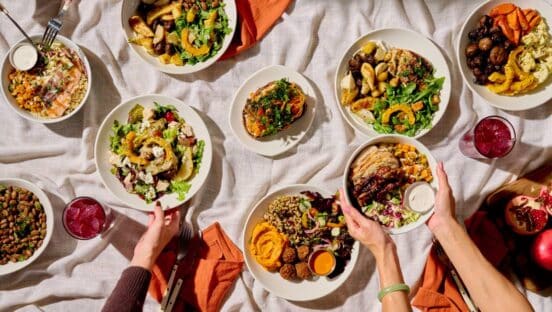
One of the menu highlights is pork belly, which is made from a proprietary recipe. The Gyro Project partners with a local meat purveyor from Greece—which also has a plant in New Jersey—to produce the ingredient. The chain also serves gyros with beef/lamb and chicken. Customers can get a customized bowl if they prefer, as well as salads, a variety of side dishes like lemon potatoes, crispy pita chips, and fries, a selection of baked goods, and creative Greek frozen yogurt, such as Samoa Sundae (shortbread crumble, caramel, toasted coconut, and chocolate sauce) or De-Constructed Baklava (Greek honey, crushed walnuts, cinnamon, and phyllo crisps). It’s a mixture of tradition and modernization.
“What’s awesome about The Gyro Project is you get a very modern approach to the whole thing. While still keeping those traditional roots as alive as possible,” Kokkosis says. “Bowls are not something in Greece. That’s something that George, being in his background, his stores are very big on that. The flavors in there—every little thing we throw in there—they’re all based on recipes from home, from our chef. We asked our moms, we asked our grandmas. We’re like, ‘Hey, what do you guys think?’ And that dialed in the traditional flavor, but it’s really a modern approach.”
Tenedios and Kokkosis are both New Jersey residents, but much of their time is spent in New York City, making it the natural next step for growth. However, The Gyro Project isn’t interested in sprinkling in locations in every central business district in Manhattan. Instead, the chain hopes to balance that with residential neighborhoods in places like Brooklyn, Long Island, and other parts of New Jersey. The “Monday through Friday, 9 to 5” office crowd is part of the brand’s demographic, but it’s not everything. The Gyro Project also wants to cater to those that work from home, the college-aged guests, the 18 to 25 year olds, and everyone in between.
The unit in the Upper West Side opened their eyes to just how diverse their customer base is.
“Greek is having a moment right now, and I think that’s going to continue for many, many years to come, especially being that it’s an underserved category, at least here in the tri-state area,” Tenedios says. “You’ve got a lot of full-serve Greek restaurants, a lot of Greek restaurants that are doing the same thing. It’s high-end seafood. You don’t have a lot of those other tiered Greek cuisines similar to what we’re doing, what I consider fast fine. We’re not a QSR, we’re not a fast casual 100 percent, but we’re not a fine-dining or full-serve restaurant. We’re that in-between mark, which is strategically where we want to be.”
Tenedios appreciates the simplicity of the brand. He also franchises fresh&co, which comes with more than 800 SKUs and three dayparts whereas The Gyro Project has around 100 SKUs. Because of this model, the two believe the chain is capable of franchising or licensing sometime in the future.
Currently, growth is self-funded, but the plan is to look at different avenues in the coming 12 to 24 months, whether that’s partnering with other operators or looking for outside capital.
“Spyros and I are actively doing tour visits—daily, weekly—throughout Manhattan and New Jersey, and we’re looking to expand as fast as we can while not jeopardizing the brand, the quality, and everything else that goes with the rapid expansion,” Tenedios says.