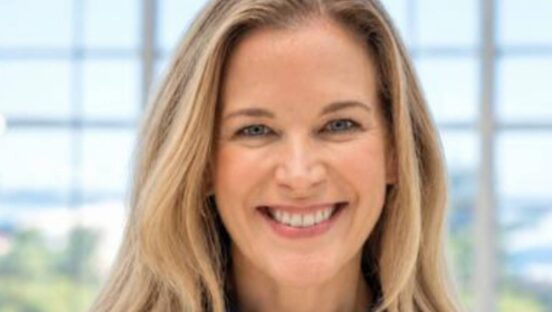

la Madeleine’s chief executive doesn’t talk about the bakery and cafe chain like it’s just any other job. For John Dillon, it’s personal.
“I grew up on la Madeleine,” he says. “I’m from the Dallas area, where the brand was founded in 1983, so it’s been part of my life for a long time. It was my mom’s favorite brand, my mother-in-law’s favorite brand, and my wife’s favorite brand. My daughter even worked at la Madeleine in high school.”
When he and his wife moved to South Carolina years ago for his role at Denny’s, she asked him to look into opening a la Madeleine franchise there because she missed the tomato basil soup so much. So, when Dillon stepped into the CEO role at the beginning of 2025, it felt less like a career move and more like a full-circle moment.
“It really felt like it was meant to be,” he says. “I have a strong passion for the history of the brand, but even more for where we can grow. We like to say the brand is 43 years young.”
Dillon spent his early months in the role focused on understanding exactly where the brand stood. He immersed himself in the business, talking with team members across the system and spending time inside cafes observing day-to-day operations. Those conversations, paired with both qualitative and quantitative surveys of managers, helped him build a clear picture of the brand’s strengths and pain points.
What emerged was a concept with deep emotional resonance among guests and a notably long-tenured workforce. At the same time, he identified a clear opportunity around relevance. la Madeleine had strong brand equities and a loyal following, but some of those strengths had grown dated and needed to be refreshed for a new generation of guests.
He also saw complexity as a barrier. The menu spanned multiple categories and carried more operational weight than a typical counter-service concept, which limited the brand’s ability to innovate. Simplifying the menu, he believed, would allow the company to execute at a higher level while reopening the door to more focused, consistent innovation—something that had been relatively limited for nearly a decade.
“I knew it was a brand with a story to tell and tremendous DNA, but some of those equities needed to be dusted off and made more relevant for today,” he says. “We needed to aggressively age down the brand from a relevancy standpoint.”
One of Dillon’s first moves was repositioning the chain from a “French” brand to a “French-inspired” brand.
“It’s just one word,” he says, “but it’s a small, subtle change with a very big impact.”
In Dillon’s view, the old positioning risked making the brand feel intimidating to everyday guests.
“French can be powerful, but it can also feel limiting and unapproachable—people think escargot, caviar, white tablecloths, high prices, and menu items they can’t even pronounce,” he says.
The new language is meant to widen the target without abandoning the core identity.
“We’re very proud of being French-founded and French-inspired, but we also need to be more approachable,” he says. “‘French-inspired’ opens the aperture for innovation and lets us introduce more craveable, relevant items while still staying true to our roots.”
That shift started coming to life in the middle of last year, when la Madeleine rolled out an all-day brunch platform that leans into familiar favorites through a French-inspired lens. The addition of items like French toast—something guests intuitively associate with the brand—was a move to meet expectations in a more accessible way.
The chain followed with items like avocado toast, new sandwiches and salads, and a line of refreshers, which are fizzy, iced drinks that blend fruit flavors with house-made lemonade, iced tea, or club soda.
“These aren’t inherently French, but they live in that sweet spot of French-inspired and American craveable flavors,” Dillon says.
la Madeleine has also shown a newfound willingness to move quickly when trends align with its DNA. When Parisian hot chocolate started taking off on TikTok, the brand leaned into the moment.
“We leaned into our roots, put it on the menu, and saw great success,” Dillon says. “That’s the kind of thing we can uniquely pull off because of our French-inspired DNA.”
Behind the scenes, he is pairing that creativity with a more structured approach to menu cadence and complexity. Limited-time offers now refresh the menu about five times a year, alongside a couple of core menu updates.
“Menu news drives traffic. I’m a firm believer in that,” he says. “At the same time, we’re simplifying in other areas so we don’t overwhelm our operators.”
Dillon’s vision extends well beyond the menu. Last year, the chain unveiled a smaller-footprint prototype designed to improve unit economics and open the door to a wider range of real estate opportunities, including airports, universities, and hospitals.
The chain’s legacy boxes typically ran 4,000 to 5,000 square feet, Dillon says, and those large footprints are increasingly hard to justify. The new prototype brings that closer to 3,000 square feet, with flexibility depending on the site, and can work across inline, endcap, and freestanding formats.
Importantly, the smaller footprint is not about scaling back the experience. Instead, the redesign leans more intentionally into the brand’s cafe identity, with brighter colors, more prominent French design elements, and a stronger emphasis on signature features like the fireplace and bakery case.
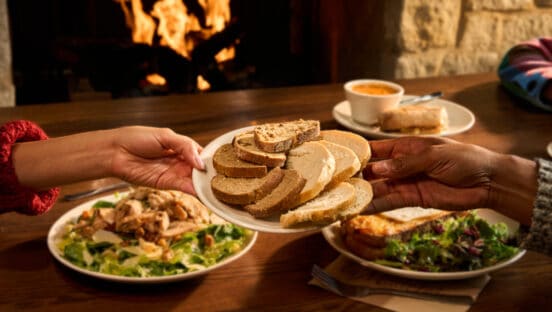
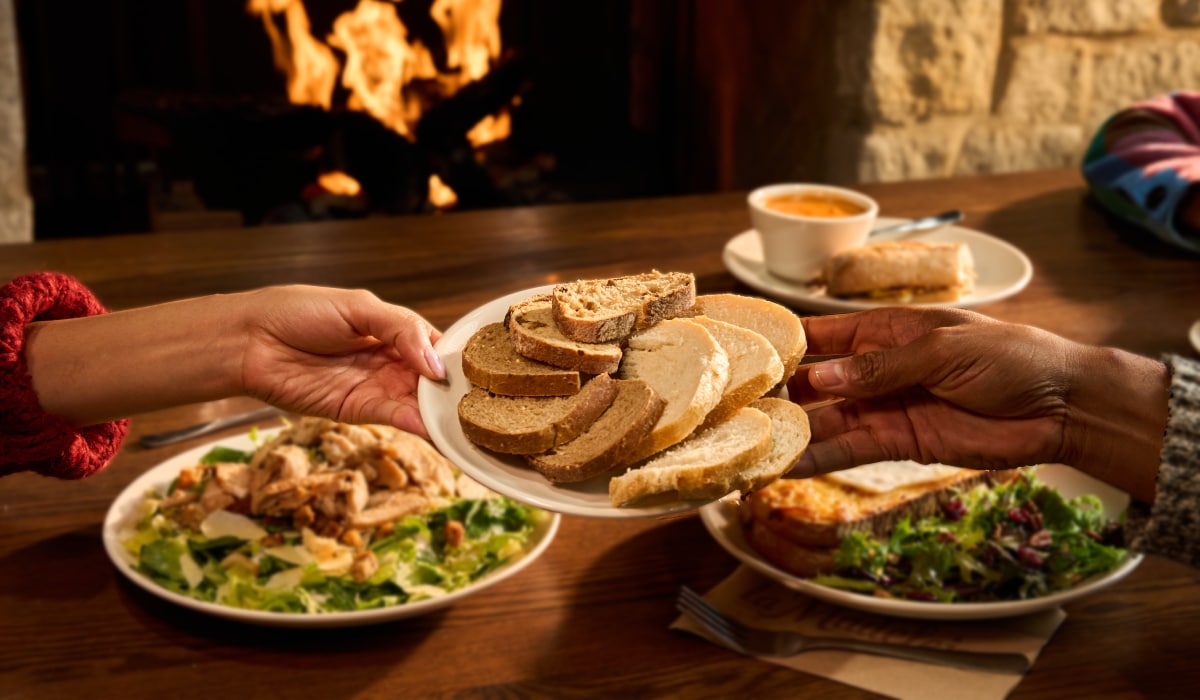
The fireplace, long one of the chain’s most recognizable equities, is again a focal point. Complimentary bread has returned as a small but meaningful gesture. Guests are greeted with a “Bonjour” at the door, a touch the company tracks and can tie to higher experience scores.
“The number one word I heard in my interviews with staff and guests was ‘warmth,’” Dillon says. “There’s the literal warmth of the fireplace, but much more important is the emotional warmth—being greeted with ‘Bonjour,’ getting fantastic food, complimentary bread, and a place where you can linger and connect.”
Those in-store touches now have to coexist with a very different reality in how guests consume the brand. Roughly half of la Madeleine’s business happens off-premises, through takeout, third-party delivery, and catering.
Dillon says la Madeleine “absolutely” wants to keep growing off-premises, but “we don’t want to lose the soul of la Madeleine from a dine-in experience standpoint.”
The balancing act hinges on choice and technology. The brand is piloting a new POS system with self-order kiosks, giving guests more flexibility in how they interact with the brand, whether that means ordering quickly to go or settling in for a longer cafe experience.
la Madeleine is also exploring tabletop ordering, so a solo guest working on a laptop can order another cappuccino and croissant with a few taps and never leave their seat.
“Ultimately, we want to meet guests where they are, instead of forcing them into one way of interacting with us,” Dillon says.
That combination of a tighter, more efficient box and a more flexible guest journey is helping to unlock new growth. la Madeleine is on track in 2026 to log its most new unit openings since 2017, including a recent entry into Nashville and a growing pipeline behind it.
The chain remains heavily concentrated in Texas, with Houston and Dallas as its largest markets, but is pushing deeper into the Midwest, Southeast, Mid-Atlantic, and Mountain West. It operates in 12 states today, leaving significant whitespace on the map.
At a time when fast casual is crowded with brands competing for a finite pool of discretionary spending, Dillon believes la Madeleine occupies a distinct lane. He describes it as “fast-casual-plus”—a hybrid model where guests order at the counter but experience a more elevated, cafe-style environment once they sit down.
He points to brands like Paris Baguette, Panera, and First Watch as competitors across different dayparts, but says none is a perfect overlap.
“There are a lot of taco, chicken, burger, and pizza brands, but there are only a couple of French-inspired cafe-bakeries, and even those aren’t the same as us,” he says. “We occupy a very unique space in a crowded restaurant category. Our job now is to tell that story more aggressively.”
The early indicators suggest that story is landing. la Madeleine closed last year with four straight periods of positive sales and traffic, and Dillon says the brand is seeing continued momentum this year. Guest satisfaction scores and Google ratings are moving in the right direction, and franchise interest is picking up alongside the new prototype and positioning.
“There’s a general buzz that la Madeleine is back,” he says. “This has always been a beloved brand, especially among people who grew up with it, and you can feel that energy returning.”