

Long John Silver’s 55th year in business was a transition one in some respects. The chain hit the milestone last August as it continued to work on image fixes along a three-front push—improve assets, upgrade technology, and transform unit economics for franchisees.
The brand has pushed a well-known $6 basket price point that recently expanded to include chicken and seafood for the first time. Last year also featured the debut of a new mobile app and loyalty program, the “Seacret Society,” where customers earn four coins for each $1 spent. They can redeem coins for “treasure” and unlock perks and exclusives. For instance, 100 coins will take $2 off; 250 $5 off; and 500 $10 off.
And there’s flexibility to redeem rather than discount, too—125 coins offers a free side; 300 a basket; 400 a combo; 500 a meal, and so on.
More recently, Long John Silver’s expanded its Digital Daily Deals amid the ongoing value race:
- Mondays: Any two meals for $14.99 using code MONDAY
- Tuesdays: Two for $4 Baja Fish Tacos using code TUESDAY
- Wednesdays: Three-piece chicken for $3.99 using code CHICKWED
- Thursdays: Any two combos for $13.99 using code 2COMBOS
- Fridays: $2 Add-A-Piece with a minimum purchase using code AAP2FRI
- Saturdays: Two chicken Sea Shares for $18 using code 2CHICKSEA
- Sundays: 25 percent off any family meal using code 25OFFFAM
The larger aim for Long John Silver’s, though, the brand previously told QSR, was to ignite some of its loyalty and showcase a differentiated offering in a crowded field. Or, as CEO Nate Fowler, who was elevated to the role eight months ago after serving as president for two years, said, “… we are constantly hit with people saying, ‘Hey, bring Long John back to our market.’ And so, we have a lot of work to get there.”
Speaking to that point, it’s a wide picture. Long John Silver’s retracted by 34 locations in 2024 to end the year with 485. It grew by six on the corporate side (228) and slid by 40 franchised units (257). In the past three years, the brand has closed net 34, 71, and 49 restaurants to go from 639 restaurants to 485. Long John Silver’s had 1,081 restaurants in 2007, per the QSR 50. The number fell to 1,022 the following year before dropping under 1,000 in 2009 at 989 units.
Year-end unit count (the next five years)
- 2010: 964
- 2011: 932 (Yum! sold the chain, as well as A&W, in September of this year for undisclosed sums to focus on the company’s larger KFC, Pizza Hut, and Taco Bell brands. Long John Silver’s was acquired by LJS Partners LLC, led by a consortium of prominent franchisee leaders and other investors. Yum!, then Tricon Global Restaurants, bought Long John Silver’s and A&W from Yorkshire Global restaurants in 2002 for $320 million. Long John Silver’s today is a wholly-owned subsidiary of LJS Partners LLC ).
- 2012: 911
- 2013: 890
- 2014: 815
As you can see below, Long John Silver’s has been rationalizing across America as it retrenches operations and execution. It’s opened just three locations in the past three years (none in 2023) and had 20 non-renewals over the stretch. It’s also reacquired 49 restaurants (20 apiece in the past two years) and 92 ceased operations for “other reasons.” The brand is projecting (not inclusive of potential closures) eight new franchise outlets and three corporate in 2025.


Long John Silver’s does not make any representations about franchisees’ future or past financial performance in its Item 19.
And although the chain doesn’t break out co-brand growth trends, either—one of its directives under the Yum! run and a part of why it’s become smaller since—it listed 144 of them store-by-store in the company’s FDD directory. That element of A&W’s business (often tied with Long John Silver’s locations) has shrunk by 79 over the past three years.
Long John Silver’s was in the process in 2024 of rolling out self-service kiosks and digital menuboards. The latter of which were being installed in new and renovated locations. Long John Silver’s paired its new app with a revamped website designed to streamline user experience and promote a consistent brand image across digital. Kiosks mirror those interfaces, too.
The company also invested in core menu items like a thicker fish option and revamped marination process for chicken, with plans to enhance sides later.
On the asset conversation, Long John Silver’s latest prototype leans on clean, brighter, and more modern touches and a move away from the old “fish shack” vibe.
Rebuilt restaurants in Flint, Michigan, and Temple, Texas, hit record sales in 2023, including the highest volume week to date. Nothing had changed, Fowler said last year, other than an improved appearance and modernized facilities. This led to Long John Silver’s looking to expedite construction of similar models in hopes of repeating results.
The brand today requires new stores to include digital menuboards inside and out, digital ordering kiosks, AI technology (as determined), designated point-of-sale (Xenial), and a set back-of-house database and computer system, drive-thru headsets and intercom equipment, a music player and sound system, and Long John Silver’s Network of the Future managed internet; cameras are approved but not required in all stores.
The digital menuboards run about $47,500 per restaurant, including installation. Kiosks are roughly $6,000–$7,000 per unit.
Numbers in this column reflect traditional freestanding units, which cover about 2,250 square feet and seat 35–45 customers.
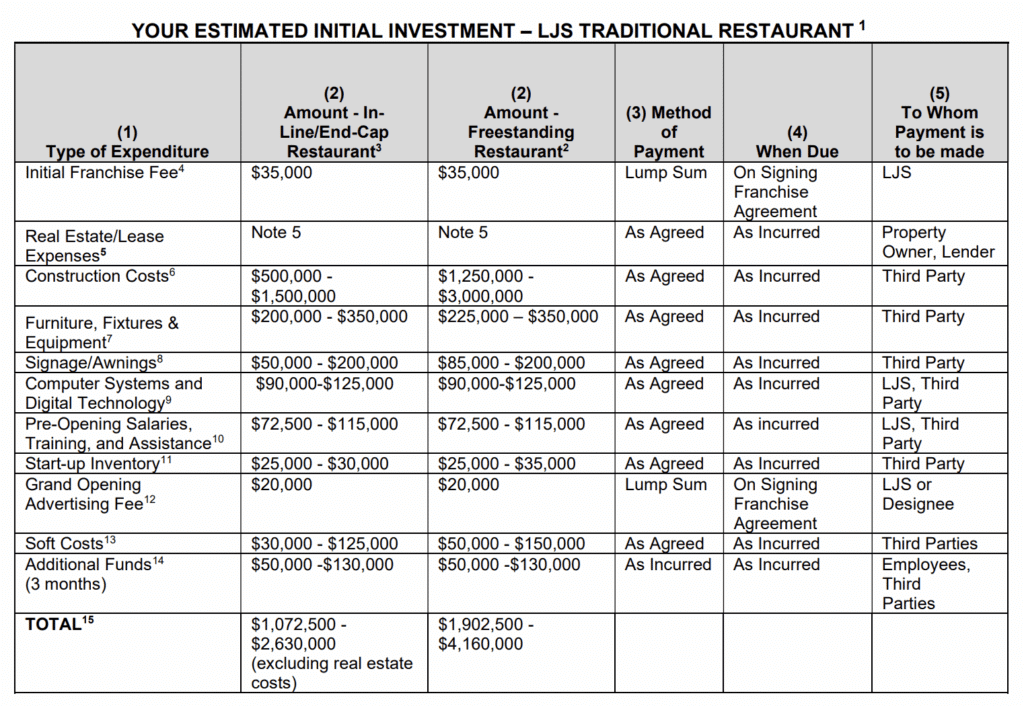
The non-trad locations (below) open between 800 and 3,500 square feet.

Last year also included executive moves with Tim Newton, a former Fat Tuesday executive, becoming chief technology officer in July 2024, and Leigh Ann VanDam, who served as design manager for Chipotle, coming on as VP of design and development the same month. Additionally, Missy Kualapai was tapped senior franchise business coach in April after 10 years with the brand.
Long John Silver’s posted total franchisor revenues of $20,636,426 last year, a decrease from $22,166,465 in 2023. Company-owned locations recorded operating income of $19,468,563 on net sales of $196,723,369—both higher than $5,903,926 and $177,040,707 the prior year.
Net income was $9,204,390 following a loss of $1,210,832 in 2023.
As Fowler noted, Long John Silver’s isn’t competing in the QSR cauldron of chicken or beef. It generally has one large national seafood competitor in Captain D’s.
Captain D’s, per its latest FDD, is the U.S.’ biggest QSR seafood chain as it ended 2024 with 530 restaurants following a retraction of 10. In the past three calendars, the brand has declined by 10, grown by five, and dipped by two, going from 537 restaurants at the onset of 2022 to the 530.
In 2007, when Long John Silver’s had 1,081 restaurants, Captain D’s had 549.
An affiliate of Centre Management Partners, LLC acquired Captain D’s in 2022 from Sentinel Capital Partners. The same group sold Captain D’s to Sentinel five years earlier. It partnered with brand management, who invested, this go-around.
Captain D’s, founded in 1969, expanded its franchised count 10 last year to 237 after growth of four and a 23-store retraction in 2022 and 2023, respectively. The company count exited 2024 at 293, down from 313 the year prior and 312 the year before.
Eighteen franchised restaurants opened in 2024 and eight ceased operations for other reasons. The growth was double 2023, when nine opened, two were reacquired by the franchisor, and three ceased. In 2022, eight opened, 22 were bought by corporate, and nine ceased.
Captain D’s sold 15 stores to a franchisee last year as well. The brand plans to open nine franchise outlets this year and zero company.
Here’s a look at Captain D’s footprint:
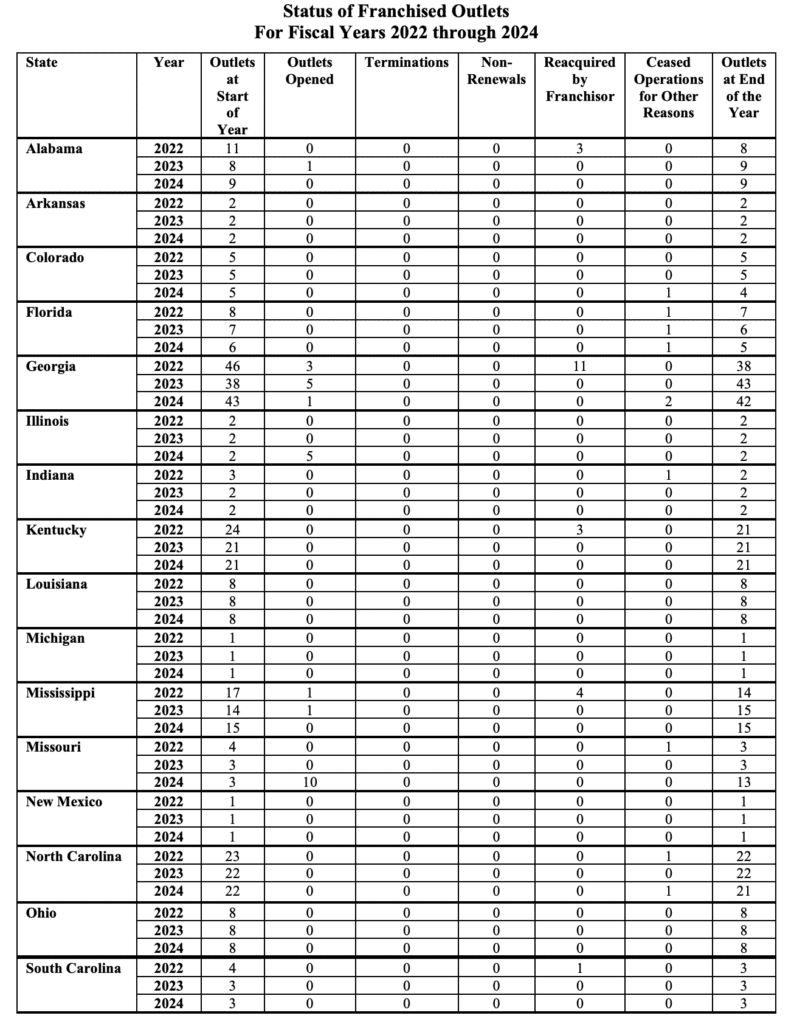
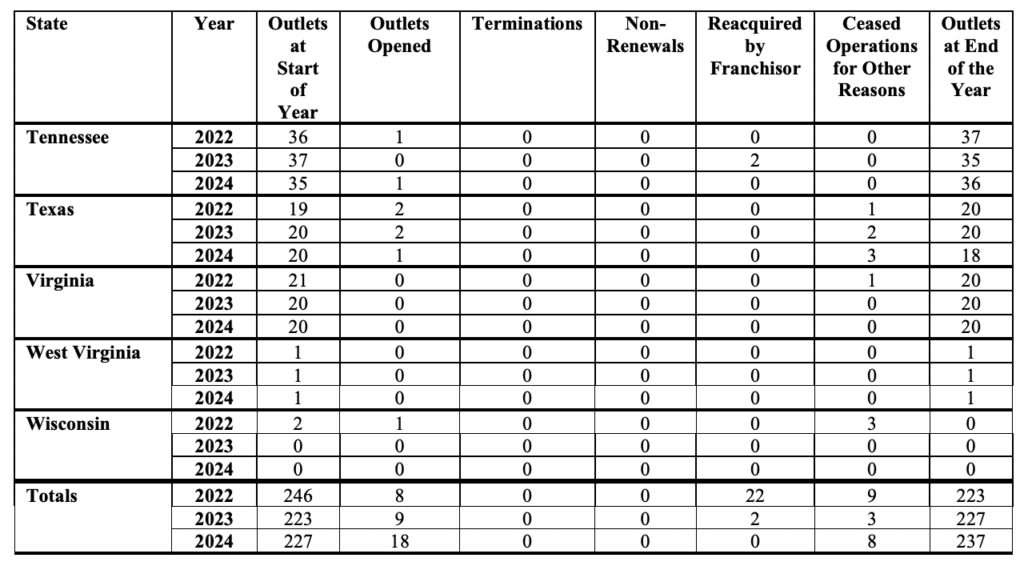
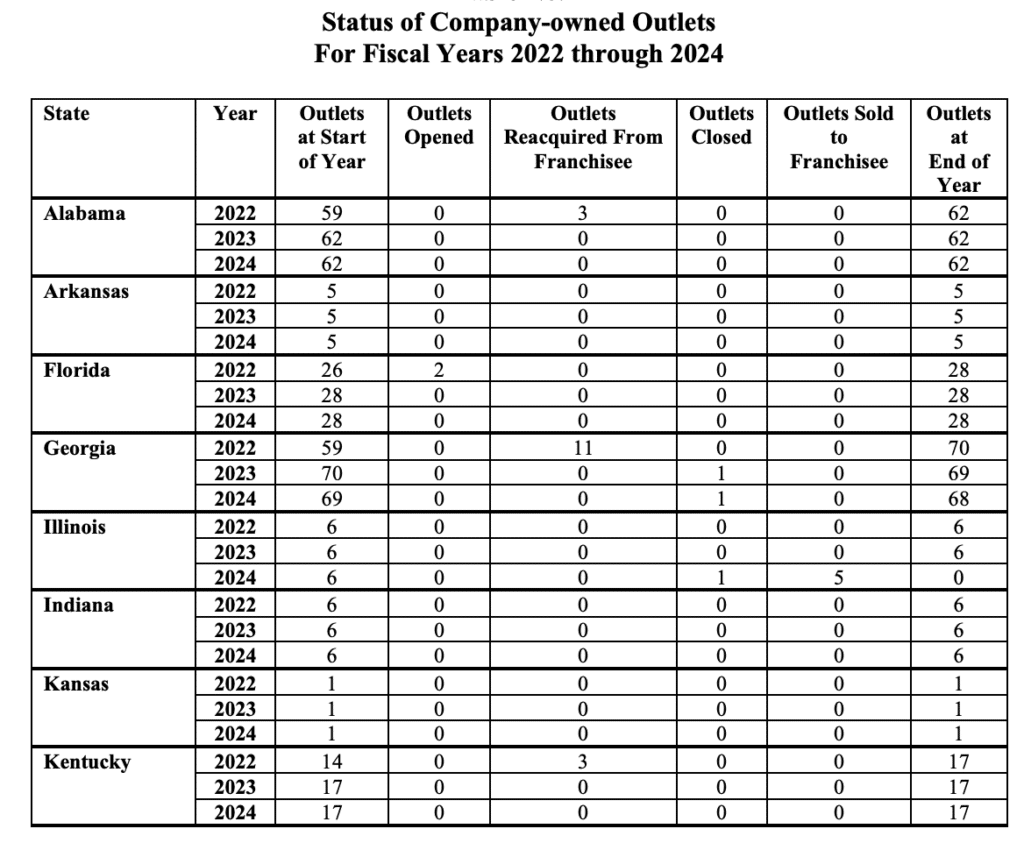
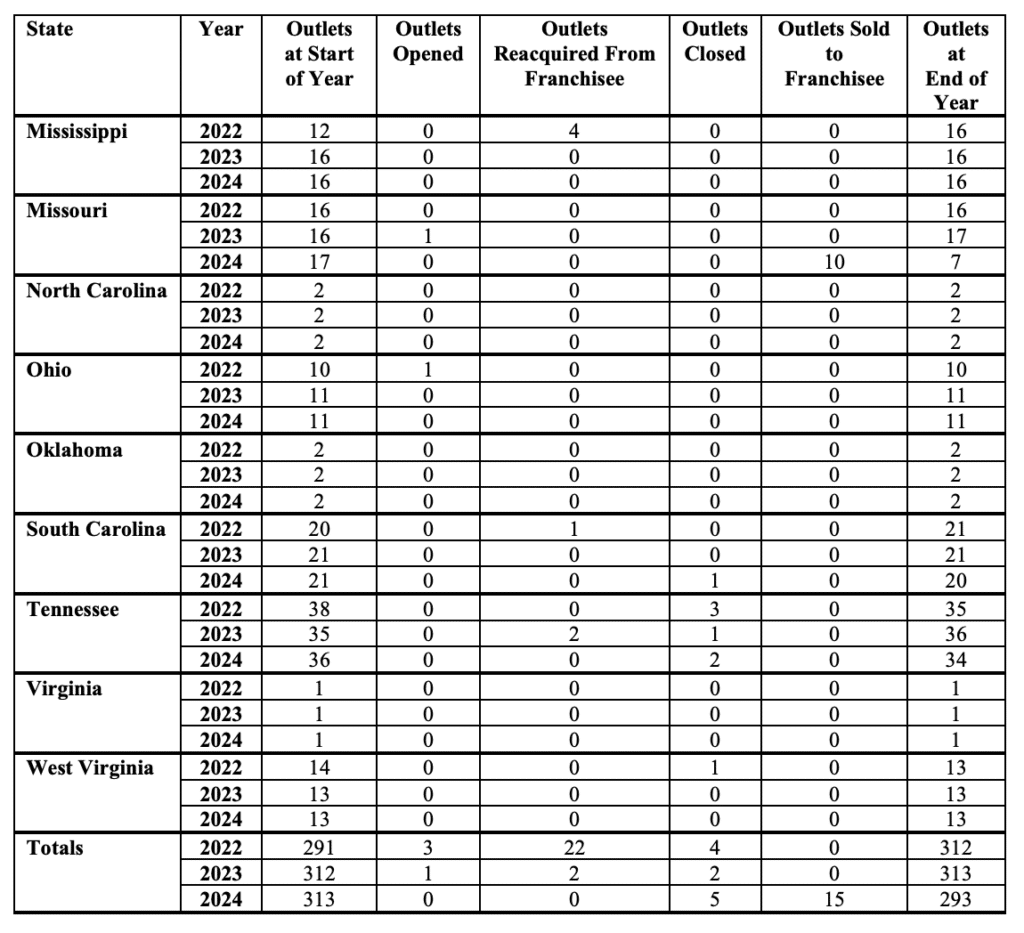
Captain D’s presents a financial look behind the curtain on its FDD.
For fiscal 2024, average gross sales for franchised and company-owned restaurants equaled $1.065 million. The median gross sales were $1.005 million. Franchises were $1.084 and $1.017 million respectively, and company-run stores averaged $1.042 million in gross sales.


The brand’s 44-seat prototype sits about 1,970 square feet and seats 44 customers. It can flex up to 2,400 square feet and 62 seats. A 32-seat prototype covers 1,500 square feet and 32 seats. There’s also an “Express” prototype at 980 square feet with no dining room. The inline or endcap prototype contains about 1,600 square feet with 22 seats.
The total investment needed to open each prototype ranges from $1,159,500 to $1,354,200 for the 44-seat restaurant (expandable to 62 seats), from $1,037,300 to $1,252,270 for the 32-seat restaurant, and $898,600 to $1,091,700 for the express restaurant, endcap, and inline restaurant. Those amounts include an amount ranging from $60,000 to $69,100 paid to the franchisor.
Captain D’s recorded total revenues of $11,580,107 last year, relatively in line with $11,835,322 the year before. Net income was $11,406,200 versus $11,676,470.
The brand was No. 8 in the QSR Contenders list at U.S. systemwide sales of $548 million.