

Transformations, by their nature, aren’t linear, Papa Johns CEO Todd Penegor says. The former Wendy’s leader joined the country’s fourth-largest pizza chain last August and stepped into a storm that’s reshuffled value perceptions in QSR—a topic the brand wasn’t getting much credit for 15 months ago.
There’s a lot going on to position Papa Johns for the future, while also managing the moment, Penegor says.
The chain posted North America same-store sales declines of 3 percent in Q3, year-over-year, (two-year stack drop of 9 percent) as total revenues of $508 million were flat compared to the 2024 quarter.
There were some clear indicators of a larger challenged segment tied to wallet guarding amid inflation. Papa Johns sold 3 percent more pizzas overall and 4 percent more per order, but total sales were effectively even thanks to order mix shifting to more medium pizzas and fewer toppings. Ticket rose 2 percent. And the majority of North America sales pressure, Penegor explains, owed to declines in products outside Papa Johns’ central pizza offerings—wings, bread sides, Papadias, and Papa Bites.
So, as is often the case when customers feel economic heat, diners controlled spend by focusing on center-of-plate items rather than sides and desserts.
“Clearly, the consumer is challenged,” Penegor says. “The landscape is hyper competitive right now to try to weigh in on share of stomach.”
Papa Johns witnessed the greatest order decline within small ticket web customers in North America. These orders tend to over-index with lower-income users, corresponding with the disproportionate sales weight the brand felt among this cohort (as reported by other chains).
But as noted, Penegor doesn’t want to lose sight of the brand’s larger goals while it fends for share today. In Q3, for instance, Papa Johns initiated a review of its expense structure to streamline the organization, reduce non-customer facing spend, simplify its operating model, and better align resources to support transformation.

Secure your spot at QSR’s Women in Restaurant Leadership Summit. Registration is now open!
So far, the company tagged “at least” $25 million of savings outside of marketing to be captured in fiscal 2026 and 2027. This, Penegor says, will create flexibility for Papa Johns to innovate elsewhere and improve its runway for growth. About half should come during 2026.
Additionally, Papa Johns announced it’s going to accelerate refranchising over the next two years, putting a timestamp on a strategy Penegor dripped out in past quarters. The goal will be to strengthen local markets and boost efficiency.
The company wants to reduce Papa Johns’ corporate restaurant ownership to a mid-single-digit percentage of the North America system. Today, there are 545 domestic company-owned locations and 2,962 franchised (total of 3,507). From June to September, Papa Johns declined by 10 stores (18 openings and 28 closures). It’s added 53 net stores in North America over the trailing four quarters, and this year’s full-calendar guidance calls for 85–95 gross new North America openings. Closure rate will be at the higher end of Papa Johns’ typical average of 1.5–2 percent and lean toward non-traditional or small-market restaurants with a blended average sales volume of about $500,000, or less than half of Papa Johns’ system average.
With refranchising, the company expects in Q4 to finalize the sale of its ownership stake in a joint venture that operates 85 restaurants in the Mid-Atlantic region. Penegor says the franchisee is an existing, well-capitalized, growth-minded operator who works well with the brand. “We need more of that,” Penegor says. “We’ve got many in our system who can scale up and work with us and have the balance sheet and operational chops to do that. So, they’re chomping at the bit to look at whatever markets we might bring it life.”
Penegor adds Papa Johns aims to bring in industry players who are “really good” in the larger restaurant space as well. Yet the wider target, he continues, is getting the refranchising message out there—that the company intends to move quickly—to generate interest and signal an opportunity to grab stake, long-run, in the pizza business. More to come in the months ahead, he says.
Penegor also addressed reports around the brand’s potential sale. He says Papa Johns remains “open-minded” and “would fully consider” such an opportunity if a deal provided the best path to maximizing shareholder value.
For now, though, the greatest avenue to do so comes via the company’s strategy at hand. “And that is where we have directed our attention,” Penegor says.

A pipeline of optionality
Papa Johns, when he arrived, set out to rebuild its innovation pipeline. That’s now grounded in three approaches—form, size, and platform innovation.
In September, the company launched its first product under the framework—the “Papa Dippa” pizza that’s cut into 16 flat strips designed for dipping (capitalizing on a chicken tenders like-run on sauce preference).
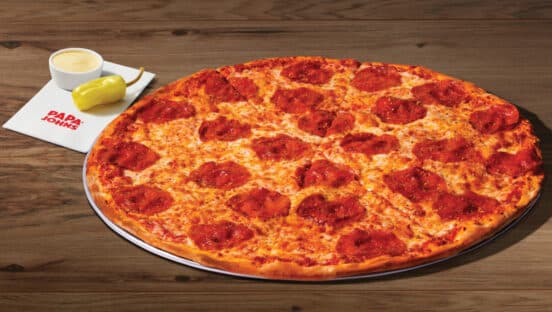
The Papa Dippa fell into “form innovation.” Papa Johns’ latest, “The Grand Papa,” is about size. It’s the chain’s largest pizza in brand history and features deli-style pepperoni and big, foldable slices for sharing.
This coming year, Penegor says, expect a consistent flow of products at price points that will allow the company to drive transactions and extend its addressable market. One case being those aforementioned, pressured side items. Papa Johns plans to reimagine the lineup and focus on more accessible dollar tags to get add-on sales back into its mix and bump margin.
Penegor hints Papa Johns will look at handhelds, chicken, and could move Papadias to a more regional offering rather than a national one as it introduces other items.
“Bring in news, bring in lapsed customers, bring in some new customers, and don’t just compete on price—compete on both sides of the barbell,” he says. “Compelling promotions as well as a lot of new news.”
Half of Papa Johns’ business flows from consumers making $100,000 or more. That guest continues to come back with large orders on key occasions. What the chain needs to solve, however, is the lower-end, more-strapped diner. It’s in the process of amplifying marketing around value. In this environment, price plays a leading component in winning consideration, Penegor says.
So Papa Johns sharpened approach with promotions such as a BOGO pizza offer in mid-September and October, which proved effective in driving orders with multiple pizzas and bent trends for select weeks. And to capture the small ticket, lower-frequency customer, Papa Johns recently introduced a half-off carryout deal supported by media. Early results, Penegor says, showed better order cadence and the ability to be a true basket starter. But it’s too early to declare victory.
And getting back to a higher-level view, Papa Johns’ 2026 pipeline is going to begin expanding its aperture beyond traditional QSR pizza and start adding new layers to the business, Penegor notes. Picture more items akin to what you would find at your neighborhood pizzeria.
But before the cycle could ramp up, Papa Johns’ needed to develop infrastructure. That begin early in Penegor’s tenure with a “Perfect Bake” project.
Essentially, Papa Johns sped ovens up a few years back. It’s slowed them back down, which means lower bake temperatures, too. In that, Penegor shared previously, there’s opportunity to bake better pizzas, introduce new crust types, and rethink innovation around handhelds, pastas, bowls, and so forth. With an optimized temperature and ensuring employees don’t pull pizzas out too quickly, it’s going to allow Papa Johns to deliver a better product.
As part of its incremental marketing spend in 2025, Papa Johns invested in a training program to vet new products and “ensure that innovation is truly customer-led and insight-driven,” Penegor says.
Papa Johns is trying to strike a barbell balance that’s always played a vital role in its DNA. Historically, the chain skewed a bit more premium with an ingredient focus, and, management said a year-plus ago, got too far over during a time when Papa Johns was ceding visits simply by falling out of value consideration. The chain has gained a lot of ground here, Penegor says, with perception scores improving steadily over the past year.
In Q3, it reinforced its barbell by leveraging value messaging alongside full-margin products. Papa Johns positioned its $6.99 Papa Pairing platform with the BOGO offer in addition to introducing a Garlic 5-Cheese Crust in August. Combined, Penegor says, the offerings led to Papa Johns growing the total number of pizzas ordered.
But, again, this is where Papa Johns needed to pulse in lures like a carryout offer and BOGO options in September and October.
“That really attacked where we were losing a lot of customers over the last quarter around single pie, web-based folks who are looking for a good deal, coming in and out. That’s traditionally what that lower-end consumer is looking for. So we’ve addressed that to meet them where they’re at,” Penegor says.
The chain, he adds, appreciated its highest sales day ever in North America on Halloween. “So, we are managing the moment with a more forward-leaning value proposition,” he says. “We are also building for the future with initiatives that will grow sales and expand margin, including a robust innovation pipeline, new sales layers, elevated operations, and a technology platform that delivers a seamless connected customer experience.”
Papa Johns invested an incremental $4 million toward supplemental marketing in Q3 to support its value efforts and build on foundational changes. It directed part of the investment toward working media to support BOGOs.
This, too, has been a key part of Penegor’s leadership—optimize channel mix and audience strategy to achieve more efficient media spending. Papa Johns invested advertising dollars in non-working media last quarter to launch a testing program and better inform future spend.
The brand wants to expand social share of voice, Penegor says. The showcase will still be on Papa Johns’ six simple ingredients in fresh, never frozen dough, and how it all comes to light (Meet the Makers campaign). “Third-party research consistently tells us that customers value high-quality real ingredients, and we believe that our commitment to fresh, quality, simple ingredients is especially important given current customer trends,” Penegor says.

Tech and experience, and Google hints
Papa Johns poured heavily into technology and its tech stack over the last year to improve experience across digital assets and owned channels, as well as better connect with users and support greater efficiency in stores by leveraging data and AI.
This, in part, will allow the company to build on marketing advancements by inviting customers into the brand and then layering in hyper-personalization to drive engagement and retention. About 70 percent of sales at Papa Johns run through digital platforms.
The company recently launched a modernized first-party digital ordering platform across its mobile apps on Android and iOS. The upgrade improved navigation, reduced clicks to purchase, and improved order tracking and targeted communication. Penegor says Papa Johns saw higher conversation rates.
Now, it’s going to modernize the design and experience of its website, which it expects to unveil in December.
And parallel to better digital ordering, Papa Johns continues to stress end-to-end customer experience and CRM potential, with a focus on session conversions and repeat purchases.
Over the last quarter, Penegor says, Papa Johns benefitted from higher CRM engagement via emails, app push notifications, and SMS communications.
The next priority concerns customer experience to “meet and exceed the convenience, value, and quality expectations of our customers across all of our demand channels,” Penegor says.
Loyalty might be the most vivid example. Penegor lowered the redemption threshold nearly a year ago so users could earn Papa Dough each purchase. Since, more guests have used their rewards and there’s been higher order frequency among loyalty ones.
As of Q3, the brand hit 40 million total accounts, an increase of roughly a million new members over the last three months.
“People really see value in our loyalty program and in the loyalty program across all cohorts, reported positive frequency gains,” Penegor says. “So we’re doing a nice job with our existing customer. The opportunity is bringing in the lapsed [guest] and bringing some new innovation will do a great job doing that beyond just price.”
Papa Johns this spring announced a partnership with Google Cloud around “click to crust” innovation and efficiency. In beta testing, new omnichannel features include an upgraded app designed to simplify navigation and reduce clicks. On the AI front, the company is exploring tools to better anticipate customer needs, generate proactive recommendations, deliver relevant offers, and integrate voice AI to streamline ordering and operations.
Penegor says Papa Johns is making progress but has a lot of whitespace ahead, particularly as it figures out how to transform first-party delivery. He explains the brand will have “some exciting stuff” to showcase early next year with Google that’s going to help it stand out on functions like group ordering and how it might better illustrate the fact its best available offer deal is in the app. “There are things that we can do to really make sure that our rewards members feel like they’re getting special treatment, and more to come on that, “Penegor says.
“But a lot of great work, good partnership, and Google and our team are working on pace to bring that to life. Can’t wait,” he adds, noting Q1 of 2026 will reveal some changes.
As it develops the first-party angle, third-party continues to lift—up low-teens in total net sales across aggregators in Q3. Papa Johns was ahead of this curve compared to peers and is 60 percent of the way done rolling out a delivery tracking service in the U.S.
In-stores, the chain also expanded operations evaluation tools to improve execution.
Penegor says Papa Johns placed clear emphasis on builds and keeping complexity out of stores. “We’re really working hard to make sure we set up our teams for success,” he says. “Coaching, training, going back to look at how we’re levering the tools that we have in our restaurants.”
Into the future, Penegor says, as Papa Johns slices through this economic cycle, it’s focusing on optionality. The brand has a strong balance sheet, he notes, and access to liquidity to do what’s needed to support the system (like marketing) or facilitate franchise-to-franchise transfers. “We continue to work to find more fuel in our brand, whether that’s refranchising, whether that’s going after some G&A savings, or, in particular, how do we go after supply chain, four-wall savings by optimizing our supply chain and the commissary network that we have,” he says. “All of those things provide fuel for us to go out and compete to make sure we meet the consumer where we are today but then complement that with some great innovation on the high end so we can play both ends of the barbell quite nicely.”
It’s worth noting anything Papa Johns promotes—high or low—presents only a quarter of its business. The rest stems from local offers, app deals, and everything else the consumer sees.
So, it’ll have a lead message accompanied by news to compete locally and, to another Penegor directive, get some co-ops set up in priority markets next year to ignite system growth around being a national pizza chain that also competes in the trenches.
“We’re going to be really conscious … when we drive our innovation into next year to not only bring the news but make sure there’s an appropriate price point to really drive that trial to get folks to fall in love with our great food all over again when they come back to try those things,” Penegor says.